Elbow, Wrist, and Forearm Muscular Mechanics: Agonists and Antagonists
An explanation of the agonist and antagonist muscle groups responsible for movements in the elbow, wrist, and forearm, including flexion, extension, pronation, and supination.
To master human kinesiology, one must understand the delicate dance between muscles that pull a joint in one direction and those that resist or oppose that movement. This article explores the muscular mechanics of the elbow, wrist, and forearm, focusing on the relationship between agonists (the prime movers responsible for a specific action) and antagonists (the muscles that oppose that action).
Key Terminology: Agonists vs. Antagonists
Before diving into specific movements, it is essential to define the roles muscles play during joint motion:
Agonist (Prime Mover): This is the muscle primarily responsible for producing a specific movement.
Antagonist: This muscle acts in opposition to the agonist. When the agonist contracts to create movement, the antagonist must typically relax or control the movement to ensure stability and prevent injury.
Study Tip: When studying for exams, don't just memorize the agonist. Always learn the antagonist as a pair. If you know the movement and the agonist, the antagonist is almost always the muscle that performs the exact opposite action.
Elbow and Forearm Movements
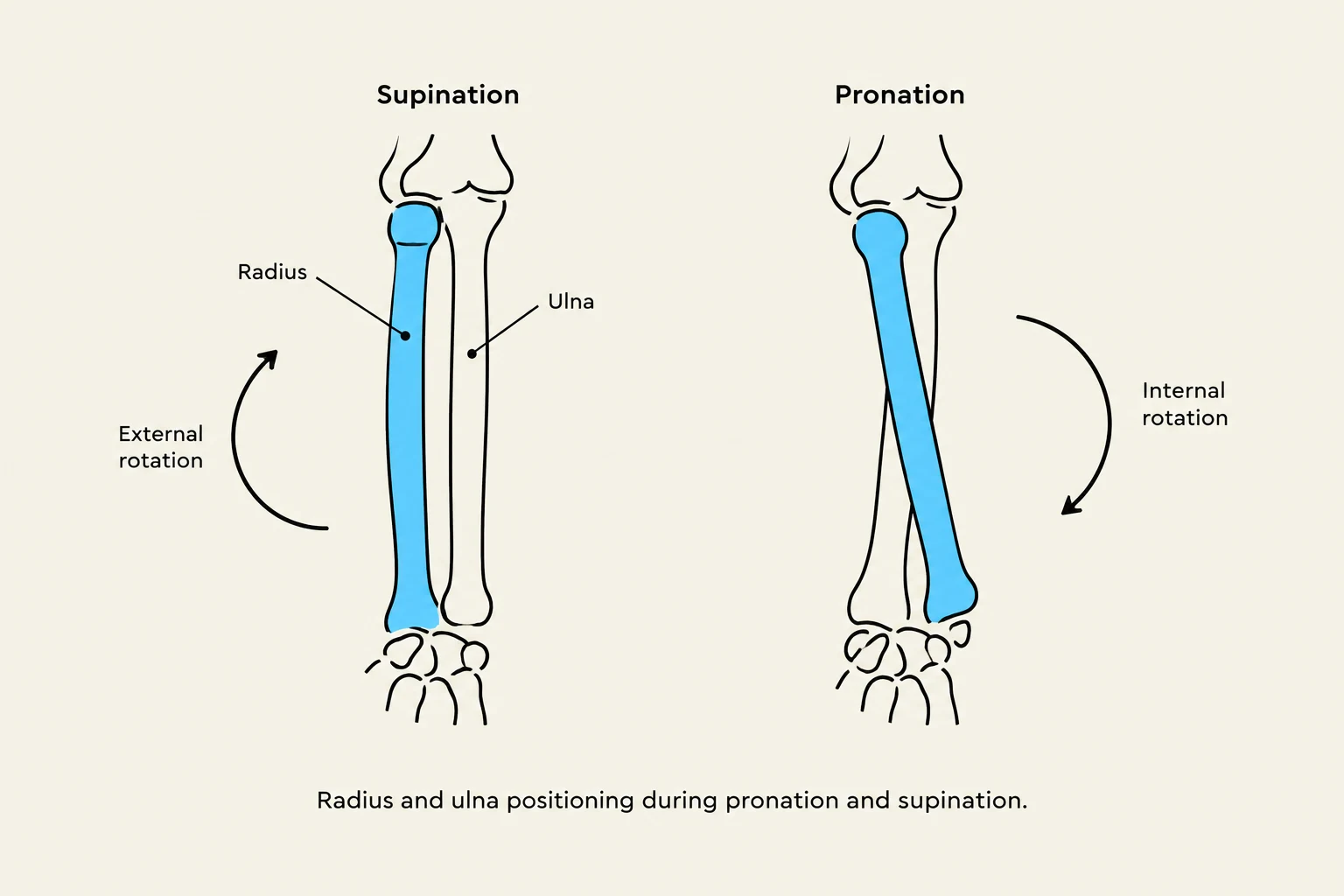
Diagram illustrating the positioning of the radius and ulna bones in the forearm during supination (external rotation) and pronation (internal rotation).
The movement of the elbow is not isolated; it is heavily influenced by the position of the forearm (rotation). Because different muscles are better positioned to pull the radius and ulna depending on whether the palm is up or down, elbow flexion is categorized into three distinct scenarios.
Elbow Flexion
Flexion is the "bending" of the elbow. The specific muscles involved change based on forearm rotation:
Flexion with Supination (Palm Up): When the forearm is supinated, the Biceps Brachii and the Brachioradialis act as the primary agonists. The Triceps Brachii serves as the antagonist.
Flexion with Neutral Forearm (Thumb Up): In a neutral position, the Brachialis becomes the primary agonist. The Triceps Brachii remains the antagonist.
Flexion with Pronation (Palm Down): When the forearm is pronated, the Brachialis is the primary agonist.
(Note: Some clinical tables may list the Triceps as an agonist during pronated flexion, but traditionally, the Triceps is the antagonist to all flexion movements.)
Elbow Extension
Extension is the straightening of the elbow. This movement is driven by the Triceps Brachii (agonist), which opposes the group of flexors: the Biceps Brachii, Brachioradialis, and Brachialis.
Forearm Rotation: Pronation and Supination
The forearm can rotate around its longitudinal axis, a movement involving the radius rotating around the ulna.
Pronation: This is the rotation that turns the palm downward. The agonists are the Pronator Teres and Pronator Quadratus. They are opposed by the Supinator and the Biceps Brachii.
Supination: This is the rotation that turns the palm upward. The Biceps Brachii, Pronator Teres, and Pronator Quadratus act as the agonists in this movement.
Wrist Movements
Wrist mechanics are more complex due to the ability to move in multiple planes: flexion/extension (sagittal plane) and radial/ulnar deviation (frontal plane).
Flexion and Extension
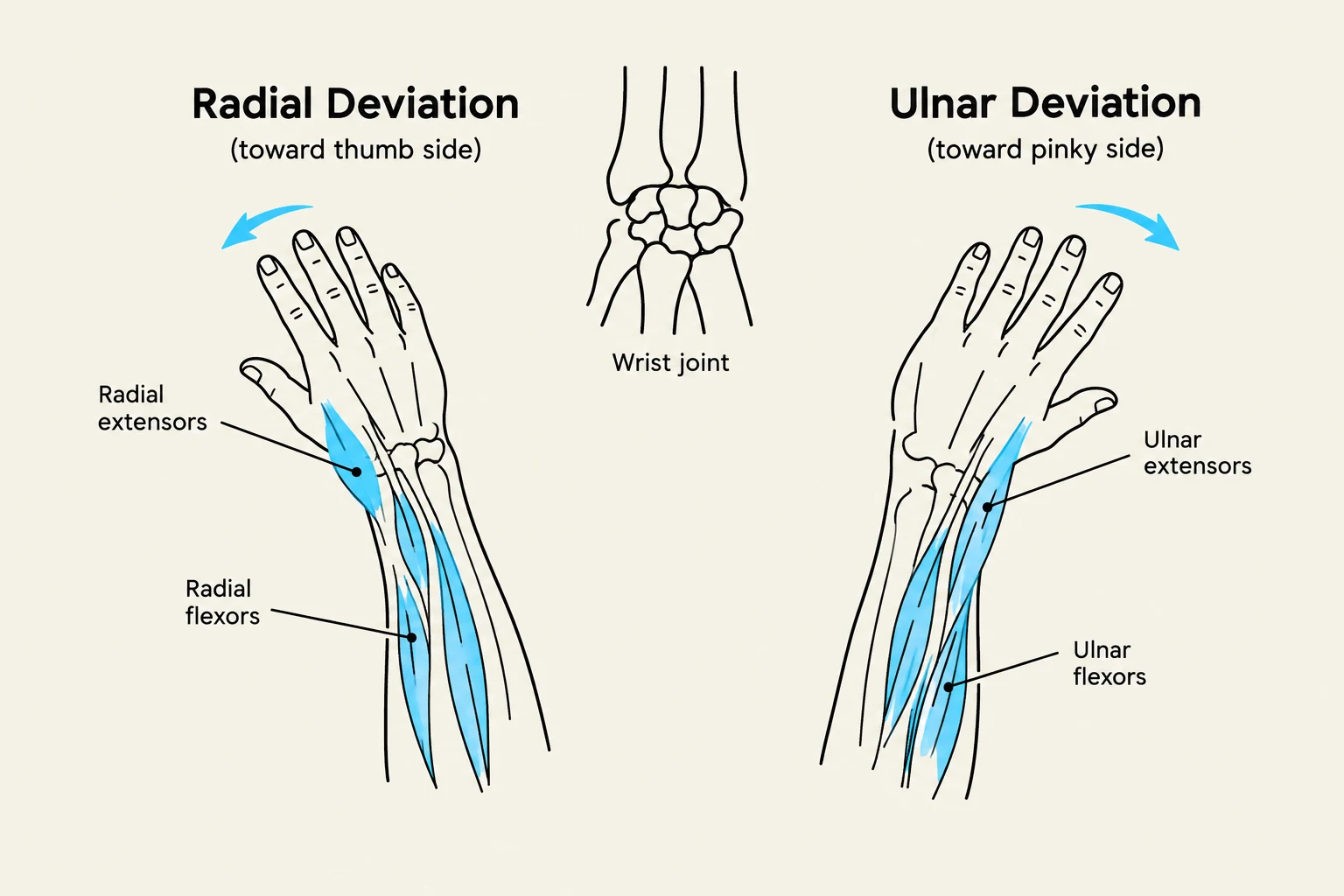
Diagram illustrating radial and ulnar deviation of the wrist, showing the muscles involved in these movements.
These movements occur when moving the palm toward the inner forearm or toward the back of the hand.
Lateral deviation refers to moving the wrist toward the sides of the hand.
Radial Deviation: This is movement toward the thumb side. It is powered by the Extensor Carpi Radialis Longus, Extensor Carpi Radialis Brevis, and Flexor Carpi Radialis. The Extensor Carpi Ulnaris and Flexor Carpi Ulnaris act as the antagonists.
Ulnar Deviation: This is movement toward the pinky side. The agonists are the Extensor Carpi Ulnaris and Flexor Carpi Ulnaris. The radial extensors and flexors serve as the antagonists.
Summary Table for Quick Review
For rapid recall, use the following logic: if a muscle name contains "Flexor," it is likely an agonist for flexion and an antagonist for extension. If it contains "Extensor," the reverse is true.
Joint
Action
Agonist(s)
Antagonist(s)
Elbow
Flexion (Supinated)
Biceps Brachii, Brachioradialis
Triceps Brachii
Elbow
Extension
Triceps Brachii
Biceps, Brachioradialis, Brachialis
Forearm
Pronation
Pronator Teres, Pronator Quadratus
Supinator, Biceps Brachii
Wrist
Flexion
Palmaris Longus, Flexor Carpi Radialis/Ulnaris
Extensor Carpi Radialis/Ulnaris
Wrist
Radial Deviation
Ext. Carpi Radialis (L/B), Flexor Carpi Radialis
Extensor/Flexor Carpi Ulnaris
Wrist
Ulnar Deviation
Extensor Carpi Ulnaris, Flexor Carpi Ulnaris
Extensor/Flexor Carpi Radialis
Keep reading for free.
Create an account to finish this reading and make it part of your study routine.