Explains the relationship between price elasticity of demand and total revenue, detailing how price changes affect revenue based on whether demand is inelastic, elastic, or unit-elastic.
For any business or producer, one of the most critical questions is: "If I change my price, what will happen to my total income?" To answer this, you cannot simply look at the price change in isolation. You must understand how consumers will react. This relationship is governed by the concept of price elasticity of demand, which measures how responsive the quantity demanded of a good is to a change in its price.
Understanding Total Revenue
Before analyzing the relationship with elasticity, we must define our goal. Total revenue (TR) is the total amount of money a seller receives from selling a good. It is calculated as the product of the price per unit and the quantity of units sold:
TR=P⋅Q
When a seller changes the price of a product, two opposing forces act on the total revenue simultaneously:
The Price Effect: This is the change in revenue resulting from the higher or lower price received for each unit sold. If you raise the price, the price effect is positive (more money per unit).
The Quantity Effect: This is the change in revenue resulting from the change in the number of units sold. Because of the law of demand, an increase in price leads to a decrease in quantity demanded, creating a negative effect on revenue.
The final impact on total revenue depends on which of these two effects is stronger. This "tug-of-war" is determined by the elasticity of demand.
This diagram illustrates the economic concept of price elasticity of demand. It shows that as the price per unit increases from P1 to P2, the quantity demanded decreases from Q1 to Q2. This is further explained by the price effect (higher price per unit) and the quantity effect (lower quantity sold).
The Three States of Elasticity
To predict the outcome of a price change, economists classify demand into three categories based on the absolute value of the price elasticity of demand (∣Ed∣):
1. Inelastic Demand (∣Ed∣<1)
Demand is inelastic when the percentage change in quantity demanded is smaller than the percentage change in price. In this scenario, consumers are relatively unresponsive to price changes. This often occurs with necessities or goods with few close substitutes.
2. Elastic Demand (∣Ed∣>1)
Demand is elastic when the percentage change in quantity demanded is larger than the percentage change in price. Here, consumers are highly sensitive to price. A small increase in price leads to a significant drop in the amount purchased. This is common for luxury goods or products with many available substitutes.
3. Unit-Elastic Demand (∣Ed∣=1)
Demand is unit-elastic when the percentage change in quantity demanded is exactly equal to the percentage change in price. The two effects—price and quantity—perfectly balance each other out.
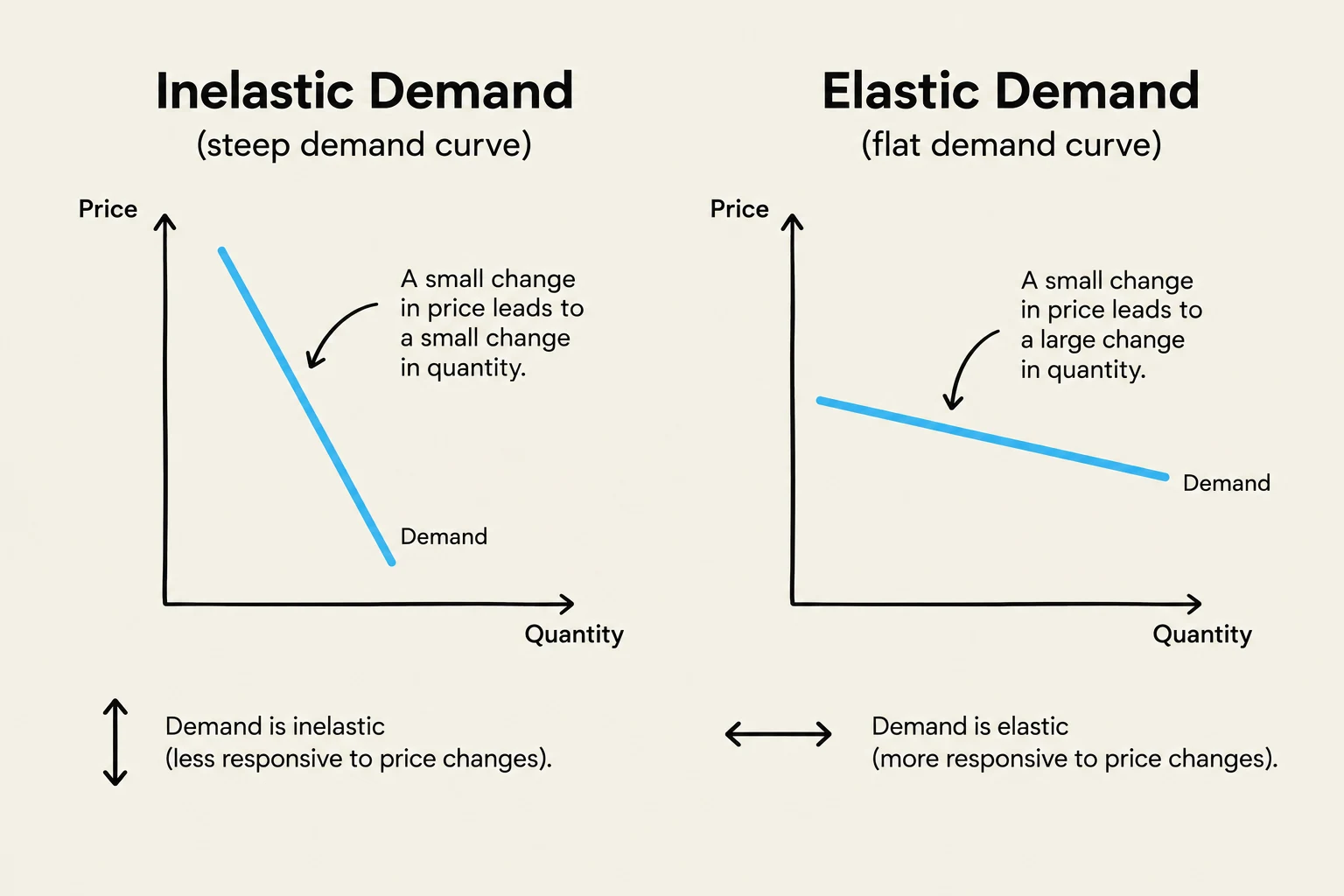
This image illustrates the concepts of inelastic and elastic demand using graphs. Inelastic demand is shown with a steep curve, indicating that price changes have a small effect on quantity demanded. Elastic demand is depicted with a flat curve, showing that price changes have a large effect on quantity demanded.
Connecting Elasticity to Revenue Outcomes
By combining the concepts of the price and quantity effects, we can derive a reliable rule for predicting revenue changes:
Demand Type
If Price Increases (↑P)
If Price Decreases (↓P)
Dominant Effect
Inelastic
Total Revenue Rises (↑TR)
Total Revenue Falls (↓TR)
Price Effect
Elastic
Total Revenue Falls (↓TR)
Total Revenue Rises (↑TR)
Quantity Effect
Unit-Elastic
Total Revenue Stays Same
Total Revenue Stays Same
Balanced
Worked Example: The Discount Strategy
Imagine an online bookseller, Nile.com, wants to increase revenue by offering a 10% discount. They have two customer groups:
Group A: Has an inelastic demand (∣Ed∣=0.625).
Group B: Has an elastic demand (∣Ed∣=1.25).
Analysis:
For Group A, because demand is inelastic, the "quantity effect" (more books sold) is too small to make up for the "price effect" (less money per book). Therefore, a discount will actually decrease total revenue.
For Group B, because demand is elastic, the "quantity effect" is massive. The surge in the number of books sold more than compensates for the lower price per book. Therefore, a discount will increase total revenue.
Exam Tip: If a question asks whether a firm should raise or lower prices to increase revenue, always check the elasticity first. If demand is elastic, lower the price. If demand is inelastic, raise the price.
Summary of Determinants
Why are some goods more elastic than others? Several factors influence this responsiveness:
Availability of Substitutes: More substitutes = more elastic demand.
Necessity vs. Luxury: Necessities are inelastic; luxuries are elastic.
Share of Income: Expensive items (large share of income) tend to be more elastic.
Time: Demand becomes more elastic over time as consumers find ways to adjust their behavior.
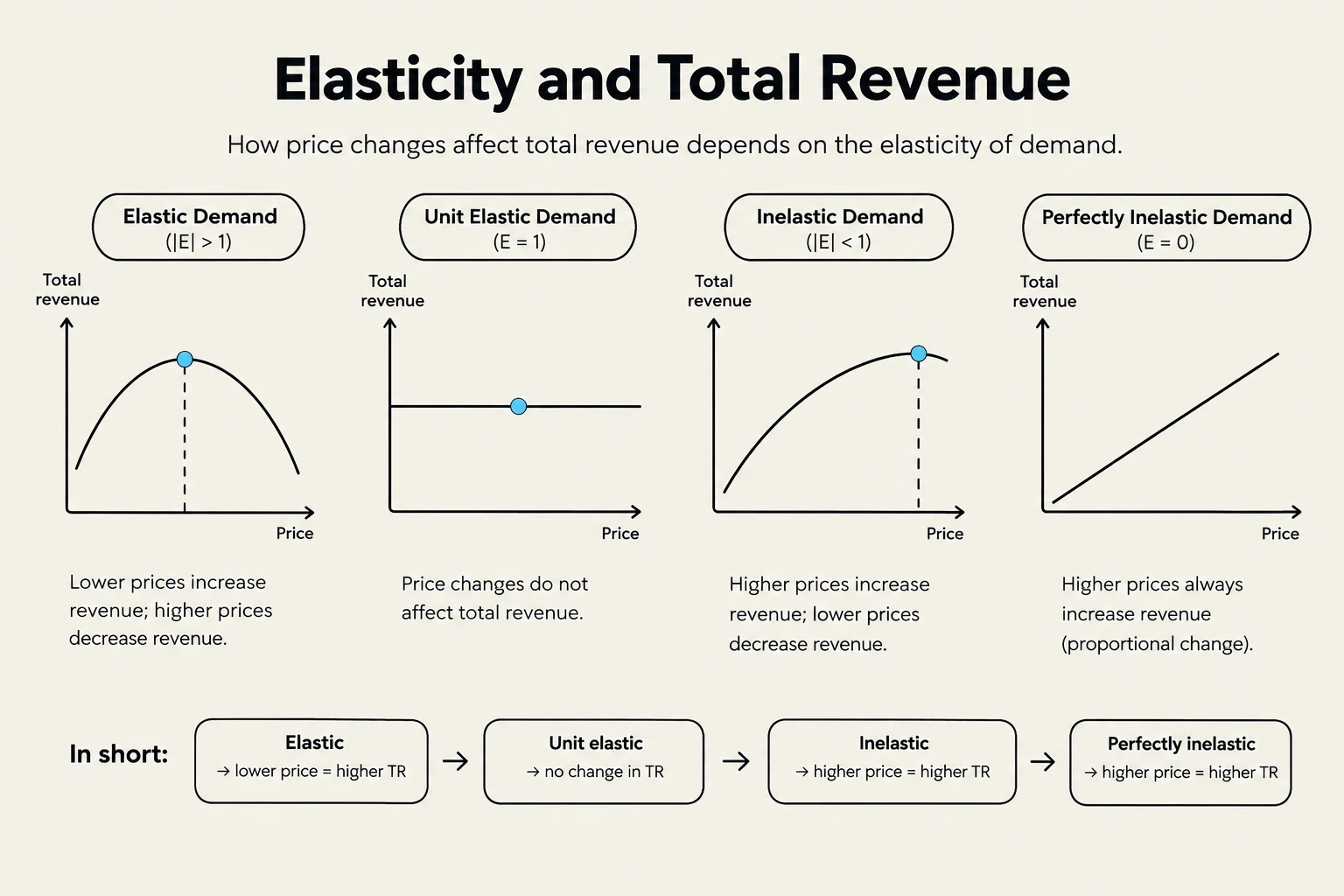
This diagram illustrates the relationship between price elasticity of demand and total revenue, showing how changes in price affect revenue under different elasticity conditions: elastic, unit elastic, inelastic, and perfectly inelastic demand.
Keep reading for free.
Create an account to finish this reading and make it part of your study routine.