Explores how humans use themselves as a template to understand supernatural agents, a phenomenon known as egocentric bias. It details the projection of psychological intentionality, emotional resonance, and moral agency onto deities, and discusses its evolutionary roots in Theory of Mind.
When we imagine a god, a spirit, or a supernatural entity, we rarely imagine something truly "alien." Instead, we tend to project our own cognitive architecture, emotions, and motivations onto these invisible forces. This phenomenon is known as egocentric bias in the context of religious cognition. It is the tendency for humans to use themselves as the primary template for understanding the minds and behaviors of supernatural agents.
Rather than viewing the supernatural as a completely distinct category of existence, our brains bridge the gap by applying human-like reasoning to entities that lack physical bodies. This article explores how this bias functions, why it occurs, and how it shapes the way humans conceptualize the divine.
The Mechanism of Projection
At the heart of egocentric bias is the concept of anthropomorphism—the attribution of human characteristics to non-human entities. In the study of the Cognitive Science of Religion (CSR), researchers argue that our mental models for "agency" are deeply rooted in our own experiences.
When we encounter a phenomenon we cannot explain—such as a sudden storm or a stroke of good luck—our cognitive systems search for an agent to blame or credit. Because our only experience with intentionality, desire, and planning comes from other humans, we "default" to these human traits when constructing a supernatural agent.
Study Tip: If an exam question asks why religious concepts are often "human-like," look for terms like anthropomorphism or egocentric projection. The core idea is that we use our own minds as the "gold standard" for what an agent looks like.
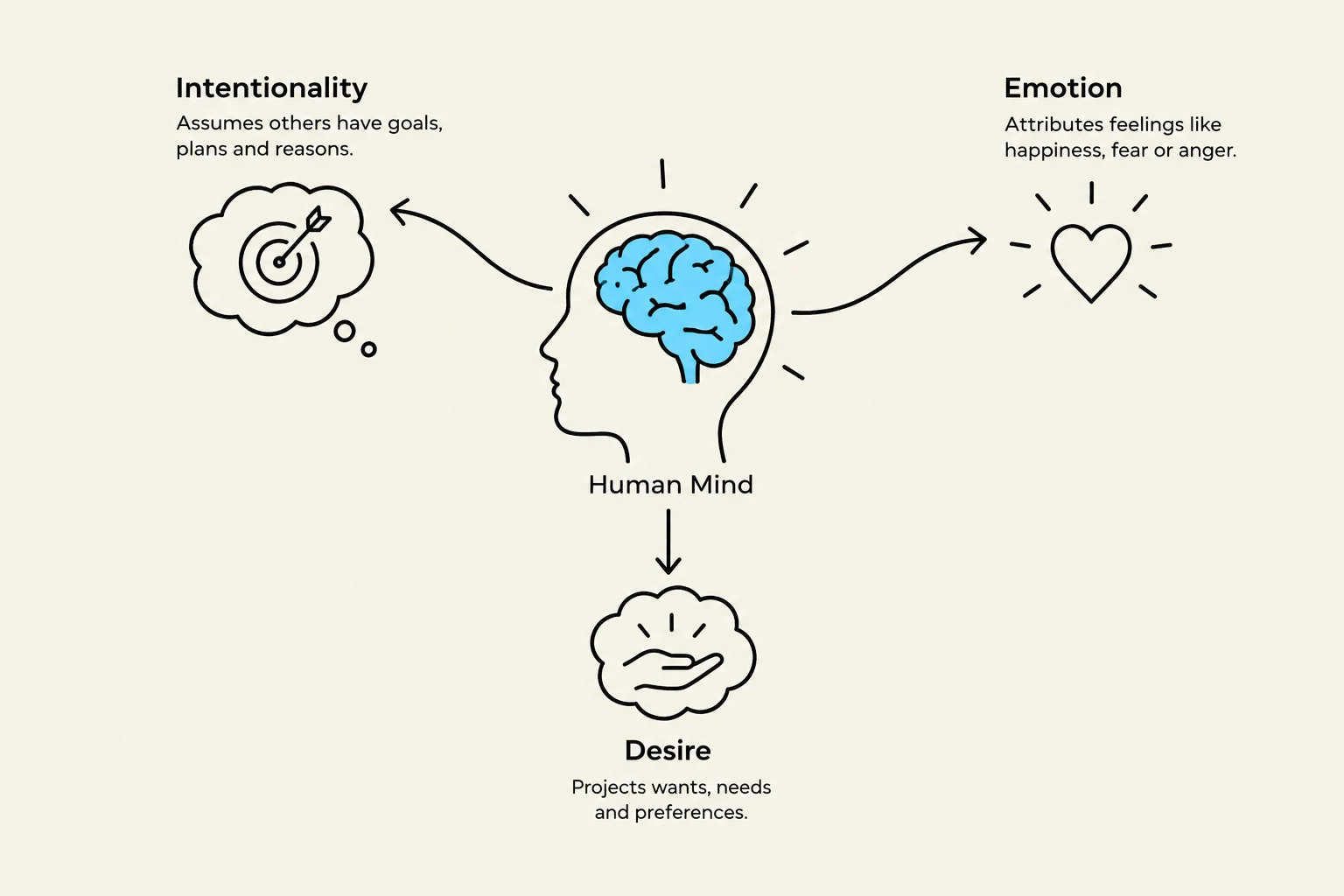
This diagram illustrates the human mind's connection to intentionality, emotion, and desire, defining each concept with a brief explanation.
Key Dimensions of Egocentric Bias
To understand how this bias manifests, we can break it down into three primary dimensions of projection:
1. Psychological Intentionality
We assume that supernatural agents have "goals" and "plans." If a person experiences a hardship, an egocentric bias might lead them to believe a deity is "testing" them or "punishing" them. We project the human concept of intent onto the universe.
2. Emotional Resonance
We often attribute human emotions—such as anger, jealousy, or love—to the divine. This makes the supernatural feel relatable, but it also makes it feel volatile. A deity that can feel "offended" is much easier for the human brain to model than a deity that operates on purely abstract, mathematical, or indifferent principles.
3. Moral Agency
We apply our social notions of "good" and "evil" to supernatural beings. This is a direct extension of our social evolution; we have spent millions of years learning to navigate the moral landscapes of human tribes, so we naturally extend that moral framework to the cosmos.
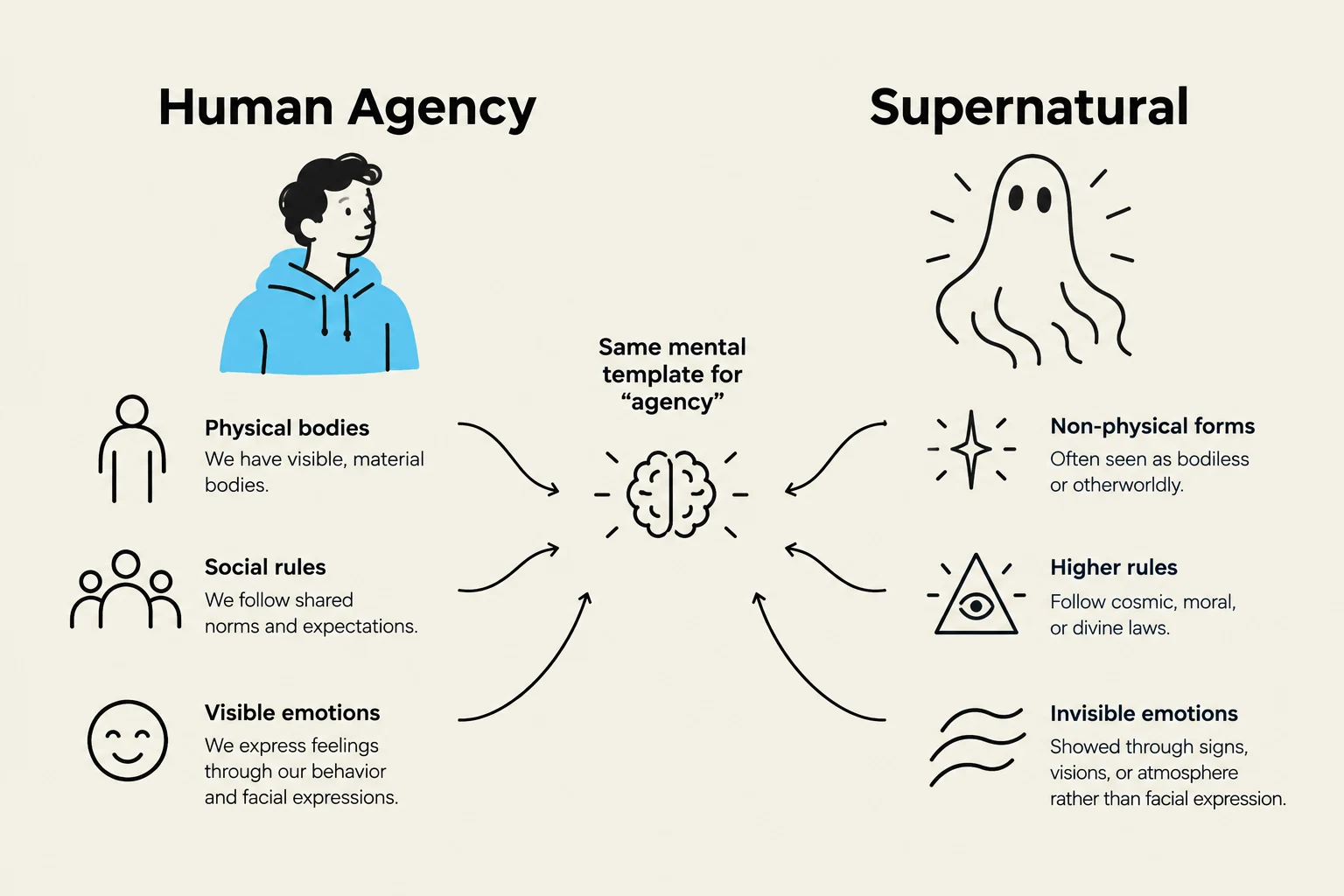
This diagram illustrates the concept of agency by contrasting human agency, characterized by physical bodies, social rules, and visible emotions, with supernatural agency, which involves non-physical forms, higher rules, and invisible emotions. Both concepts share a common mental template for "agency".
Why Does This Bias Exist?
From an evolutionary perspective, egocentric bias may be a "byproduct" of our highly developed social intelligence. Humans are "hyper-social" creatures; our survival once depended on our ability to accurately predict the intentions and emotions of our peers.
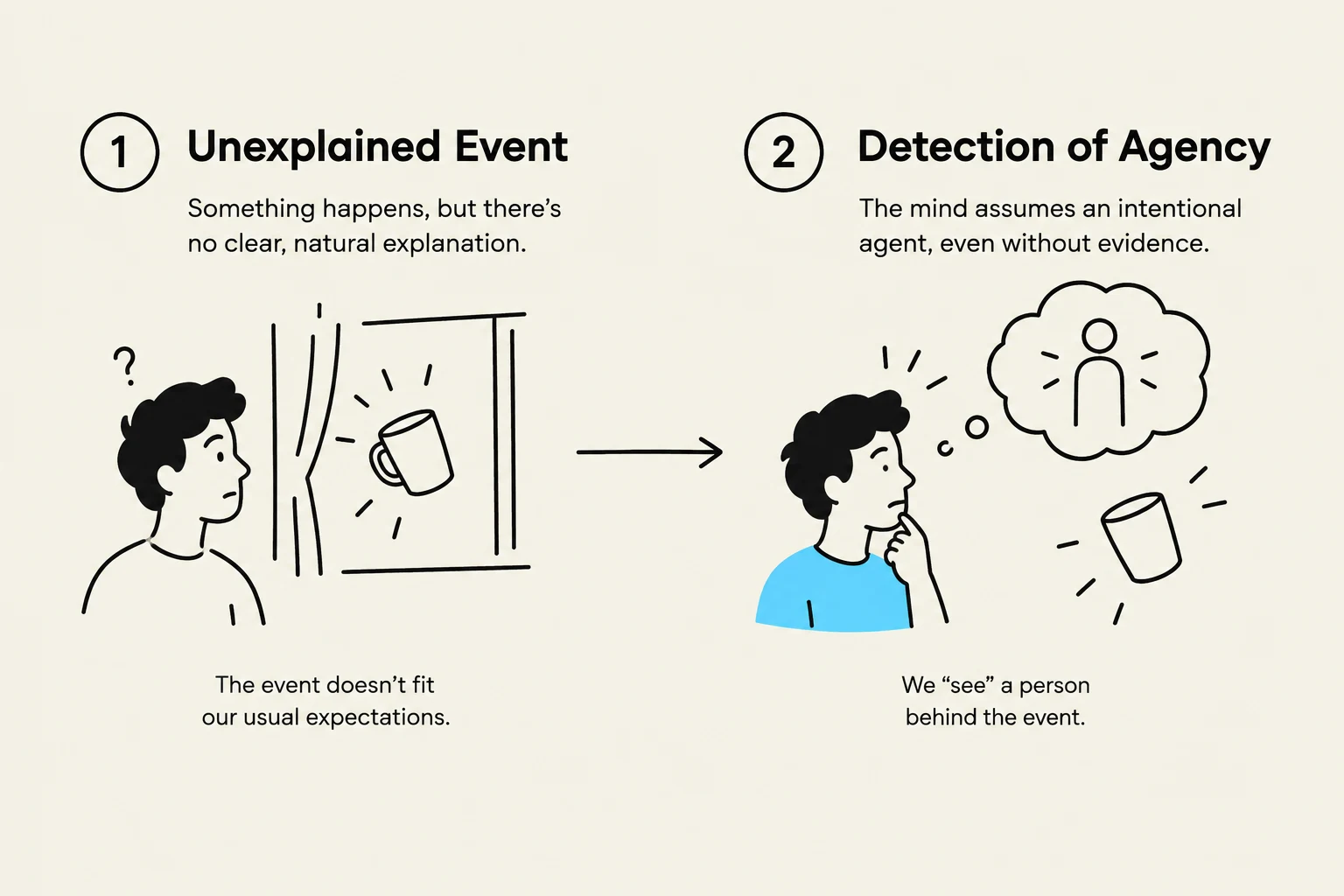
This ability is governed by our Theory of Mind (ToM)—the capacity to attribute mental states to others. Because our ToM is so finely tuned to human social interaction, it is "over-applied" to the environment. When we encounter an unexplained event, our ToM "misfires," treating the event as if it were a social interaction with an invisible person.
Worked Example: The "Angry Storm"
To see this in practice, consider two different ways of viewing a thunderstorm:
Scientific View: A thunderstorm is the result of atmospheric pressure changes, temperature gradients, and moisture condensation. There is no "mind" involved.
Egocentric/Supernatural View: The storm is a sign of a deity's wrath. The thunder is a "shout," and the lightning is a "strike" intended to punish a specific group of people.
In the second view, the person has used their own understanding of anger (the emotion), shouting (the communication), and punishment (the social goal) to create a coherent model of the storm. Even though the storm has no brain, the human mind treats it as if it does, because that is the only way the human brain knows how to process agency.
This illustration depicts the psychological phenomenon of agency detection, where the mind tends to attribute events to an intentional agent, even in the absence of clear evidence. It shows an unexplained event, like a mug falling, leading to the assumption of a person behind it.
Summary for Students
Egocentric bias in religious cognition is not necessarily a "flaw" in thinking, but rather a consequence of how our brains are wired to understand the world. By using ourselves as the template, we make the unknown feel known, even if that means projecting human limitations onto the infinite.
Concept
Definition
Anthropomorphism
Attributing human traits to non-humans.
Theory of Mind
The ability to attribute mental states to others.
Agency Detection
The tendency to perceive intentionality in the environment.
Keep reading for free.
Create an account to finish this reading and make it part of your study routine.