Economic Coercion and the Integrity of Democratic Elections
This reading explores how economic coercion, particularly the threat of job loss or wage reduction, can undermine the principle of free and fair elections. It examines the role of the secret ballot, the employer-employee power imbalance, and presents a mathematical model to illustrate the cost of dissent for voters fac
In modern democratic theory, the right to vote is often treated as a fundamental pillar of liberty. We assume that every citizen possesses a single, autonomous voice that can shape the direction of their nation. However, the mere existence of a legal right to vote does not guarantee a free election. For a vote to be truly meaningful, it must be cast without fear of retribution. When the act of voting is tied to an individual's survival—specifically their ability to earn a living—the democratic process faces a profound threat known as economic coercion.
The Illusion of Choice: When Voting is Not Secret
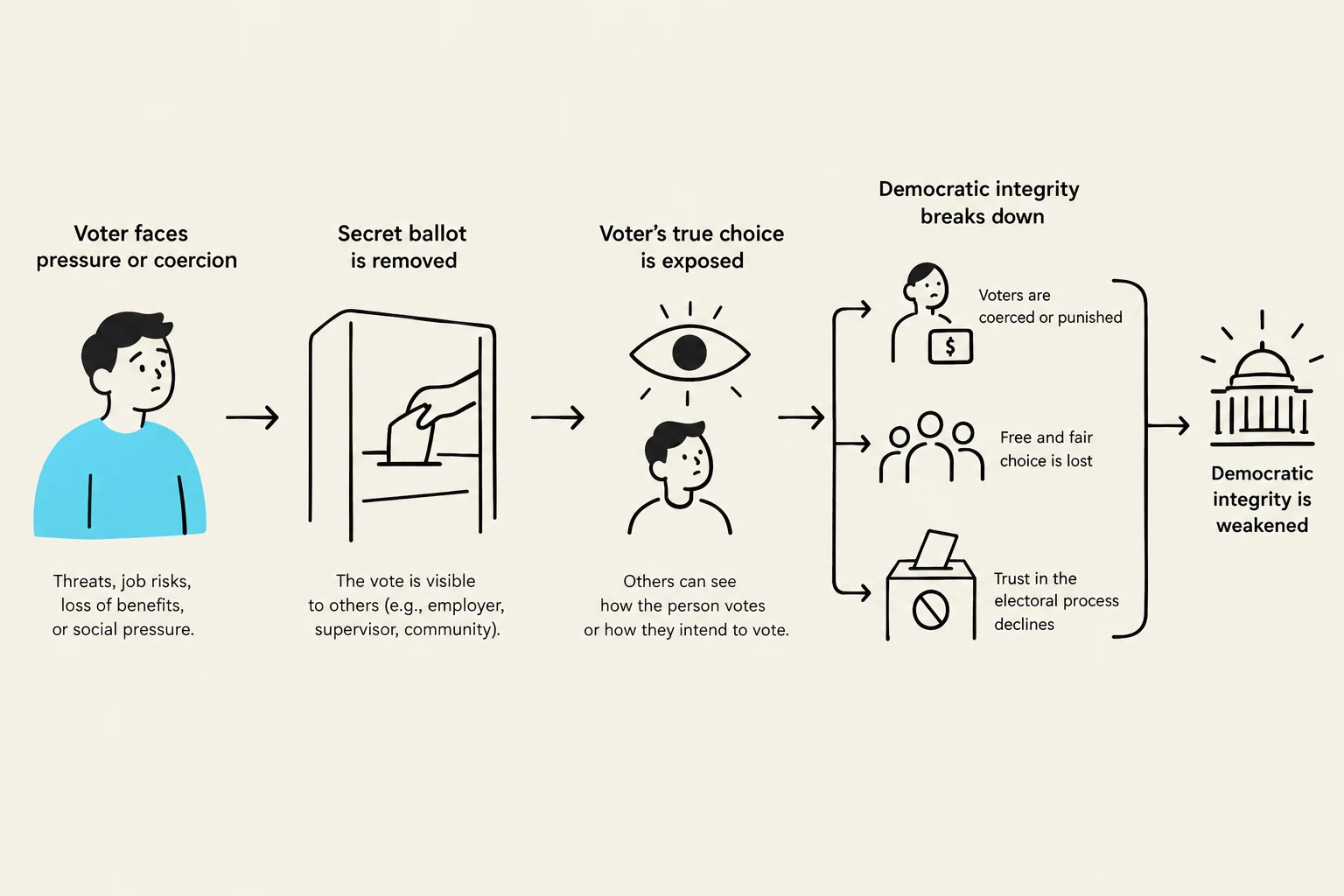
The foundation of a free election is the secret ballot. The secret ballot ensures that a voter's preference remains private, preventing anyone from monitoring their choice and subsequently punishing them for it. Without this privacy, the "choice" at the polling station becomes a performance rather than an expression of will.
In historical contexts where the secret ballot was absent, voting was often a public affair. In such systems, an individual's political alignment was visible to their community, their landlords, and most critically, their employers. When a vote is public, the cost of dissent becomes visible and immediate. If a worker votes against the interests of a powerful local industry or a dominant political faction, they are essentially signaling their opposition to those who hold the keys to their livelihood.
Exam Tip: When analyzing the integrity of an election, distinguish between procedural democracy (the existence of voting mechanisms) and substantive democracy (the ability of citizens to vote without fear of consequence).
This diagram illustrates how the erosion of secret ballots and voter coercion can lead to a breakdown in democratic integrity, resulting in weakened trust in the electoral process.
The Employer-Employee Power Imbalance
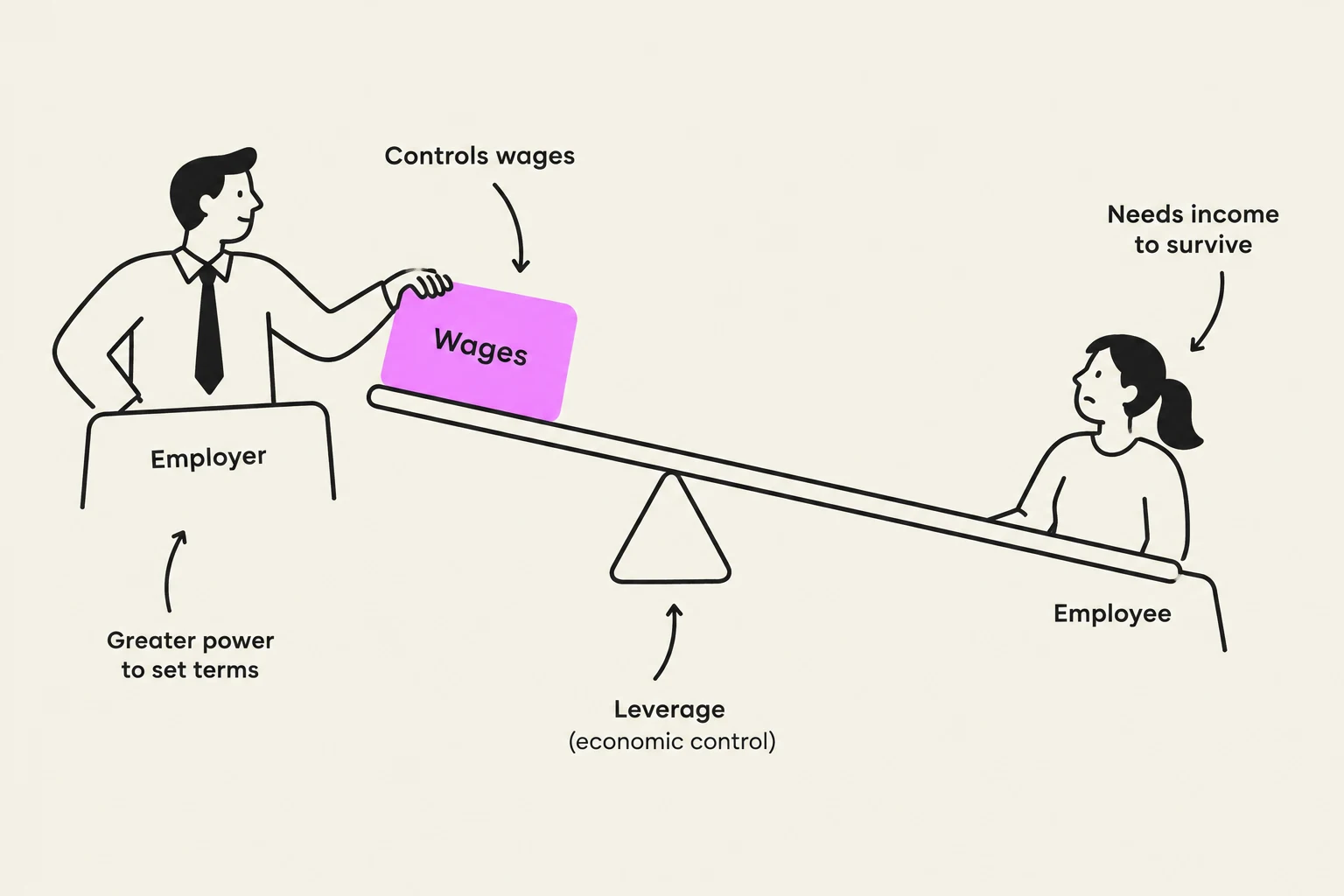
The most potent form of economic coercion occurs within the workplace. In many societies, the relationship between an employer and an employee is characterized by a significant power asymmetry. The employer controls the means of production and, crucially, the distribution of wages, while the employee relies on those wages for basic necessities like food, housing, and healthcare.
When an employer exerts influence over the political process, they are leveraging this asymmetry. This can manifest in several ways:
Direct Dismissal: The most extreme form of coercion is the threat of termination. If an employee is known to support a candidate or a policy that contradicts the employer's interests, they may face "retaliatory firing."
Wage Withholding or Reduction: Even if an employee is not fired, an employer may use subtle methods to punish political dissent, such as denying raises, reducing overtime hours, or withholding bonuses.
Implicit Pressure: Often, coercion does not need to be an explicit threat. A culture of "company loyalty" where political alignment is expected can create an environment where employees feel they must vote a certain way to remain in good standing.
This illustration depicts the economic leverage employers have over employees, as employers control wages and have greater power to set terms, while employees need income to survive.
Modeling the Cost of Dissent
To understand why an individual might choose to vote against their own interests due to coercion, we can look at a simple economic model of decision-making. Let V represent the perceived benefit of voting for a preferred candidate, and C represent the cost of that vote.
In a free election, the cost C is primarily the time spent at the polls. However, under economic coercion, the cost C includes the probability of economic loss. We can express the total cost of a "dissenting" vote as:
Ctotal=Ctime+P(loss)⋅L
Where:
P(loss) is the probability that the employer will discover the vote and take action.
L is the magnitude of the economic loss (e.g., loss of annual salary).
If the expected loss P(loss)⋅L is greater than the perceived benefit V of the preferred candidate, the rational actor—under the pressure of coercion—will vote for the candidate favored by the employer to minimize their total cost. This demonstrates how economic vulnerability can mathematically override political preference.
The Paradox of Liberty and Reform
The struggle to eliminate economic coercion is central to the history of democratic reform. Even as legal rights are expanded, the underlying economic structures can continue to suppress political agency. The paradox of liberty lies in the fact that a person can be legally "free" to vote, yet remain economically "unfree" to express their true preference.
True political reform, therefore, requires more than just the implementation of a secret ballot; it requires protections that decouple an individual's economic survival from their political identity. This includes labor laws that prevent retaliatory firing and social safety nets that reduce the catastrophic impact of losing employment. Without these protections, the vote remains a tool that can be captured by those who control the economy.
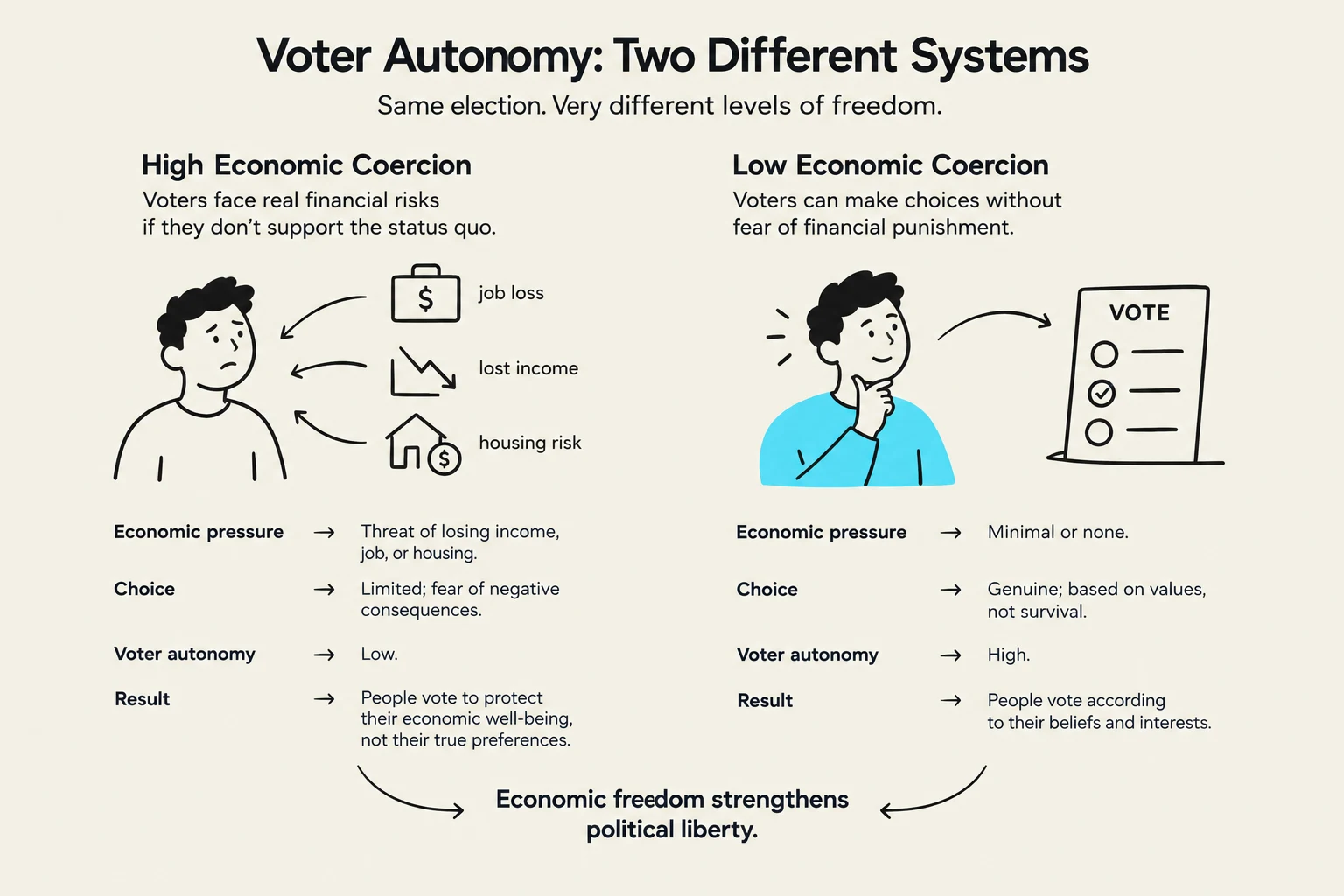
This illustration contrasts two systems of voter autonomy: High Economic Coercion, where voters face financial risks for not supporting the status quo, leading to limited choices and low autonomy; and Low Economic Coercion, where voters have minimal economic pressure, genuine choices based on values, and high autonomy, resulting in people voting according to their beliefs. The graphic concludes that economic freedom strengthens political liberty.
Summary for Students: Remember that economic coercion turns a political right into a high-stakes economic gamble. The presence of a secret ballot is a necessary, but often insufficient, condition for a truly free and fair democratic process.
Keep reading for free.
Create an account to finish this reading and make it part of your study routine.