


Ecology is the study of how living organisms interact with one another and their physical environment. To understand the complexity of life, ecologists often study these interactions across different scales. This guide follows the progression from the individual level—how a single organism manages its internal physiology—to the population level, where we examine how groups of individuals grow, structure themselves, and interact through behavior and predation.
Physiological Ecology: The Individual in the Environment
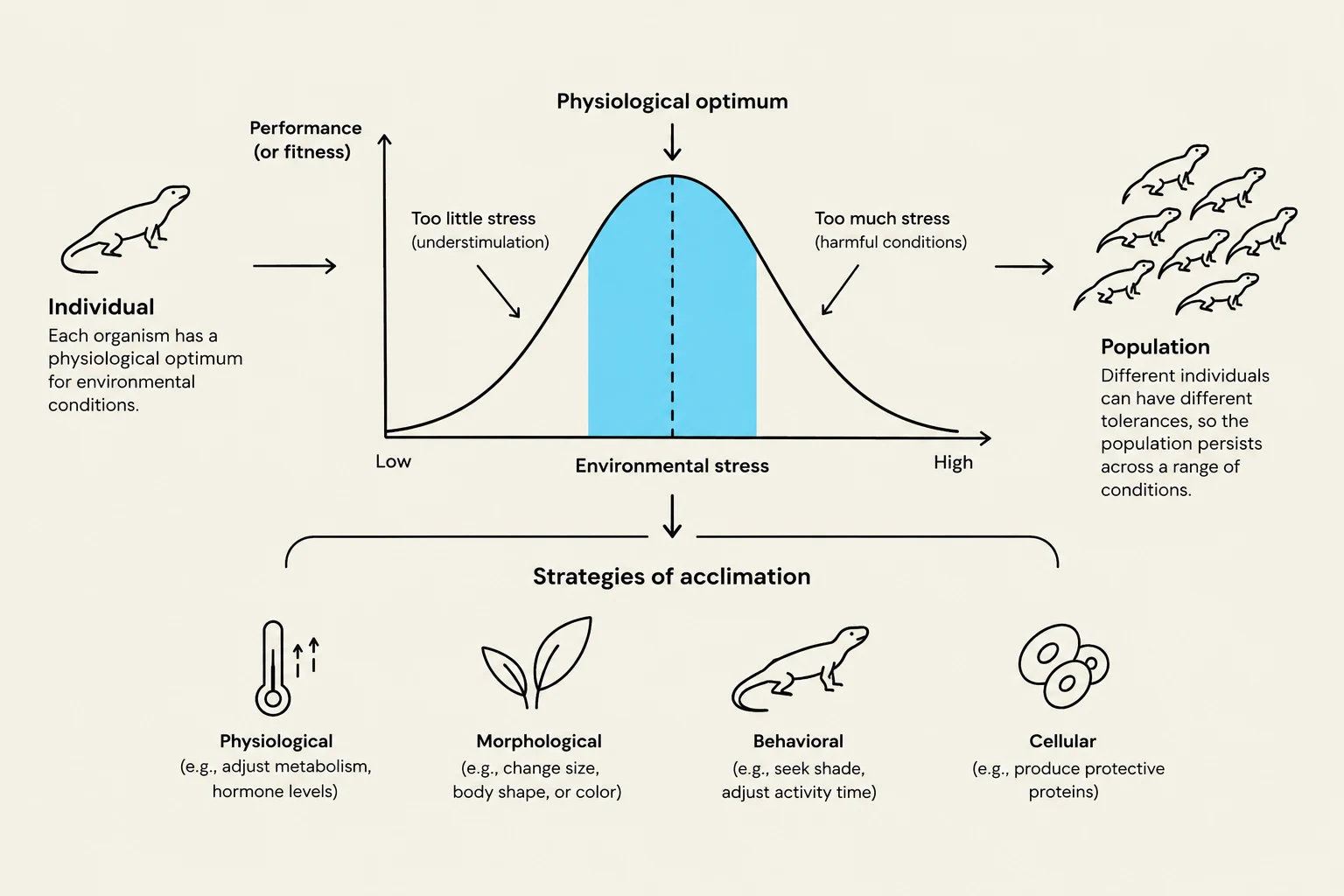
Physiological ecology examines how individuals depend on and adapt to their environment. Every organism faces environmental stress, such as extreme temperatures or limited water, which can push them away from their optimum—the specific environmental condition where their physiological performance is maximized.
To survive, organisms employ different strategies:
- Acclimation: A physiological adjustment made by an individual to a change in the environment (e.g., a human producing more red blood cells at high altitudes).
- Adaptation: Genetic traits that have evolved over generations to improve an organism's fitness in its specific environment.
- Tolerance vs. Avoidance: Some species evolve to tolerate harsh conditions, while others develop behaviors or life cycles to avoid them entirely.
Temperature and Water Regulation
Temperature and water are two of the most critical factors in physiological ecology.
Temperature regulation differs significantly between plants and animals. Animals may use behavioral or physiological mechanisms to maintain a stable internal temperature, whereas plants must manage the thermal stress of being sessile (unable to move) by adjusting their leaf structure or metabolic rates.
Water regulation is governed by water potential, which describes the tendency of water to move from one area to another. In plants, water potential gradients drive the movement of water from the soil, through the roots, and up to the leaves. In animals, maintaining osmotic balance is essential to prevent dehydration or cellular swelling.
Keep reading for free.
Create an account to finish this reading and make it part of your study routine.
Continue reading freeAlready have an account? Log in
Updated