Ecology, Capitalism, and the Transformation of North America
Explores the historical shift from hunter-gatherer societies to agricultural and capitalist systems in North America, examining its ecological and societal impacts. Covers pre-colonial lifeways, the colonial fur trade, the rise of agriculture, and the extinction of species like the passenger pigeon.
The history of North America is often told through the lens of political boundaries and wars, but a deeper history lies in the relationship between humans and the natural world. This history is defined by a fundamental shift in how humans interact with the environment: moving from the reciprocal, nomadic lifeways of hunter-foragers to the sedentary, extractive systems of agriculture and capitalism. This transition did more than change what people ate; it fundamentally altered the continent's ecosystems and the very meaning of what it meant to be human.
Pre-Colonial Lifeways: Reciprocity and the Natural Order
For the vast majority of human history, humanity lived as hunter-foragers. This era was characterized by a nomadic existence, where survival depended on a deep, integrated understanding of the landscape. One of the most significant biological turning points in this history was the domestication of fire by Homo erectus. Fire allowed for the cooking of food, making it more digestible and yielding a higher caloric intake, which ultimately shaped human biology.
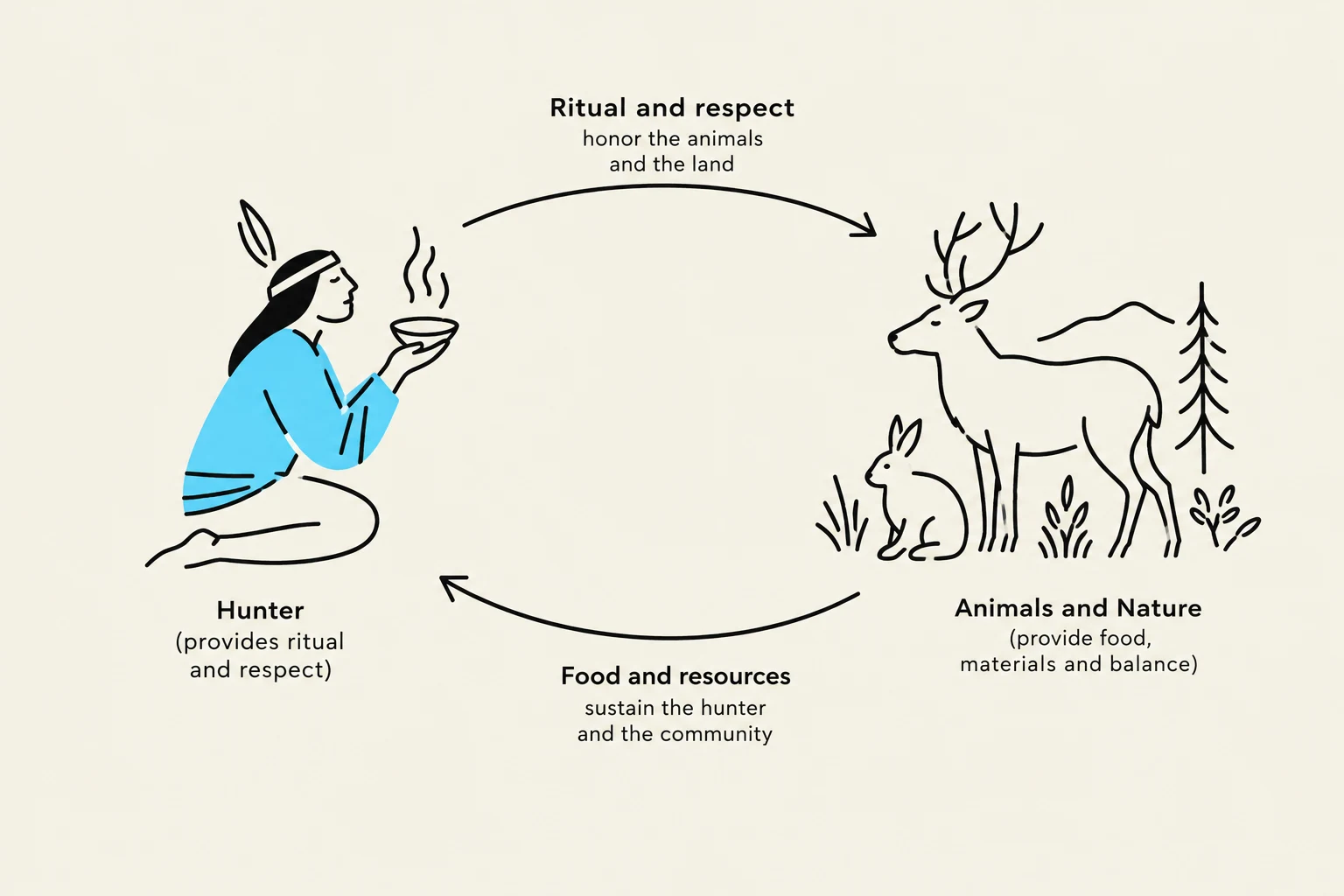
Unlike the later colonial mindset, many Indigenous American cultures did not view the natural world as a collection of objects to be owned. Instead, they viewed nature through a lens of "greater-than-human" realities. Within these cultures, killing an animal was often seen not as an act of dominance, but as an act of reciprocity—a gift exchanged between the hunter and the prey.
Indigenous peoples also acted as active managers of their environment. They utilized controlled burns (fire) during the early spring to prepare the land for planting and to manage vegetation. By maintaining relatively low-density populations, they helped stabilize ecosystems rather than depleting them.
Exam Tip: Remember that for foraging cultures, the relationship with animals was often defined by reciprocity (a gift) rather than dominance (an act of conquest).
This diagram illustrates the cyclical relationship between a hunter and nature, where respect for animals and land leads to sustenance and balance.
The Colonial Shift: From Fur to Farm
The arrival of Europeans introduced a new logic to the North American continent: capitalism. Under this system, nature was transformed into a commodity—something to be extracted, sold, and used for the accumulation of wealth. This shift was driven by different colonial powers with different economic priorities.
The French and Dutch focused heavily on the fur trade. Rather than seeking to transform the soil through intensive farming, they sought wealth on the soil in the form of furbearers. The beaver became the central figure of this economy, serving as a keystone species that underpinned the entire trade due to the massive European demand for beaver hats.
In contrast, the English (and later British) colonies were driven by agriculture and the ideals of Puritanism. The English sought to push the "border of wildness" to create settled, productive landscapes. This often involved the "civilizing" of Indigenous peoples and the conversion of wild lands into managed farms.
This diagram illustrates the economic drivers of colonial powers, focusing on the fur trade. It contrasts the strategies of French/Dutch traders and British merchants, highlighting the role of indigenous peoples and the eventual profits and wealth generated from the fur trade, which fueled empire and industrial growth.
The Rise of the Farmer and the Decline of the Wild
As colonial societies became more sedentary, a historical tension emerged between the farmer and the hunter. In the agricultural worldview, the farmer is the creator of the world, while the hunter is often seen as an outsider or a threat to the order of the land.
This tension was mirrored in the political and social structures of the time. Colonial governance was often shaped by mercantilism, a system where colonies provided raw materials and served as markets for the finished goods of the "motherland". Social hierarchies were also strictly maintained, often mirroring the episcopal structure of the Church of England, which featured a top-down authority.
The environmental cost of this transition was profound. The shift toward market-driven extraction led to the destruction of several keystone species—species that have a disproportionately large effect on their environment.
Case Study: The Passenger Pigeon
Perhaps the most tragic example of this era was the extinction of the passenger pigeon. Once numbering in the billions, these birds were a keystone species whose massive migrations and "rainstorms of manure" actually helped fertilize forests and support the growth of certain trees. However, the combination of market hunting, the expansion of railroads, and habitat destruction drove them to extinction. The last of their kind, a bird named Martha, died in a way that signaled the end of an era for the American wilderness.
The Evolution of American Identity
By the nineteenth century, the American identity was being forged through these competing ideals. The tension between the "heroic" frontier hunter and the "productive" farmer became a central theme in the American imagination.
While the hunter was initially viewed with suspicion, the nineteenth century saw the emergence of the "hunter-naturalist" as a symbol of the "American Native"—a figure that attempted to reconcile the drive to hunt with a growing appreciation for the natural world.
Ultimately, the history of hunting in colonial America is a story of the Grand Domestication. It is the story of how the human drive to dominate and organize the world eventually transformed the continent from a series of reciprocal, wild ecosystems into a structured, capitalist landscape.
Summary Table: Key Economic Drivers
Colonial Power
Primary Economic Focus
View of Nature
French/Dutch
Fur Trade (Beaver)
Nature as a source of commodities
English/British
Agriculture
Nature as something to be tamed/civilized
Indigenous
Foraging/Reciprocity
Nature as a "greater-than-human" reality
Keep reading for free.
Create an account to finish this reading and make it part of your study routine.