Explore Earth's five spheres (atmosphere, hydrosphere, biosphere, lithosphere, magnetosphere) and its internal structure. Learn about the evolution of the atmosphere, its modern composition, and the distinct layers like the troposphere, stratosphere, mesosphere, thermosphere, and exosphere. Understand the greenhouse ef
Earth is a complex, interconnected system that supports life through the constant interaction of several distinct layers or "spheres". By studying these components, scientists engage in planetary geology, which allows us to compare Earth's unique characteristics to other planets and moons in our solar system.
The Five Spheres of Earth
To understand how our planet functions, we can divide it into five primary spheres:
Atmosphere: The layer of gases surrounding the planet, extending up to approximately 100 km.
Hydrosphere: All the water on the Earth's surface and beneath the ground. It covers roughly 70% of the planet's surface.
Biosphere: The sum of all living organisms on Earth.
Lithosphere: The solid, rocky outer layer consisting of minerals and rocks, reaching a thickness of about 70–100 km.
Magnetosphere: The magnetic field that extends thousands of kilometers into space, controlling charged particles.
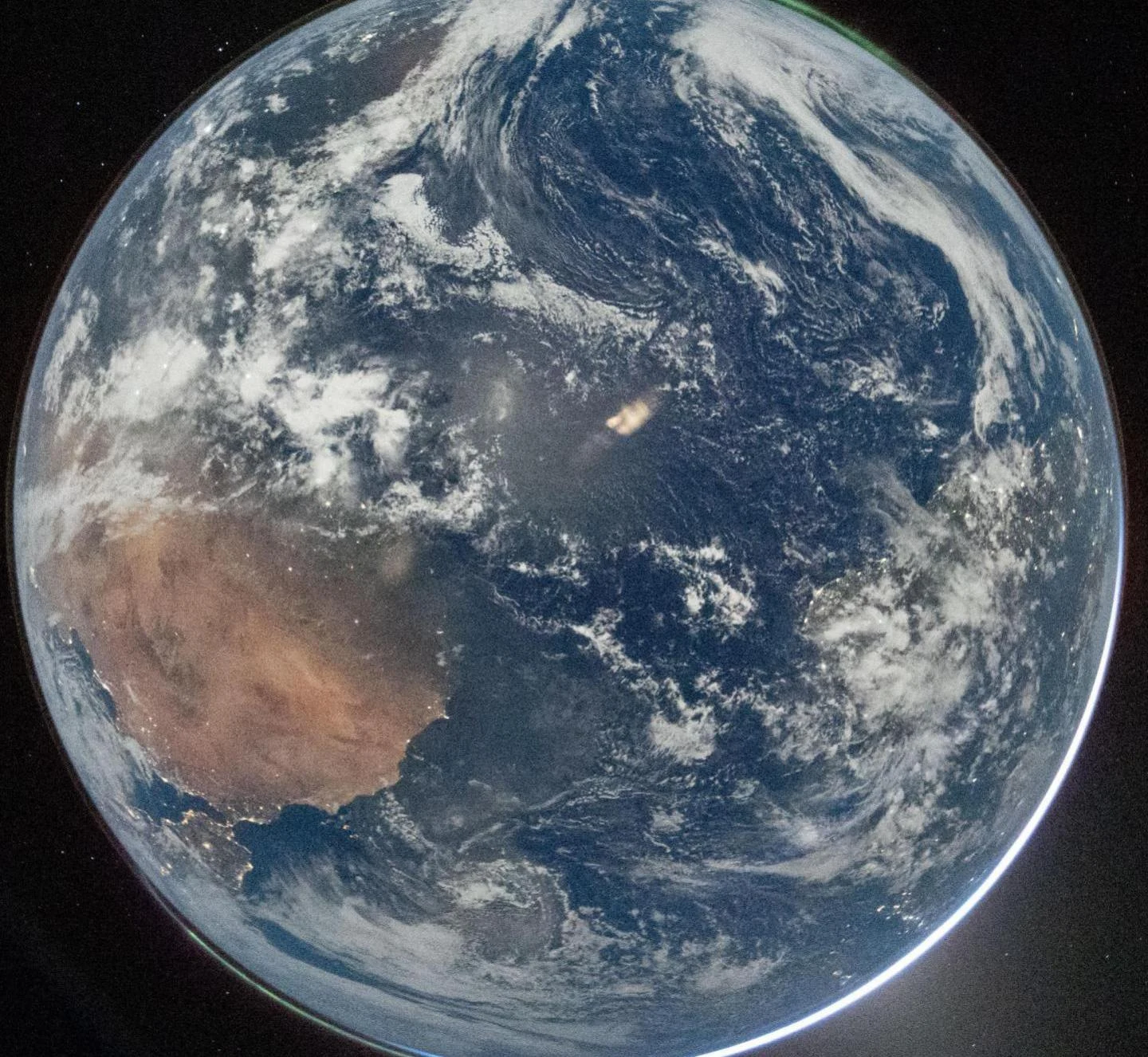
View of Earth from space, showing continents, oceans, and cloud patterns.
Internal Structure and Planetary Geology
While the spheres describe the surface and atmosphere, the internal structure of the Earth is equally vital to its geological activity. The lithosphere sits atop a much deeper interior.
Diagram illustrating the layers of the Earth, including the crust, mantle, outer core, and inner core, along with the magnetosphere and hydrosphere.
The Earth's interior is organized into several distinct layers:
Crust: A thin, outermost layer ranging from 5 to 50 km in thickness.
Mantle: A massive layer approximately 2,900 km thick.
Core: A central region approximately 3,500 km thick, which is further divided into:
Outer Core: A liquid layer about 2,200 km thick.
Inner Core: A solid central sphere about 1,300 km thick.
The Evolution of the Atmosphere
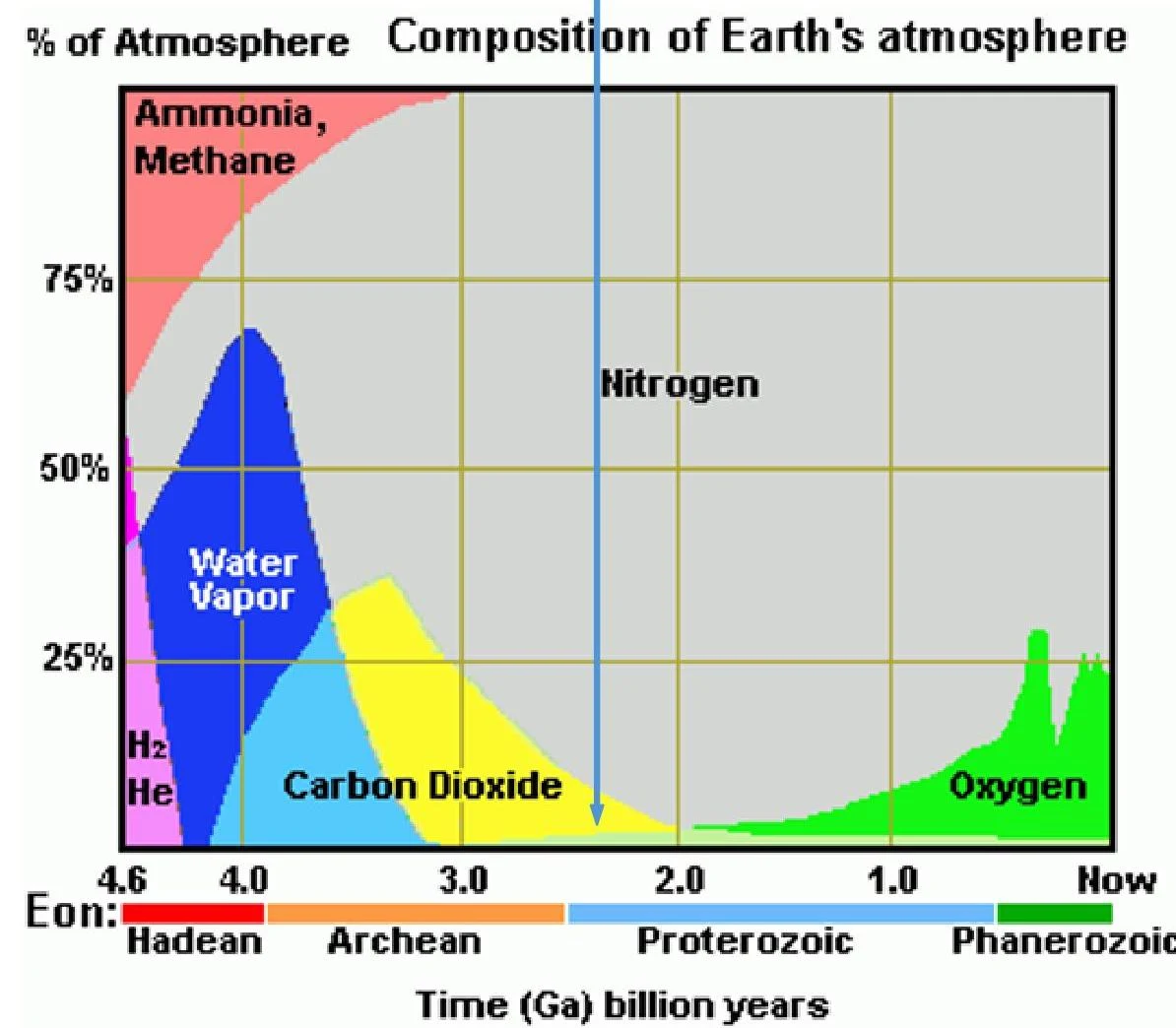
The atmosphere is a layer of gases retained by Earth's gravity. It is unique in our solar system because it contains large amounts of oxygen. However, its composition has changed drastically over billions of years.
Initially, Earth had a primary atmosphere composed of hydrogen (H) and helium (He), which eventually escaped into space. This was followed by a secondary atmosphere released from the Earth's interior via volcanic activity, containing gases like methane (CH4), carbon dioxide (CO2), sulfur dioxide (SO2), and water vapor (H2O).
The most significant turning point was the Great Oxidation Event during the early Proterozoic era (approximately 2.4 Ga). As life evolved in the oceans, organisms began producing oxygen, which eventually accumulated in the atmosphere. By the early Proterozoic (540 Ma), the atmosphere had reached a composition similar to what we see today.
This graph illustrates the changing composition of Earth's atmosphere over billions of years, showing the relative percentages of gases like Nitrogen, Oxygen, Carbon Dioxide, Water Vapor, Ammonia, and Methane across different geological eons.
Modern Atmospheric Composition
Today, the atmosphere is composed primarily of:
Nitrogen: 78%
Oxygen: 21%
Argon: 0.93%
Minor gases:CO2, neon, He, and CH4.
Other important constituents include water vapor, dust, aerosols, and ozone.
Atmospheric Structure and Layers
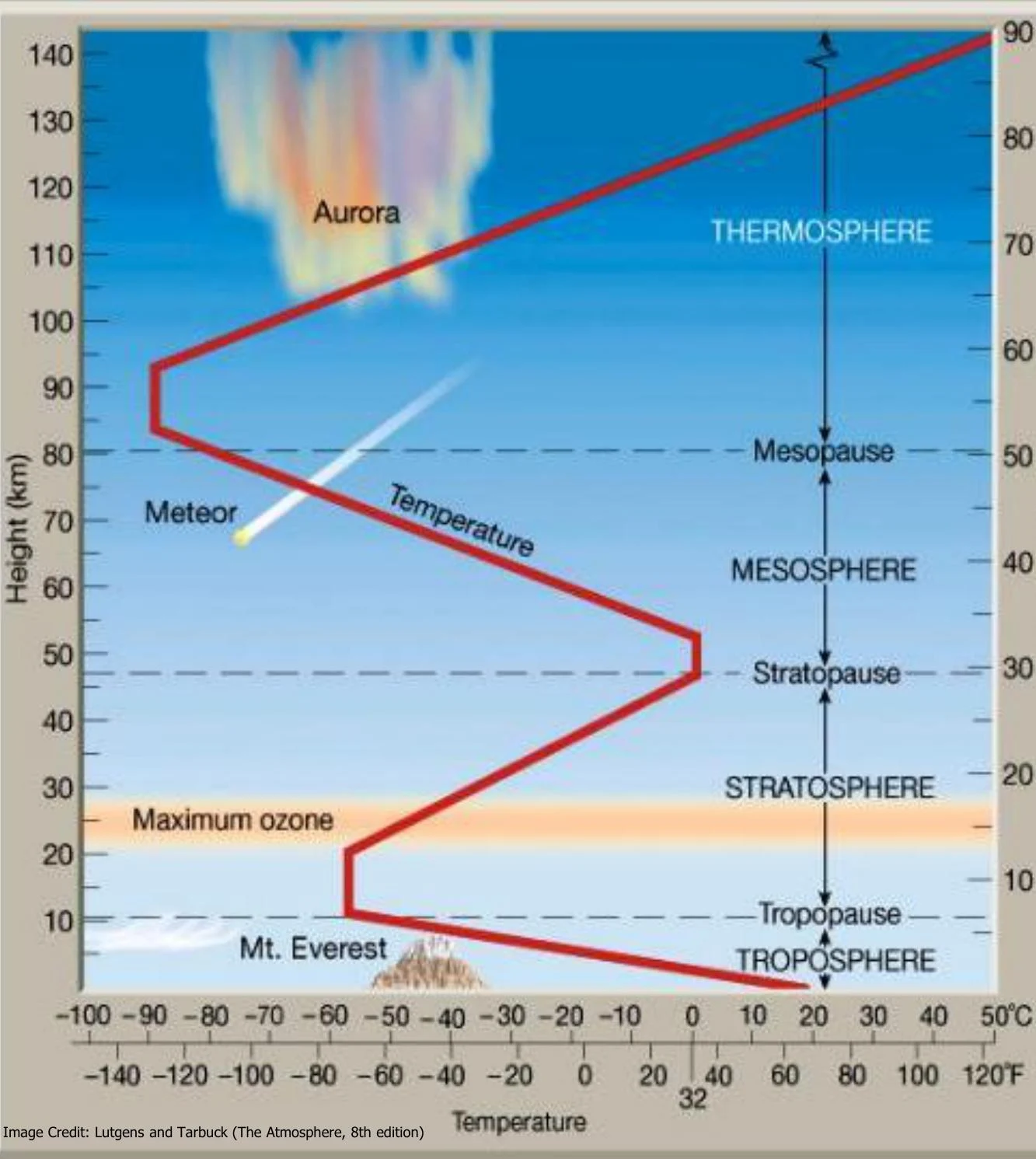
The atmosphere is organized into layers defined by their temperature profiles and how they absorb solar radiation.
This graph illustrates the layers of Earth's atmosphere, including the troposphere, stratosphere, mesosphere, and thermosphere, along with temperature variations and phenomena like auroras and meteors.
1. Troposphere (~0–12 km)
This is the layer where we live and where weather occurs. It is driven by atmospheric convection: warm air rises due to lower density, while cooler air sinks.
This diagram illustrates the concept of convection currents, showing how hot air rises and cold air sinks, creating a circular flow.
2. Stratosphere (12–50 km)
In this layer, temperatures actually increase with altitude. This is due to the Ozone Layer, which absorbs harmful UV radiation.
This diagram illustrates the Earth's atmosphere, showing the troposphere and stratosphere. It depicts how different types of ultraviolet (UV) radiation from the sun interact with the stratospheric ozone layer, with UV-A, UV-B, and UV-C rays shown. The diagram also indicates surface-level ozone (smog) and its sources, such as industrial emissions and vehicles.
The Importance of Ozone: The ozone layer (O3) absorbs 97–99% of the Sun's UV radiation, protecting all life from damaging rays. In the 1980s, an "ozone hole" was discovered over Antarctica caused by chlorofluorocarbons (CFCs). Thanks to international bans on CFCs, the layer is largely recovering.
3. Mesosphere (50–80 km)
This is the coldest layer of the atmosphere, with temperatures dropping below −90∘C. It serves as a shield, as the density of the air creates friction that causes meteors and comets to burn up before hitting the surface.
4. Thermosphere (80–600 km)
This layer absorbs high-energy UV and X-ray radiation, causing temperatures to soar from −120∘C to 2000∘C. It contains the ionosphere, a region of electrically charged particles that reflects radio waves, enabling long-distance communication.
5. Exosphere (600–10,000 km)
The outermost layer merges with space. It is extremely thin, consisting of sparse hydrogen and helium. It is considered a "region of escape" because particles can move fast enough to break free from Earth's gravity.
The Greenhouse Effect and Climate Change
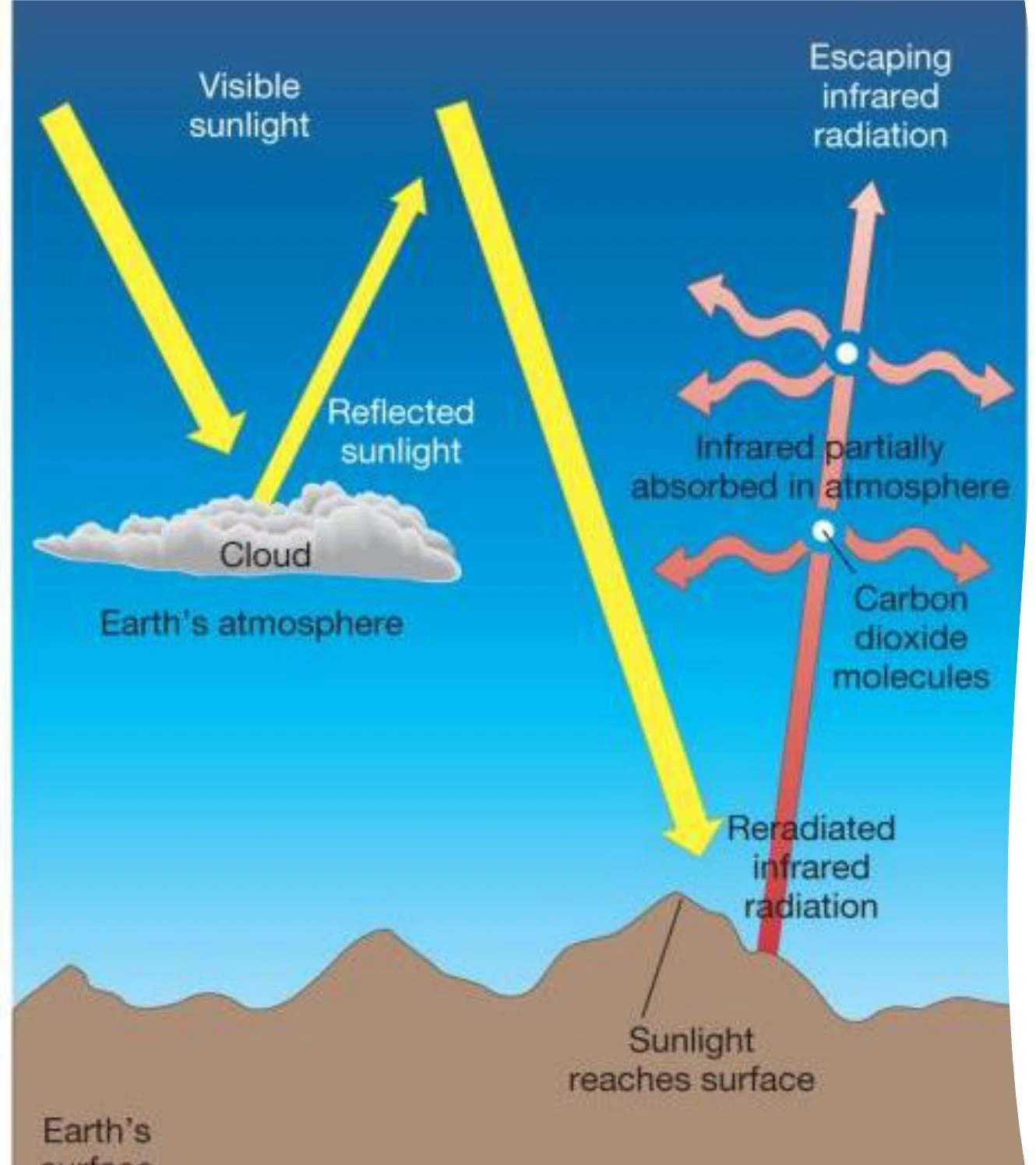
The atmosphere does more than just provide air; it regulates temperature through the greenhouse effect. When sunlight hits the Earth, the surface absorbs it and reradiates it as infrared thermal radiation. Greenhouse gases—such as CO2, H2O, and CH4—absorb some of this infrared radiation, trapping heat and warming the planet.
This diagram illustrates how visible sunlight interacts with Earth's atmosphere and surface, and how infrared radiation is absorbed and re-emitted by greenhouse gases like carbon dioxide.
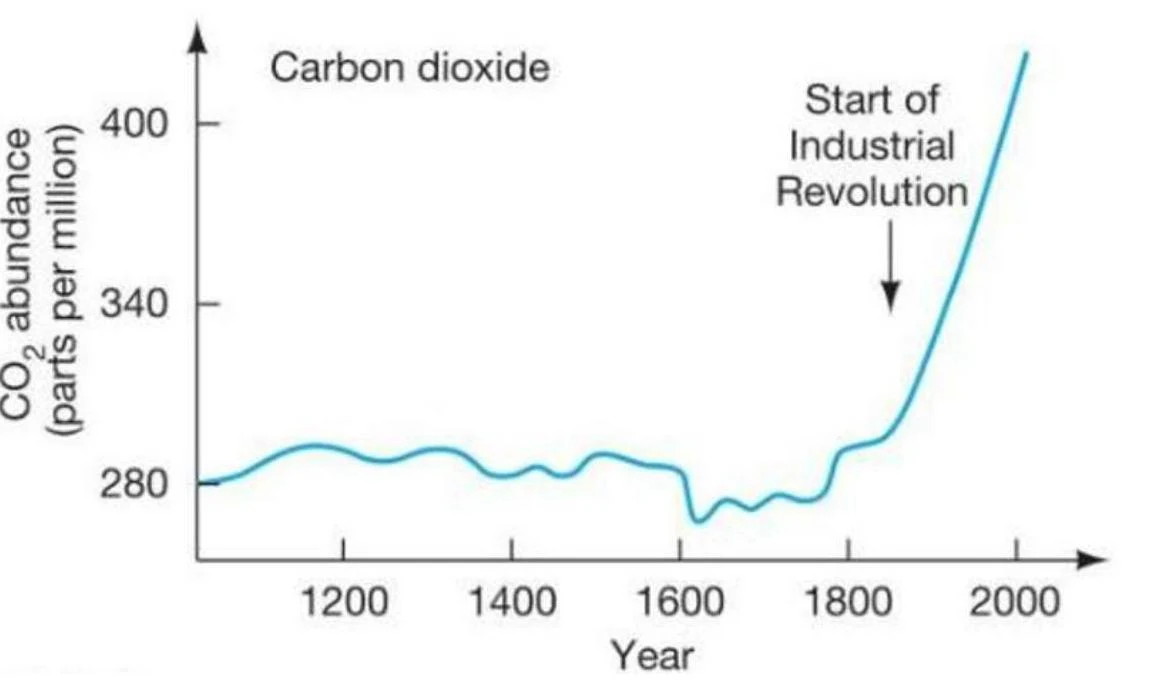
While the greenhouse effect is necessary for life, human activities (such as burning fossil fuels) have significantly increased CO2 levels. This intensification of the greenhouse effect is driving global warming, which may lead to several consequences:
Rising sea levels from melting glaciers.
More severe weather patterns.
Crop failures and the expansion of deserts.
The spread of tropical diseases to new regions.
A graph showing the increase in carbon dioxide abundance in parts per million from the year 1200 to 2000, with a notable acceleration starting around the Industrial Revolution.
Exam Tip: Remember that the temperature profile of the atmosphere is the key to identifying its layers. If temperature increases with height, you are likely in the Stratosphere (due to ozone) or the Thermosphere (due to X-ray/UV absorption).
Keep reading for free.
Create an account to finish this reading and make it part of your study routine.