Dynamics of Property Rights and Conveyance Systems
This content explains the fundamental concepts of voluntary property transfers, distinguishing between assets and claims, and detailing various conveyance systems like consensual and traditio, as well as abstract vs. causal transfer systems.
In the study of property law, understanding how an entitlement moves from one person to another is fundamental. This process, known as the voluntary transfer of assets, involves a specific legal act intended to shift a property right from a transferor to a transferee.
It is important to distinguish this from other ways assets might change hands. For instance, the transfer of property via operation of law (such as inheritance after death), through court orders (such as expropriation), or the movement of funds within a banking system are not considered voluntary transfers of property rights within the scope of this legal framework.
The Nature of Money: Assets vs. Claims
This illustration depicts the distinction between physical currency and a bank account claim, showing a coin being exchanged and a person interacting with a bank account balance.
A common misconception in property law involves the distinction between physical currency and digital bank balances. While we often speak of "owning" money in a bank account, the legal reality is quite different.
Bank Account Balances as Personal Claims
Money held in a bank account is not an owned asset in the property law sense. Instead, it represents a personal claim (an obligation) held by the client (the creditor) against the bank (the debtor). When you transfer money to someone via a bank transfer, you are not transferring a tangible object; you are instructing your bank to debit your account and credit the payee's account. Because this is a claim rather than a physical object, it cannot be vindicated (a legal action to recover specific property).
Physical Currency as Movable Objects
In contrast, ownership of money exists in a property law sense only in relation to banknotes and coins. These are treated as movable, tangible objects that are capable of being transferred through the standard mechanisms of property law.
Conveyance Systems and the Publicity Requirement
When property rights are transferred, the law must address the publicity requirement—the need to make a transfer visible or known to ensure legal certainty for third parties. To manage this, European legal systems generally follow one of two primary conveyance systems: the Consensual System or the Traditio System.
1. The Consensual System
In a consensual system, the transfer of a property right is finalized through the mere agreement or consent of the parties. This is often referred to as the solo consensus rule, where the conclusion of a contract of sale is sufficient to pass ownership directly from the seller to the buyer.
Examples: France, Belgium, and England utilize consensual elements.
English Law Nuance: For movable objects, ownership can pass immediately upon agreement. However, for immovable objects (land), the transfer only affects the parties involved until a deed is signed and, in many cases, registered with a Land Registry to be effective against the rest of the world.
Exam Tip: Exceptions to Solo Consensus
Even in consensual systems, ownership does not always pass immediately upon contract. The "specificity principle" requires that the object be identified. Therefore, ownership cannot pass for:
Generic goods: (e.g., "500 bottles from a warehouse") until they are measured and set aside.
Future goods: (e.g., "wheat to be harvested next year") until they exist and are appropriated to the contract.
Note on "Sale ex Bulk": If you sell an undivided 50% share of a bulk (like a silo of wheat), ownership passes immediately because you are selling a share of the whole, not a specific unseparated portion.
2. The Traditio System
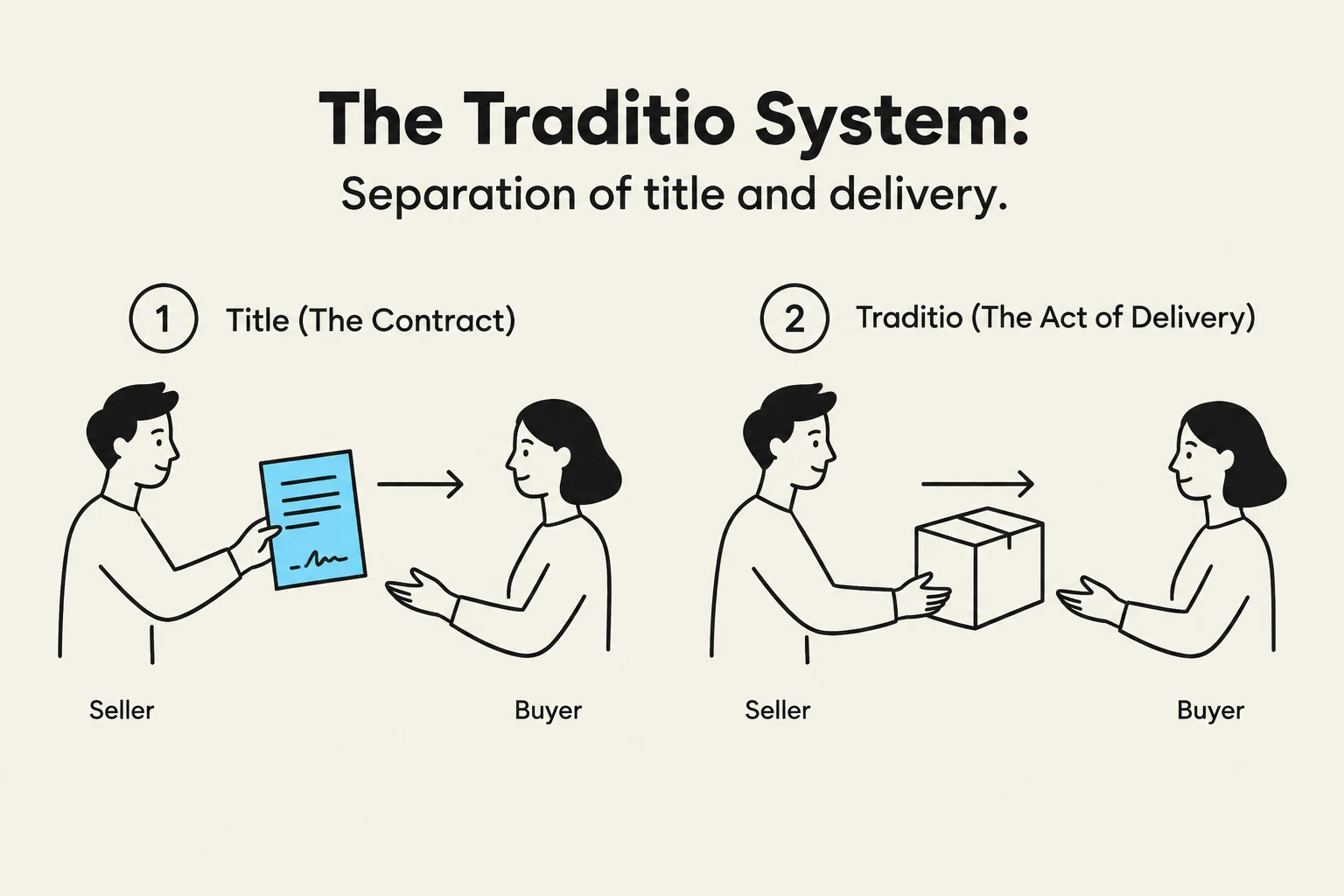
The Traditio System illustrates the separation of title and delivery in a transaction, showing a seller transferring a contract to a buyer, followed by the physical delivery of goods.
The tradition system requires more than just a contract; it requires a specific act of delivery, known in Roman law as traditio, to complete the change in ownership. This system relies on the principle of separation, which distinguishes between the title (the underlying legal act like a sale or gift that creates the obligation to transfer) and the traditio (the actual act that effectuates the transfer).
Forms of Delivery (Traditio)
Direct Possession:
Traditio vera: The physical handing over of the object.
Traditio symbolica: Handing over something that provides access, such as the keys to a building.
Constructive Delivery (Traditio Ficta):
Traditio brevi manu: When someone who already holds an object (e.g., a lessee) becomes the owner.
Constitutum possessorium: The mirror image, where an owner becomes a holder/bailee (e.g., selling a car but keeping it as a renter).
Abstract vs. Causal Transfer Systems
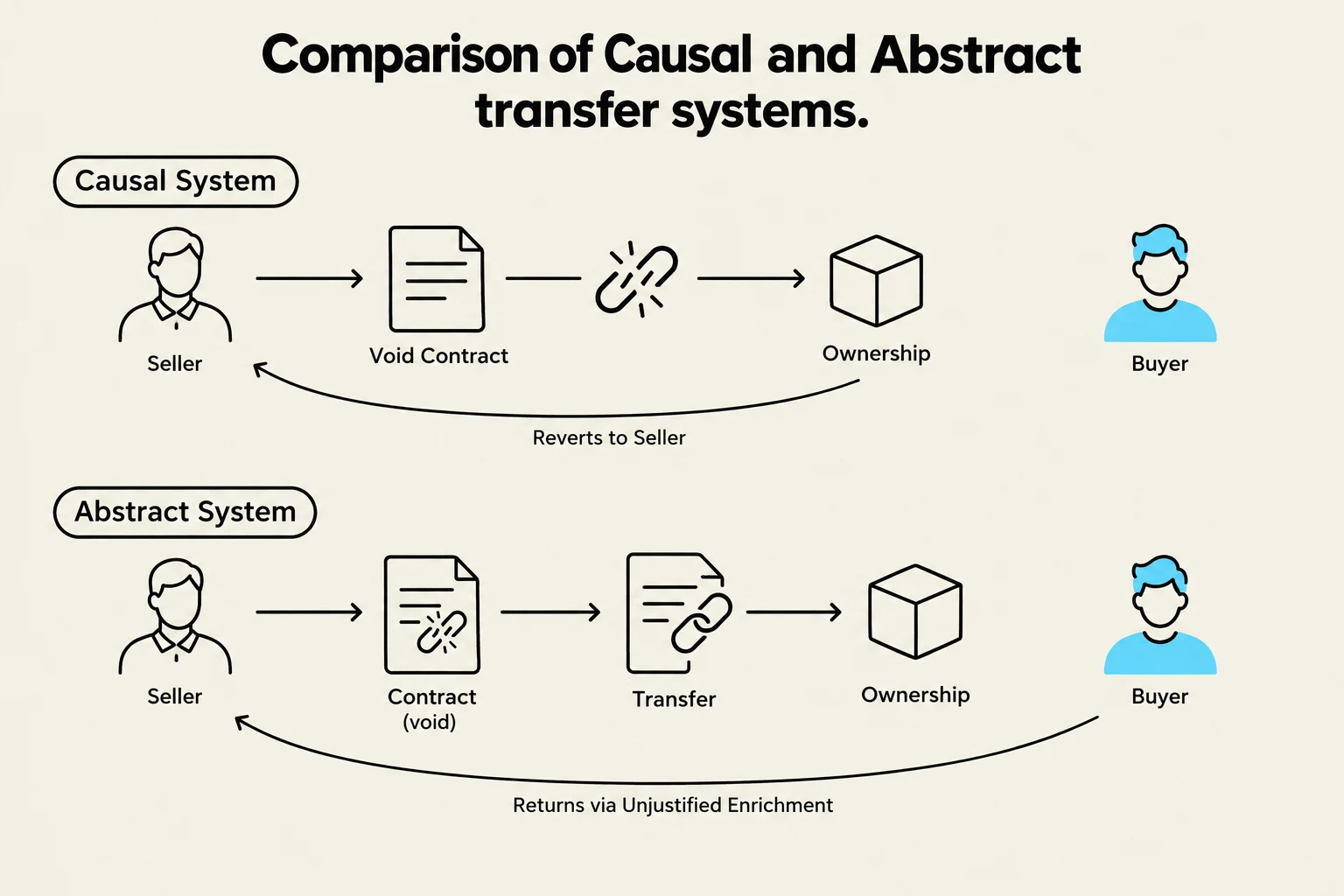
This diagram compares causal and abstract transfer systems, illustrating the flow of ownership from seller to buyer in each.
A second major dividing line in property law is the relationship between the validity of the underlying contract (the cause) and the validity of the transfer itself.
Causal Transfer Systems
In causal systems, the validity of the transfer is strictly dependent on a valid underlying contract (causa traditionis).
If the contract is void or avoided, the transfer is also invalid, and ownership automatically reverts to the transferor.
Risk: This can be dangerous for third-party buyers. If a seller sells an item to A (void contract) and A sells it to B, B may not actually own the item because A never legally acquired it (the Nemo plus rule).
Abstract Transfer Systems (The German Model)
The German system operates on the abstract principle, where the act of transfer is legally independent of the underlying contract.
The Separation Principle: The contract (the promise) and the transfer (the delivery) live in "separate legal worlds".
Effect: Even if the underlying contract is defective (e.g., due to a mistake), the transfer of ownership can still be valid.
Remedy: If the contract is void, the buyer does not automatically lose ownership. Instead, the buyer has an obligation based on unjustified enrichment to return the object to the seller.
Comparison Table: Causal vs. Abstract Systems
Feature
Causal System
Abstract System (German)
Dependency
Transfer depends on a valid contract
Transfer is independent of the contract
Void Contract
Ownership reverts to seller
Ownership stays with buyer; buyer must return via enrichment claim
Third-Party Protection
Lower (risk of Nemo plus)
Higher (protects subsequent acquirers)
Summary of Immovable Transfers
The application of these systems varies significantly by jurisdiction when dealing with land:
Germany/Austria: Requires agreement before a notary and registration in the land register, which has a constitutive effect (the right is created by registration).
England: Distinguishes between registered and unregistered land (which requires title investigation).
France: Uses a consensual system where ownership passes upon agreement; registration serves only a publicity function for third parties rather than creating the right itself.
Keep reading for free.
Create an account to finish this reading and make it part of your study routine.