


Understanding how objects move—or why they stay still—is a fundamental goal of physics. To master this, we must bridge the gap between the forces acting on an object and the resulting motion (or lack thereof). This study article explores the mechanics of dynamics and static equilibrium, focusing on how to mathematically resolve complex force systems into manageable components.
The Foundation: Newton's Second Law
At the heart of all motion analysis is Newton's second law. This principle provides the mathematical link between the net force acting on an object, its mass, and its acceleration. The law is expressed by the formula:
Where is the sum of all external forces, is the mass of the object, and is the acceleration.
When an object is accelerating, the net force is non-zero. For example, if a tugboat pushes a barge, the applied force must overcome the drag force of the water to create acceleration. If the forces are perfectly balanced, the acceleration is zero, leading us to the concept of equilibrium.
Visualizing Forces: The Free-Body Diagram
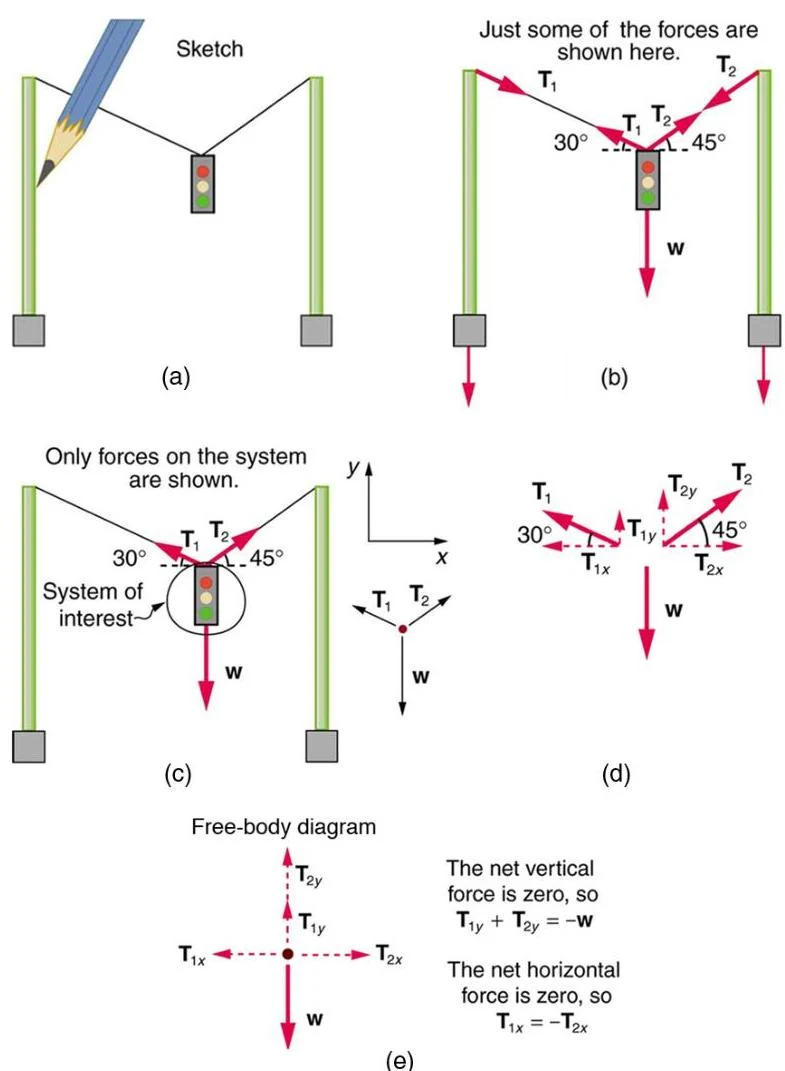
Before performing any calculations, you must visualize the forces at play. The most effective tool for this is the Free-Body Diagram (FBD). An FBD is a simplified sketch that represents the object of interest as a single point or a simple shape, with all external forces drawn as vectors pointing away from that center.
A common mistake is to include forces that are not acting on the object, or to omit forces that are essential to the system's stability. For instance, when analyzing a barge, we might omit the vertical weight and buoyant force if they cancel each other out, allowing us to focus solely on the horizontal forces causing motion.
Keep reading for free.
Create an account to finish this reading and make it part of your study routine.
Continue reading freeAlready have an account? Log in
Updated