


Understanding how objects move requires more than just describing their path; we must understand the causes behind that motion. While kinematics focuses on the description of motion—such as position, velocity, and acceleration—dynamics investigates the forces that actually cause those changes in motion. By integrating these two fields, we can solve complex real-world problems, from calculating the tension in a suspended traffic light to predicting how a bathroom scale reacts in a moving elevator.
The Foundation: Newton's Second Law
At the heart of dynamics is Newton's second law, which provides the mathematical link between force and motion. It states that the net external force acting on an object is directly proportional to its acceleration.
The relationship is expressed by the formula: where is the sum of all external forces, is the mass of the object, and is the acceleration.
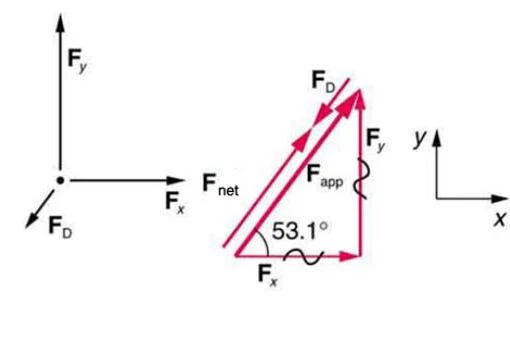
When multiple forces act on an object in different directions, such as two tugboats pushing a barge at different angles, we must treat these forces as vectors. In such cases, the net force is the vector sum of all individual forces. For example, if two perpendicular forces and act on a barge, the magnitude of the total applied force is found using the Pythagorean theorem: .
Exam Tip: Always determine the direction of the net force first. According to Newton's first law, the acceleration of an object will always be in the same direction as the net external force.
Keep reading for free.
Create an account to finish this reading and make it part of your study routine.
Continue reading freeAlready have an account? Log in
Updated