An explanation of dual-process models in cognitive science, distinguishing between System 1 (intuitive, fast) and System 2 (deliberate, slow) thinking and their roles in belief formation and decision-making.
Have you ever made a snap judgment about someone's character based on a single glance, only to realize later that your initial impression was completely wrong? Or perhaps you have spent hours meticulously researching a complex topic, weighing every piece of evidence before forming a conclusion. These two very different ways of thinking are not just personality traits; they are fundamental components of how the human mind processes information.
In cognitive science, this distinction is explained through Dual-Process Models. These models suggest that our cognition is not a single, unified stream of thought, but rather a tension between two distinct systems: one that is fast and intuitive, and another that is slow and analytical. Understanding these systems is crucial for grasping how we form beliefs, make decisions, and even how religious or supernatural ideas take root in the human mind.
System 1: The Intuitive Engine
System 1 is often described as the "autopilot" of the brain. It is characterized by being fast, automatic, emotional, and subconscious. When you see a person scowling, you don't need to perform a logical analysis to know they are likely angry; your brain recognizes the pattern instantly.
System 1 operates using heuristics—mental shortcuts that allow us to navigate a complex world without being paralyzed by the sheer volume of incoming data. These shortcuts are incredibly efficient and allow for rapid responses to environmental stimuli. However, because they rely on patterns and associations rather than rigorous logic, they are prone to systematic errors and cognitive biases.
Example: The Availability Heuristic
If someone asks you if shark attacks are more common than falling coconuts, you might instinctively say "shark attacks" because shark attacks are more dramatic and easier to recall from news reports. Your System 1 relies on the ease of memory retrieval rather than actual statistical frequency.
Diagram illustrating System 1 thinking, characterized by fast, automatic, and intuitive responses with little effort or control, triggered by a stimulus and leading to a quick belief.
Exam Tip: When asked to identify System 1 processes, look for keywords like automatic, subconscious, fast, effortless, and heuristic-based.
System 2: The Deliberate Analyst
In contrast to the rapid-fire nature of System 1, System 2 is the "pilot." It is slow, effortful, logical, and conscious. This is the part of your mind you engage when you are solving a difficult math problem, learning a new language, or carefully evaluating the validity of a political argument.
System 2 is responsible for complex computations and the monitoring of System 1. While System 1 provides the "gut feeling," System 2 provides the "reasoning." It has a much higher capacity for precision, but it comes at a cost: it is cognitively expensive. It requires significant mental energy (often referred to as cognitive load) and can only be sustained for limited periods before fatigue sets in.
Example: Mathematical Verification
If you see the equation 2+2=4, your System 1 might answer instantly. However, if you are asked to calculate 144⋅(15÷3), you cannot rely on intuition. You must engage System 2 to step through the operations sequentially and deliberately.
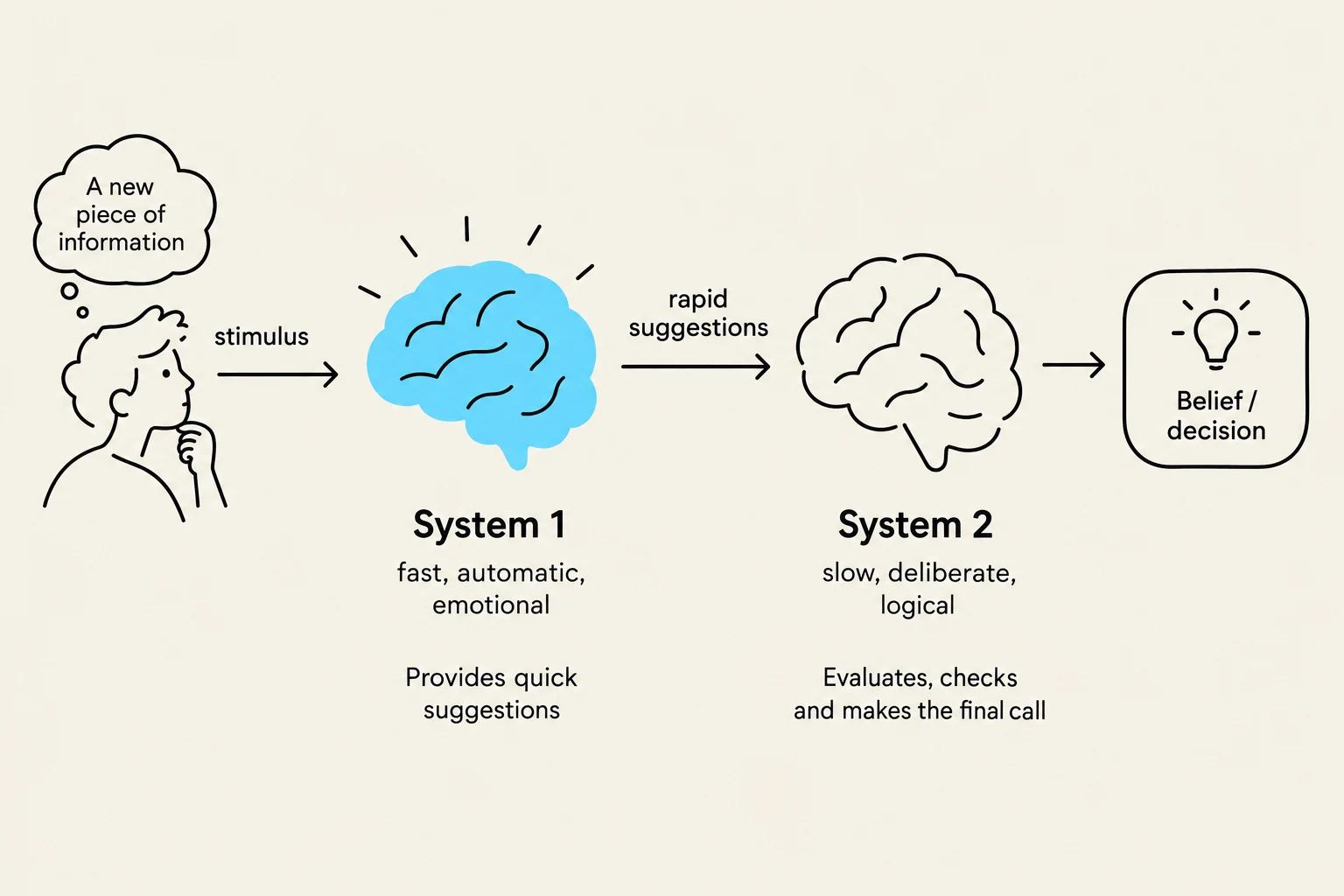
This diagram illustrates Kahneman's dual-process theory of the mind, distinguishing between System 1 (fast, automatic, emotional) and System 2 (slow, deliberate, logical) thinking processes in decision-making.
The Interaction in Belief Formation
The most fascinating aspect of dual-process theory is how these two systems interact to form our beliefs. In many cases, System 1 generates a "belief" or an intuition almost instantly. For instance, if you hear a story about a miraculous event, your System 1 might immediately find the story plausible because it is coherent and emotionally resonant.
Once this intuitive belief is formed, System 2 enters the fray. It can play two different roles:
The Monitor: System 2 can act as a filter, checking the intuitive belief against logic and evidence. If System 2 finds a flaw, it can override the System 1 impulse (e.g., "I feel like this is true, but the math doesn't add up").
The Rationalizer: Often, instead of checking the belief, System 2 is used to justify it. If System 1 forms a strong emotional belief, System 2 might work backward to find logical-sounding reasons to support that belief, a process known as motivated reasoning.
This interaction explains why humans can be both highly rational and deeply irrational at the same time. We use our logic not always to find the truth, but often to defend the intuitions that our fast-thinking brain has already accepted.
Summary Table: System 1 vs. System 2
To help consolidate these concepts, refer to the following comparison:
Feature
System 1
System 2
Speed
Fast / Instantaneous
Slow / Deliberate
Effort
Low / Effortless
High / Taxing
Control
Automatic / Subconscious
Controlled / Conscious
Function
Pattern recognition, intuition
Logic, reasoning, calculation
Error Type
Cognitive biases, heuristics
Fatigue, calculation errors
Understanding the dual-process model allows us to be more mindful of our own thinking. By recognizing when we are relying solely on System 1, we can intentionally "switch on" System 2 to ensure our beliefs are grounded in more than just immediate intuition.
Keep reading for free.
Create an account to finish this reading and make it part of your study routine.