An overview of drug naming conventions, classification systems, pharmaceutical forms, and the fundamental principles of pharmacokinetics, including absorption, distribution, metabolism, and excretion (ADME).
Understanding how drugs are named, how they are categorized, and how they move through the human body is essential for safe clinical practice. In nursing, this knowledge forms the basis of medication administration and patient safety. To master pharmacology, one must distinguish between the science of what a drug does to the body (pharmacodynamics) and the study of how the body handles the drug (pharmacokinetics).
Drug Naming Conventions
When you look at a medication, you may see several different names. These names serve different purposes in medical and legal contexts.
Chemical Name: This describes the drug's precise chemical composition and molecular structure (e.g., (+)-2-(p-isobutylphenyl) propionic acid).
Generic Name: This is the non-proprietary, official name approved by regulatory bodies like Health Canada. It is the standard name used in scientific literature.
Brand (Trade) Name: This is the proprietary name based on a registered trademark. The use of this name is restricted to the patent owner (e.g., Advil).
Drug Classification
To make the vast number of available medications manageable, drugs are grouped into classes or subclasses based on specific criteria:
By Structure: Grouping drugs that share a similar chemical shape (e.g., β-adrenergic blockers or calcium channel blockers).
By Therapeutic Use: Grouping drugs based on the disease or condition they treat (e.g., antibiotics, antihypertensives, or anti-inflammatories).
Pharmaceutical Forms
Pharmaceutics is the science of preparing and dispensing drugs, including the design of dosage forms. Drugs come in various forms to ensure they are delivered effectively to the target site. Common forms include:
Liquids: Solutions and suspensions.
Solids: Powders, capsules, tablets, and coated tablets (such as enteric-coated tablets, which are designed to dissolve at specific points in the GI tract).
Pharmacokinetics: The ADME Model
Pharmacokinetics is the study of how the body processes a drug from the moment it enters until it is completely eliminated. This is often summarized by the ADME model: Absorption, Distribution, Metabolism, and Excretion.
Absorption and Bioavailability
Absorption is the movement of a drug from its site of administration into the bloodstream. The route of administration significantly impacts both the rate and the extent of this process.
A critical concept here is bioavailability, which describes the percentage of the administered dose that reaches the systemic circulation.
Exam Tip: When comparing routes, remember that intravenous (IV) administration provides 100% bioavailability because the drug enters the systemic circulation directly, bypassing the digestive process and the liver.
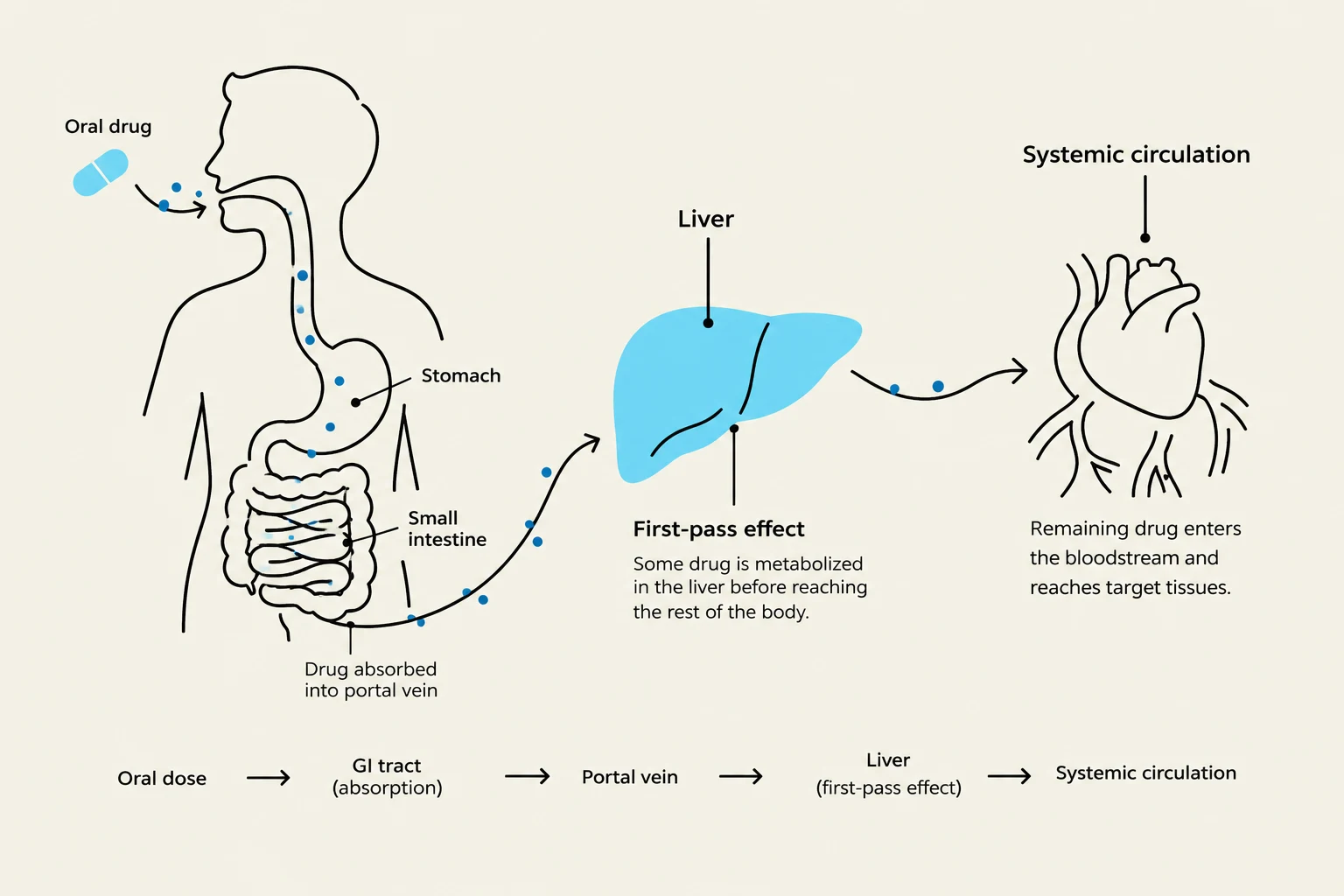
One major obstacle to bioavailability is the first-pass effect. When drugs are absorbed via the intestines, they are carried through the hepatic portal system to the liver first. The liver may metabolize a large portion of the drug before it ever reaches the rest of the body, significantly reducing the amount of active drug available.
Diagram illustrating the first-pass effect of an orally administered drug, showing its absorption in the GI tract, metabolism in the liver, and subsequent entry into systemic circulation.
Routes of Administration
The route chosen depends on the desired onset of action and the patient's condition:
Enteral Route: Includes oral, sublingual, buccal, and rectal administration. Sublingual and buccal routes are highly vascularized, allowing the drug to bypass the liver and enter the bloodstream directly.
Parenteral Route: Refers to routes "other than" enteral, typically involving injections. These include Intravenous (IV), Intramuscular (IM), Subcutaneous (SubQ), and Intradermal.
IV drugs enter systemic circulation immediately.
IM absorption is generally faster than SubQ because muscles are more vascular.
Topical Route: Application to body surfaces (skin, eyes, etc.) for local or systemic effects.
Transdermal: Specifically formulated patches designed to release drugs at a steady rate for systemic absorption.
Inhalational: Small particles absorbed across the respiratory membrane in the alveoli.
Distribution and Metabolism
Once in the blood, distribution occurs—the transport of the drug to its site of action. Drugs are distributed more quickly to highly vascular organs like the heart, liver, and kidneys.
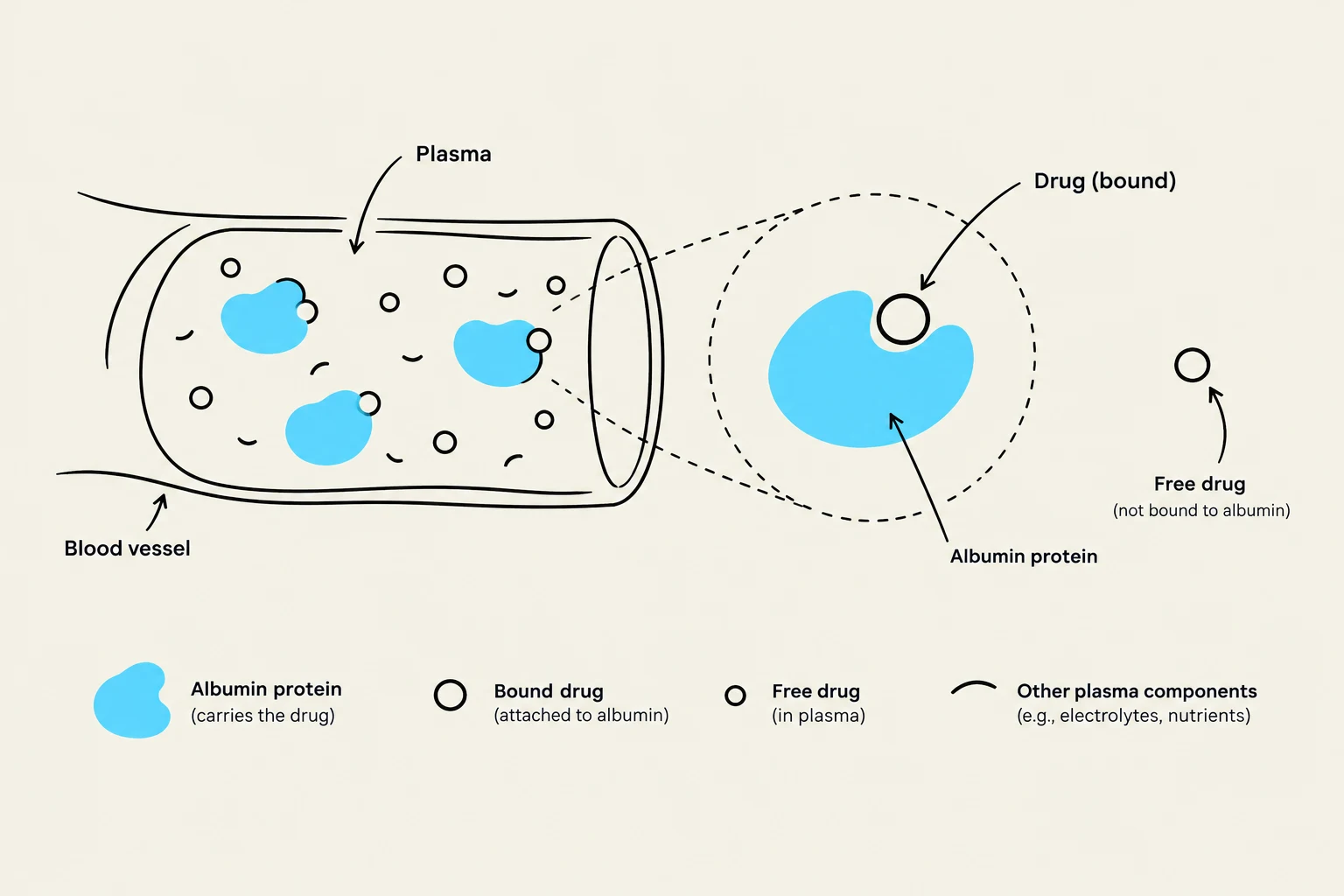
In the bloodstream, drugs exist in two states: bound (attached to carrier proteins like albumin) and free (unbound). Only the free drug is pharmacologically active.
This diagram illustrates how drugs can be bound to albumin proteins in the blood plasma or exist as free drugs not bound to albumin. It also shows other plasma components.
Metabolism (or biotransformation) is the biochemical alteration of the drug, primarily occurring in the liver. This process often uses cytochrome P450 enzymes to turn drugs into more water-soluble forms for easier excretion.
Excretion
Excretion is the final removal of drugs and their metabolites from the body. The kidneys are the primary organ for excretion, though the liver, bowels, and lungs also play roles.
Mathematical Concept: Half-Life
The half-life (t1/2) is the time required for the serum concentration of a drug to be reduced by 50%. This value is vital for determining dosing intervals.
Worked Example:
If a drug has a peak level of 160 mg/L and a half-life of 4 hours, how long until it reaches 20 mg/L?
After 4 hours (1st half-life): 160→80 mg/L
After 8 hours (2nd half-life): 80→40 mg/L
After 12 hours (3rd half-life): 40→20 mg/LAnswer: 12 hours.
Summary of Pharmacokinetics
To visualize how these processes interact, consider the movement from administration to elimination:
This diagram illustrates the pharmacokinetic processes of a drug in the body: Administration, Absorption, Distribution, and Metabolism.
Understanding these principles allows healthcare providers to predict drug effects, manage potential drug-drug interactions, and ensure that patients receive the correct dose through the most effective route.
Keep reading for free.
Create an account to finish this reading and make it part of your study routine.