Drug Discovery and Development: From Molecule to Medicine
An overview of the complex, multidisciplinary process of drug discovery and development, covering biological foundations, target validation, lead identification and optimization, pharmacokinetics, pharmacodynamics, and clinical trials.
The process of bringing a new drug to market is one of the most complex, expensive, and high-stakes endeavors in modern science. It requires a multidisciplinary approach, blending biology, chemistry, and computer science to navigate a path that has a success rate of less than 1%. From the initial identification of a disease to the final clinical trials and market distribution, every step is designed to ensure that a compound is not only effective at treating a condition but also safe for human consumption.
Understanding the Biological Foundation
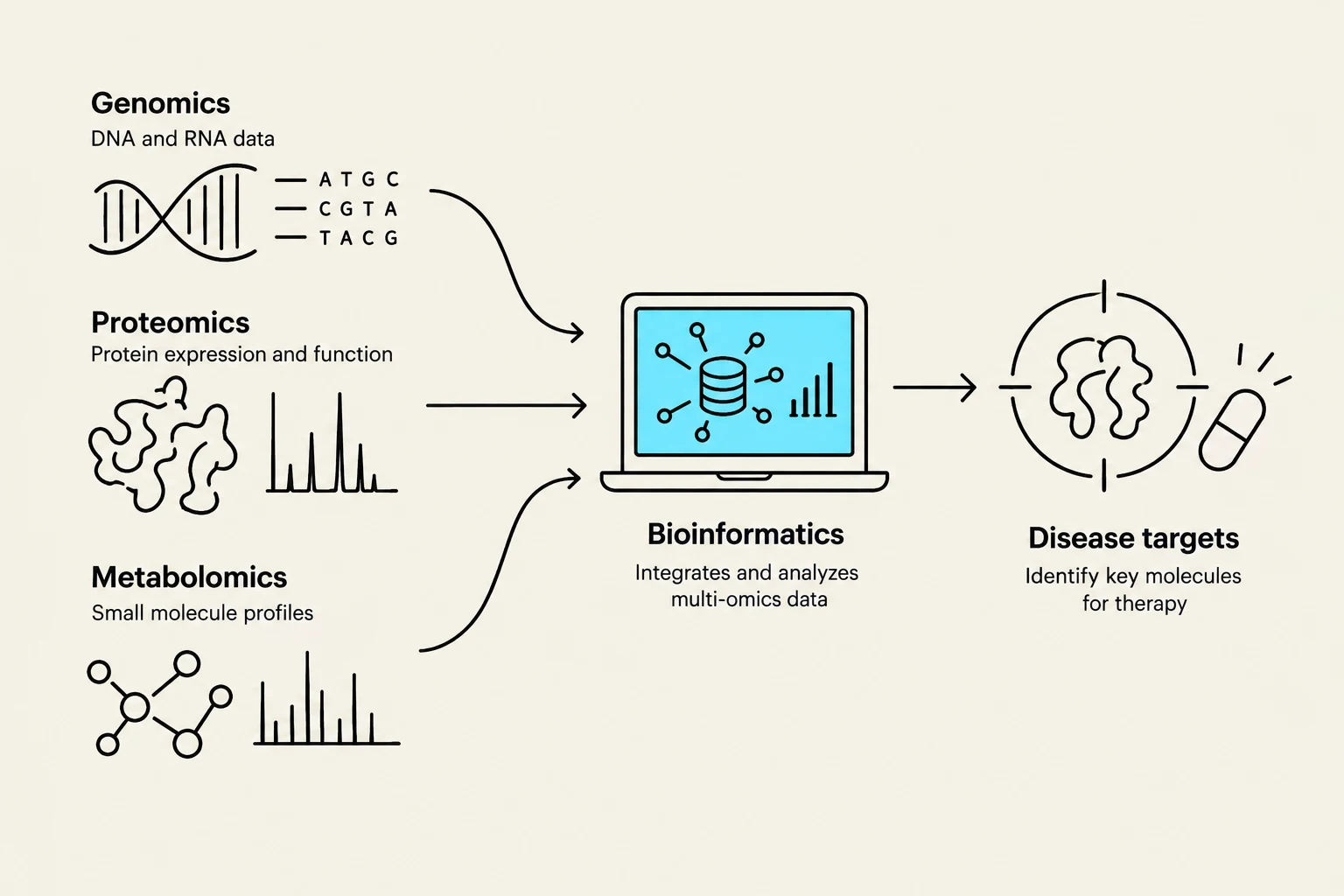
Before a drug can be designed, scientists must understand the molecular mechanism of a disease. This involves exploring the "omics" sciences to map out the biological landscape:
Genomics: The study of the complete set of DNA within an organism.
Proteomics: The study of the entire complement of proteins expressed by a cell or organism.
Metabolomics: The study of small-molecule metabolites within cells and tissues.
By integrating these fields through Bioinformatics, researchers can identify specific biological targets—such as a particular protein or enzyme—that, when modulated by a drug, will produce a therapeutic effect.
This diagram illustrates the process of integrating and analyzing multi-omics data from genomics, proteomics, and metabolomics to identify disease targets for therapy.
Target Validation and Lead Identification
Once a potential pharmaceutical target is identified, it must be validated to ensure that interacting with it actually treats the disease. Following validation, the search begins for lead molecules—promising compounds that exhibit a desired biological effect.
There are several modern strategies for finding these leads:
High-throughput screening (HTS): A method where one specific target is tested against a vast library of many different compounds to see which ones "stick" or react.
Structure-based design: Using the known 3D shape of a target protein to design a molecule that fits perfectly into its active site.
Computer-aided design (CAD): Utilizing computational models to simulate how molecules will behave before they are even synthesized in a lab.
Exam Tip: Remember the difference between "Extensive screening" (many targets, many compounds) and "High-throughput screening" (one target, many compounds).
The Chemistry of Interaction: Protein-Ligand Binding
At the heart of drug action is the interaction between a ligand (the drug molecule) and a protein (the target). This interaction is governed by thermodynamics and the energy released when the two entities bind. The stability of the drug-target complex depends on several types of non-covalent interactions:
Ionic interactions: Electrostatic attractions between oppositely charged groups.
Hydrogen bonds: Strong, directional attractions between a hydrogen atom and electronegative atoms like oxygen or nitrogen.
Dipole-dipole moments: Interactions between molecules with permanent or induced dipoles (e.g., ion-dipole).
van der Waals interactions: Weak, short-range forces that occur between all atoms when they are in close proximity.
This illustration depicts three types of non-covalent interactions: hydrogen bonds, ionic bonds, and van der Waals forces, explaining how they contribute to the binding of a drug to its target.
Lead Optimization and Structure-Activity Relationships
A "lead" is rarely a perfect drug; it usually requires refinement. During lead optimization, chemists attempt to improve the molecule's potency and safety.
A critical tool in this stage is the study of Structure-Activity Relationships (SAR). By making small, systematic changes to the chemical structure of a molecule (such as adding a methyl group or changing a ring structure), scientists can observe how these changes affect the drug's biological activity. This allows them to identify the pharmacophore—the essential part of the molecular structure that is responsible for the drug's biological effect.
Pharmacokinetics and the Therapeutic Index
A drug must do more than just bind to a target; it must be able to reach that target in a living body. This is described by Pharmacokinetics, often summarized by the acronym ADME:
Absorption: How the drug enters the systemic circulation.
Distribution: How the drug moves through the body to various tissues.
Metabolism: How the body (primarily the liver via Cytochrome P450 enzymes) chemically alters the drug.
Excretion: How the drug is removed from the body, usually through the kidneys or liver.
While pharmacokinetics is what the body does to the drug, pharmacodynamics is what the drug does to the body.
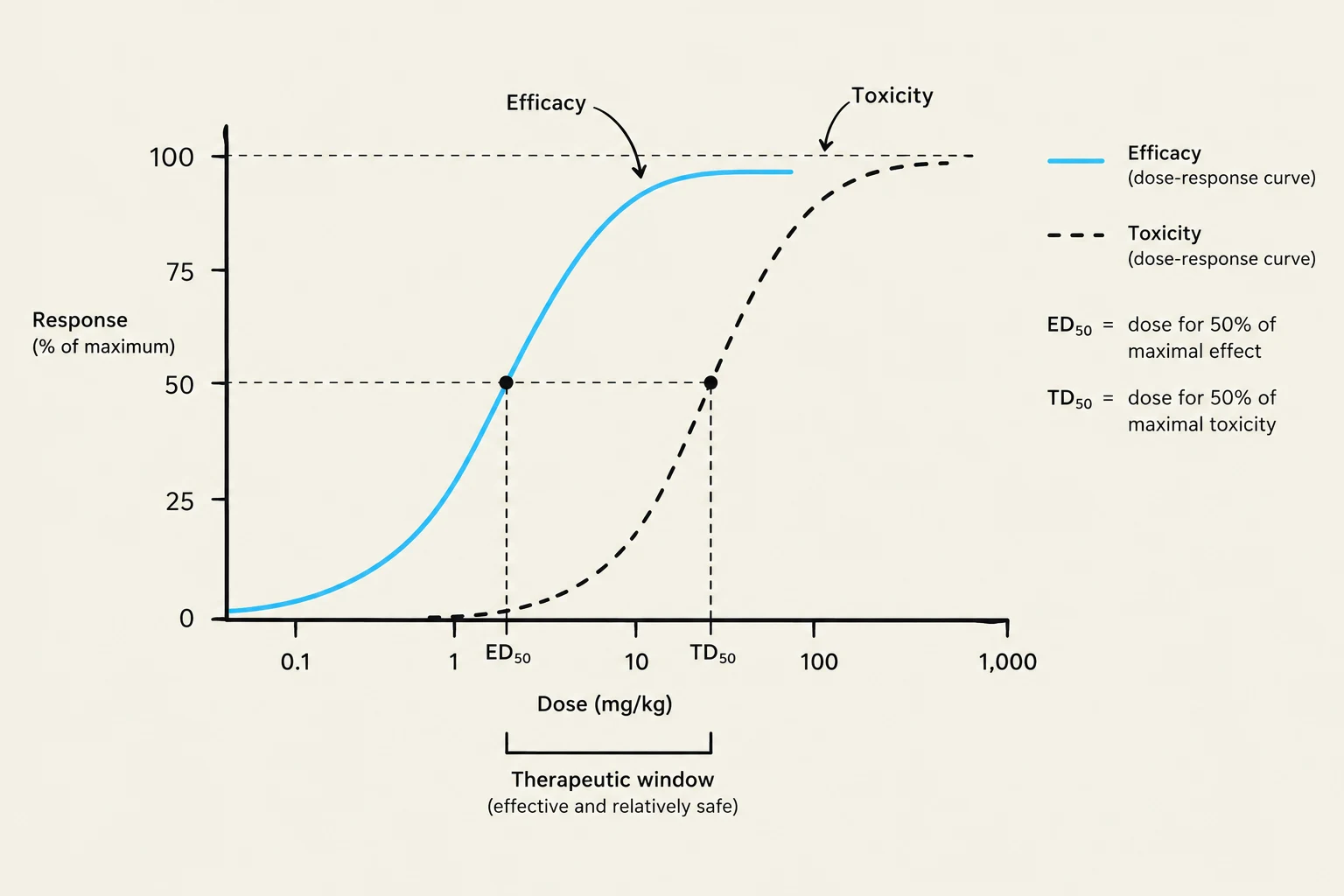
Safety Check: A crucial metric in development is the Therapeutic Index. This is a comparison of the dose that produces a maximum therapeutic effect to the dose that produces toxic effects.
Therapeutic Index=Effective DoseToxic Dose
A high therapeutic index means a large safety margin, making the drug safer for patients.
This graph illustrates the relationship between drug dose and response, showing efficacy and toxicity curves. It defines ED50 as the dose for 50% of maximal effect and TD50 as the dose for 50% of maximal toxicity, highlighting the therapeutic window.
From Lab to Market: Clinical Trials
The final stages of development involve rigorous testing to ensure safety and efficacy in humans:
Preclinical Trials: Testing in cells and animal models to assess toxicity and biological activity.
Phase I Clinical Trials: Testing on a small group of healthy volunteers to evaluate safety and dosage.
Phase II Clinical Trials: Testing on a small group of patients to see if the drug works for the intended disease.
Phase III Clinical Trials: Testing on large groups of patients to confirm efficacy and monitor side effects.
Phase IV: Post-market surveillance once the drug is available to the general public.
Throughout this entire journey, companies must manage patents to protect their intellectual property, which typically lasts for 20 years from the date of filing.
Keep reading for free.
Create an account to finish this reading and make it part of your study routine.