Examines the economic, religious, ideological, and geopolitical factors that propelled the European Age of Exploration from the 15th to the 17th century, including the spice trade, Renaissance Humanism, and the Doctrine of Discovery.
The Age of Exploration, spanning from the 15th to the 17th century, was a transformative era that reshaped the global map. It was not triggered by a single event, but rather by a complex intersection of economic necessity, religious fervor, geopolitical shifts, and a new intellectual landscape. As European powers began to look beyond their continental borders, they sought to establish new trade routes, spread their faith, and assert dominance over rival states, ultimately leading to the expansion of European influence across Africa, the Americas, and the Indian Ocean.
The Economic and Geopolitical Catalyst
By the 15th century, Europe was facing significant economic pressures that made long-distance maritime travel a necessity rather than a luxury.
The Spice Trade and the Ottoman Empire
One of the primary economic drivers was the intense desire for luxury trade goods, most notably spices. At the time, traditional land-based trade routes were becoming increasingly difficult and expensive to navigate. The expansion of the Ottoman Empire acted as a major geopolitical obstacle, pushing European powers to seek alternative maritime routes that could bypass existing middlemen and Ottoman-controlled territories.
The Role of Portugal
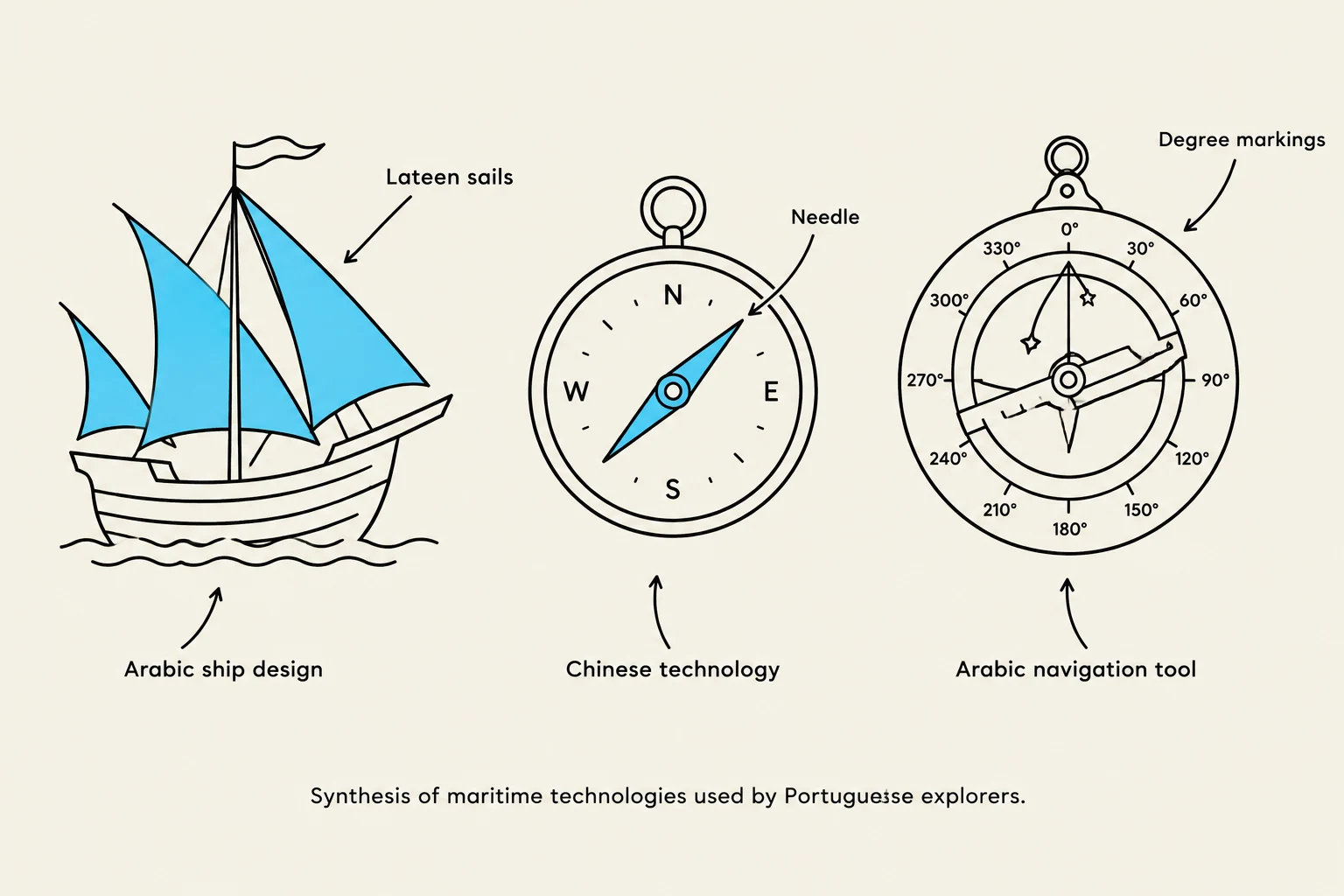
The image illustrates the synthesis of maritime technologies, including Arabic ship design with lateen sails, Chinese compass technology, and an Arabic navigation tool with degree markings, as utilized by Portuguese explorers.
Portugal emerged as the pioneer of this era. Under the influence of Prince Henry the Navigator, Portugal set ambitious goals: creating new trade routes to reach African goods, spreading Christianity, and advancing the science of cartography (map-making).
Portugal's maritime success was built on a combination of borrowed and developed technology:
The Caravel: A ship design developed in Portugal that incorporated elements from Arabic shipbuilders.
The Compass: Technology borrowed from China.
The Astrolabe: An instrument perfected by Arabic sailors.
Through these tools, Portuguese explorers like Vasco da Gama successfully reached Calicut, India, in 1498, becoming the first Europeans to reach India via a sea route. This allowed Portugal to build forts along the Indian coast and dominate the spice trade throughout the 16th century.
Study Tip: When analyzing why Portugal succeeded, remember it wasn't just about bravery; it was about the synthesis of international technologies (Arabic, Chinese, and Portuguese) that allowed for long-distance navigation.
Ideological Shifts: Renaissance Humanism
While economics provided the "why," the intellectual climate of the Renaissance provided the "how" for the European mindset.
Renaissance Humanism represented a shift away from the medieval focus on looking inward for God or focusing solely on the afterlife. Instead, Humanists argued that the ultimate aim of life was to act within the physical world and find God through the study of the world itself. This movement emphasized:
Individual Achievement: The concept of Virtù—the ability to have a significant impact in one's chosen field—became a central ideal.
Discovery: Humanism provided the ideological incentive for exploration by commanding individuals to "discover God's world".
This new focus on human potential and the beauty of the physical world encouraged explorers to seek prestige, wealth, and personal glory.
Religious Motivation and the Doctrine of Discovery
Religion was not merely a side effect of exploration; it was a primary driver. The desire to spread the Christian religion was deeply influenced by the legacy of the Reconquista.
The Catholic Church as a Partner
The Catholic Church played a decisive role in legitimizing European expansion through the Doctrine of Discovery. This was a series of papal bulls (church laws) that provided the legal and moral justification for Christian forces to occupy territories inhabited by non-Christians.
In Africa: In the 1450s, Portugal received permission from the Church to "conquer" Africa with the intent of bringing its people to Christianity.
In the Americas: In 1493, Pope Alexander VI issued the Inter Caetera, which granted Spain title to all discovered and future lands in the Americas.
Dividing the World
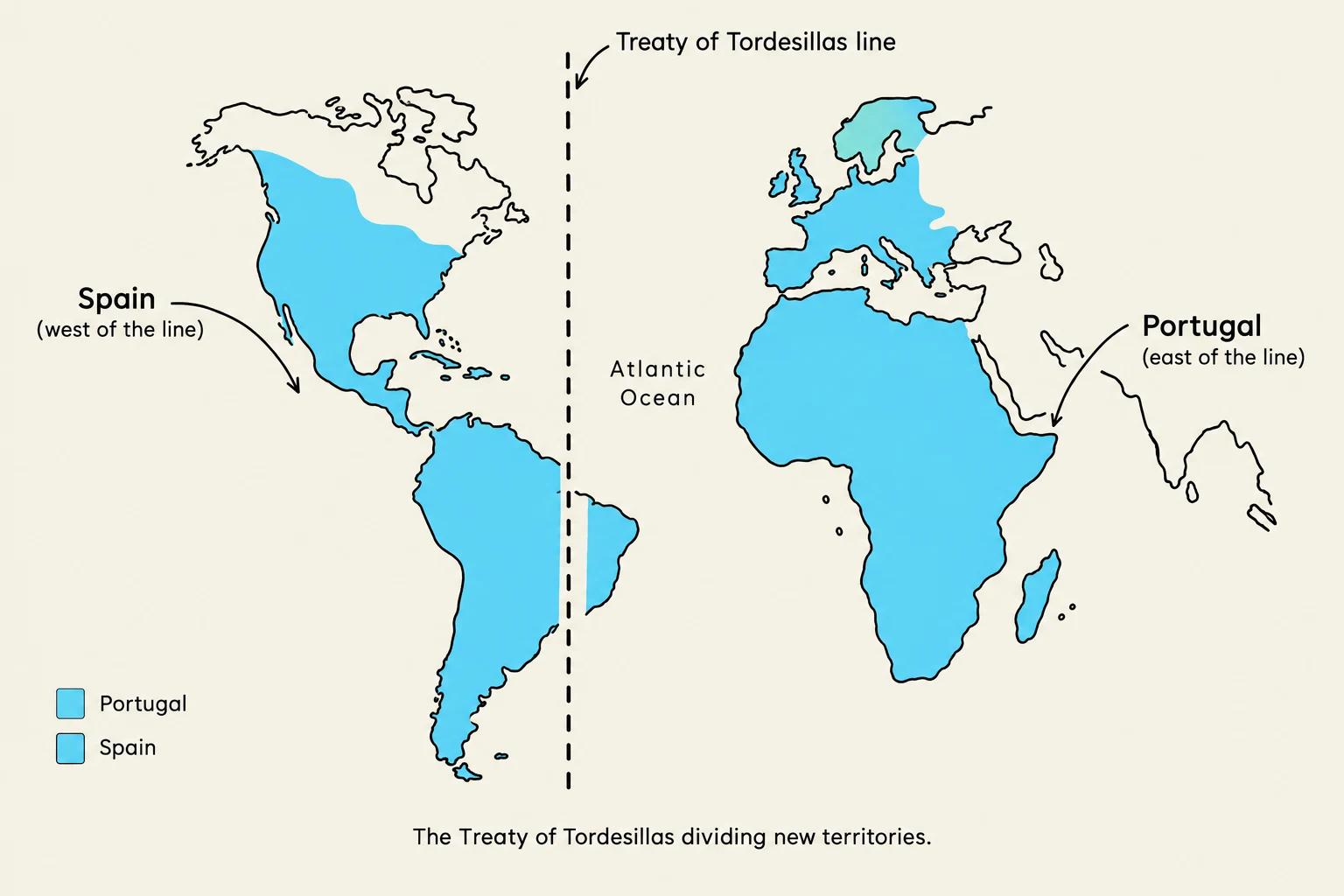
The Treaty of Tordesillas dividing new territories between Spain and Portugal.
This religious endorsement led to significant geopolitical agreements to prevent conflict between the two major Catholic powers. The Inter Caetera drew a line in the Atlantic to divide claims. This was further refined by the Treaty of Tordesillas in 1494, which shifted the division line westward. This treaty had lasting consequences, such as allowing Portugal to claim Brazil.
Critical Thinking Note: The Doctrine of Discovery had devastating consequences for Indigenous populations. By providing a legal framework for colonization, it effectively ignored the rights and claims of Indigenous peoples and laid the groundwork for future practices like residential schools.
The Human Cost: The Atlantic Slave Trade
The expansion of European influence also had a dark and lasting impact on global demographics and social structures. As Portugal and Spain occupied islands off the African coast (such as the Madeira and Canary Islands), they established Europe's first plantation colonies to grow sugar.
To fuel these plantations, Portugal laid the foundations of the Atlantic Slave Trade. By the mid-15th century, tens of thousands of enslaved Africans were being sent to markets in Lisbon annually. This system of forced labor not only shaped the economies of the era but also fundamentally influenced how Europeans would perceive race in the centuries to follow.
Summary of Drivers
To succeed in your studies, categorize the drivers of the Age of Exploration into these four pillars:
Driver Type
Key Factor
Result
Economic
Spice Trade & Ottoman obstacles
Search for new maritime routes
Religious
Reconquista & Spreading Christianity
Use of the Doctrine of Discovery
Ideological
Renaissance Humanism
Focus on Virtù and discovering the world
Geopolitical
State Competition
Treaties like Tordesillas to divide territory
Keep reading for free.
Create an account to finish this reading and make it part of your study routine.