DNA Modification Enzymes and Bacterial Transformation
This article explores the essential enzymes used for DNA manipulation, such as phosphatases, kinases, ligases, and polymerases, and the principles governing bacterial transformation, including chemical methods and electroporation.
In molecular biology, the ability to manipulate DNA at the molecular level is fundamental to cloning, genome editing, and genetic engineering. This process relies on a specialized toolkit of enzymes that can cut, join, modify, or synthesize DNA strands. Once DNA has been modified in a test tube, it must be introduced into a living host—typically bacteria—to be replicated or expressed. This process is known as transformation. This article explores the essential enzymes used for DNA manipulation and the principles governing bacterial transformation.
DNA Modification Enzymes
To perform successful molecular cloning, researchers must precisely control the ends of DNA molecules. Various enzymes are used to add, remove, or repair these termini.
Phosphatases and Kinases
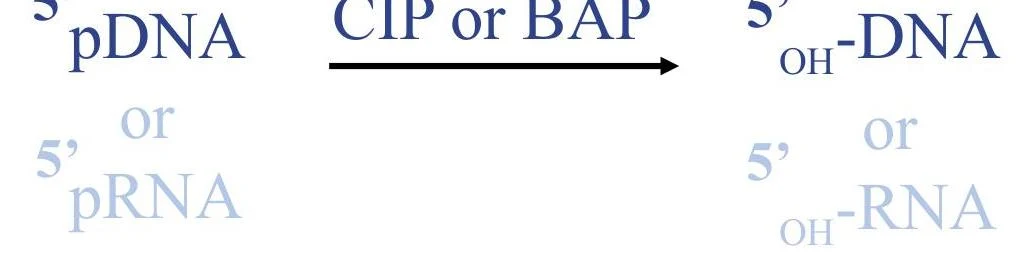
One of the most critical steps in cloning is managing the phosphate groups at the 5' ends of DNA. Alkaline Phosphatase is an enzyme used to remove the terminal 5' phosphate from DNA. This is particularly useful for preventing vector self-religation; if the vector's 5' phosphates are removed, it cannot ligate back to itself without an insert that provides the necessary phosphates. Common versions include:
Calf intestinal alkaline phosphatase (CIP): A flexible enzyme that can be inactivated by heating to 68°C.
Bacterial alkaline phosphatase (BAP).
Conversely, if a researcher needs to add a phosphate group, they use T4 Polynucleotide Kinase. This enzyme catalyzes the transfer of a γ-phosphate from ATP to the 5'-terminus of nucleotides, effectively performing the reverse reaction of a phosphatase. It can be used on DNA, RNA, or synthetic oligonucleotides.
Diagram illustrating the dephosphorylation of DNA or RNA using CIP or BAP enzymes.
Ligases and Polymerases
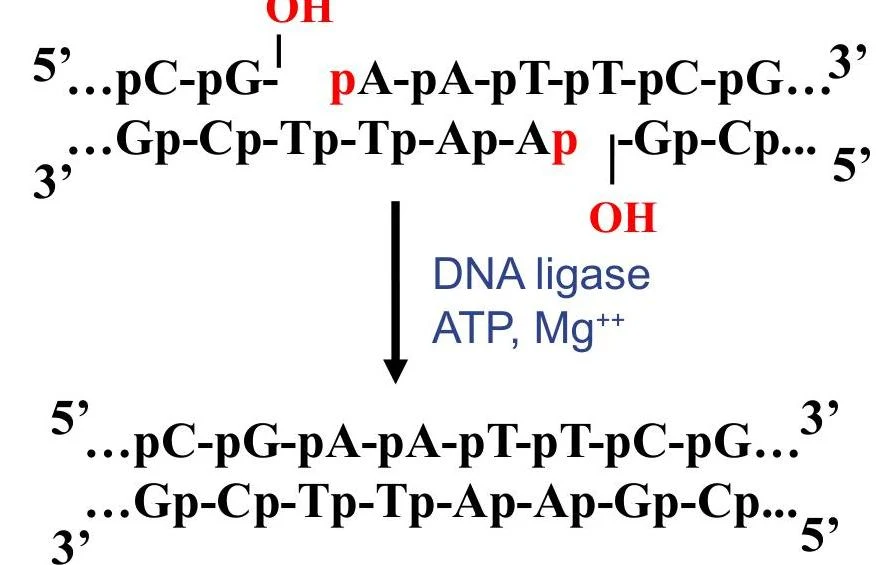
Once the DNA fragments are prepared, they must be joined. T4 DNA Ligase is a single 68 kDa polypeptide derived from T4-infected E. coli that catalyzes the formation of a phosphodiester bond between adjacent 3'-OH and 5'-P termini.
Diagram illustrating DNA ligation by DNA ligase, ATP, and Mg++.
To prepare DNA ends for ligation (such as "filling in" overhangs or "chewing back" ends), polymerases and nucleases are employed:
DNA Polymerases:
Klenow Fragment of DNA polymerase I: A Δ1−323 fragment that lacks 5'-3' exonuclease activity. It is often used to fill in 5' overhangs.
T4 DNA polymerase: Contains both 5'-3' polymerase activity and 3'-5' exonuclease activity.
Nucleases:
Nuclease S1: A single-stranded DNA (ssDNA) exonuclease.
Nuclease Bal31: A double-stranded DNA (dsDNA) exonuclease.
Exonuclease T: A 3'-5' ssDNA exonuclease.
Exonuclease III: A 3'-5' exonuclease.
Finally, Reverse transcriptase is used to synthesize DNA from an RNA template.
Principles of Bacterial Transformation
Transformation is a form of horizontal gene transfer where exogenous genetic material is taken up and incorporated into a bacterium. While bacteria can undergo transformation via conjugation (direct contact) or transduction (via bacteriophages), transformation specifically refers to the direct uptake of DNA through the cell membrane.
For transformation to be successful in laboratory strains like E. coli, the recipient cells must be in a state of competence. This state can occur naturally due to environmental stressors like starvation, but in the lab, it is induced via chemical or physical methods.
Transformation Methods
There are several ways to induce competence in E. coli:
Chemical Transformation: The most common method involves treating cells with calcium chloride (CaCl2) to make them competent. This is followed by a "heat shock" (typically 42∘C for 45 seconds) to encourage DNA uptake.
Electroporation: This method uses high-voltage electrical pulses to create temporary pores in the cell membrane. It is highly efficient but requires specialized equipment and the removal of all metal ions from the suspension to prevent arcing.
Method
Efficiency (transformants/μg)
Simple
Stockable
Requires Equipment
CaCl2
105−6
Yes
No*
No
HACo3+
108
No
Yes
No
DMSO
107−8
Yes
Yes
No
Electroporation
108−10
Yes/No
Yes
Yes
Note on Stocking: If you wish to keep frozen stocks of competent cells, you must add glycerol (to 10%) or DMSO (to 5%) to protect the cells during freezing.
Calculating Transformation Efficiency
Transformation efficiency is a measure of how many cells are successfully transformed per microgram of DNA used. To calculate this, you need the amount of DNA used, the final volume of the cell suspension, the volume plated, and the number of colonies observed.
The formula is:
Transformation efficiency: μg of DNA# of transformants×Vol plated (mL)Final volume (mL)=μg of DNA# of transformants
Advanced Genome Modification: Meganucleases and Beyond
Beyond simple cloning, modern biotechnology uses engineered enzymes to target specific sequences within a genome.
Meganucleases (Homing Nucleases)
Meganucleases are rare-cutting enzymes that recognize long DNA sequences (typically 18-30 base pairs). Because they recognize such long sequences, they are highly specific. Examples include I-SceI and I-CreI. These can be engineered to recognize custom sequences for precise genome modification.
Zinc-Finger and TAL Effectors
To achieve even greater precision, researchers have developed fusion proteins:
Zinc-Finger Nucleases (ZFNs): These consist of a zinc-finger protein (which provides sequence-specific binding) fused to an endonuclease like FokI.
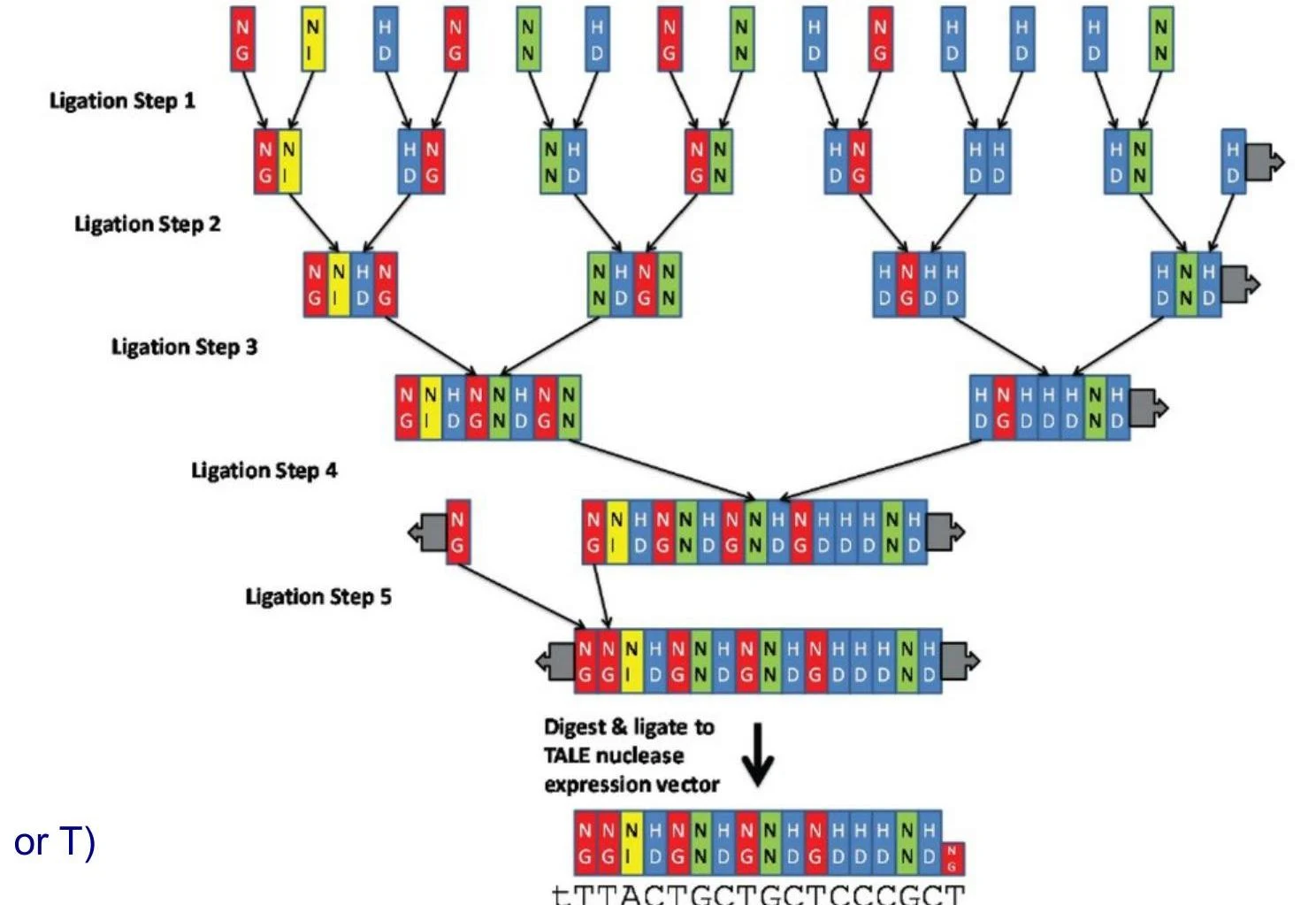
Transcription Activator-Like Effectors (TALEs): Derived from Xanthomonas bacteria, these proteins use "Repeat Variable Diresidues" (RVDs) to recognize specific nucleotides. For example, the RVD "NI" recognizes Adenine (A), while "HD" recognizes Cytosine (C).
Diagram illustrating the stepwise ligation process to construct a TALE nuclease expression vector, showing the assembly of DNA segments.
These tools represent the evolution from simple DNA "cutting and pasting" to sophisticated, programmable genome editing.
Keep reading for free.
Create an account to finish this reading and make it part of your study routine.