DNA Ligation and Molar Ratio Calculations in Molecular Cloning
Learn the principles of DNA ligation, including single, blunt, and double digests. This guide explains how to calculate the insert to vector molar ratio and determine reagent volumes for successful molecular cloning experiments.
In the workflow of bacterial cloning, restriction digestion is only the beginning. Once you have used restriction enzymes to cut your plasmid and your DNA of interest (the insert) at specific palindromic sequences, you must physically join them together. This process is known as ligation. Ligation uses the enzyme DNA ligase to catalyze the formation of phosphodiester bonds between the DNA fragments, effectively "pasting" the insert into the vector.
Success in ligation depends on two main factors: the compatibility of the DNA ends produced during digestion and the precise mathematical balance between the amount of insert and the amount of vector used in the reaction.
Types of Ligation: Single, Blunt, and Double Digests
The method of ligation is dictated by the type of ends created during the preceding restriction digest step.
Single and Blunt End Ligation
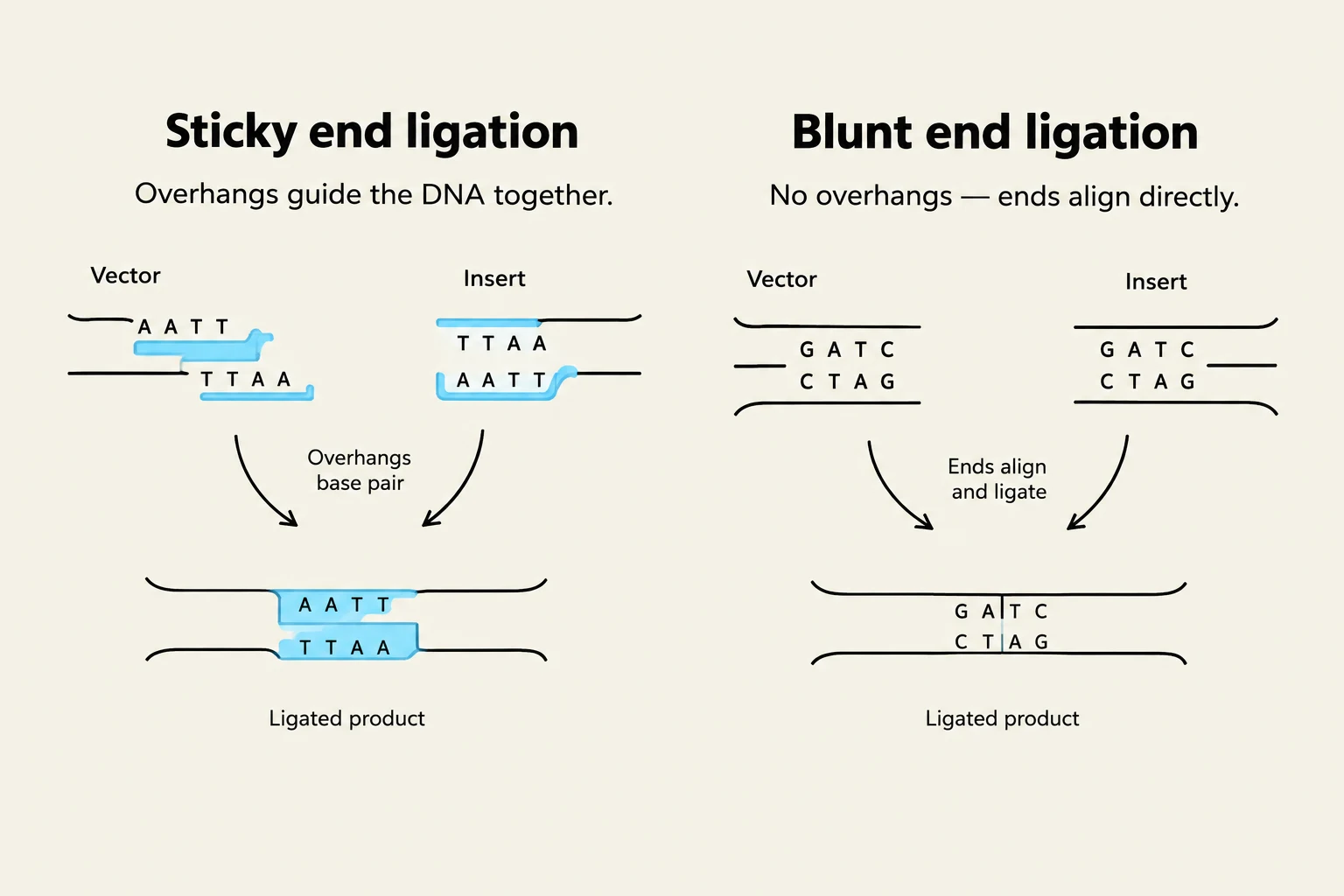
If a plasmid is cut with a single restriction enzyme that produces sticky ends (short, single-stranded overhangs), the ligation is relatively efficient because the overhangs can hydrogen-bond to one another. However, if the digestion results in blunt ends (straight cuts with no overhangs), the ligation is generally more difficult because there is no base-pairing to help hold the two DNA molecules together long enough for the ligase to act.
Double Digest Ligation
In many cloning strategies, two different restriction enzymes are used to cut the plasmid at the Multiple Cloning Site (MCS). This is known as a double digest. Double digests are highly advantageous because they create two different, non-compatible sticky ends. This prevents the plasmid from simply re-ligating to itself without an insert and ensures that the insert is integrated in the correct orientation.
Diagrams illustrating sticky end ligation and blunt end ligation in DNA.
Calculating the Insert to Vector Molar Ratio
One of the most common mistakes in cloning is adding too much or too little insert. Because DNA molecules vary in size, we cannot simply use a 1:1 mass ratio (e.g., 50 ng of vector and 50 ng of insert). Instead, we must use a molar ratio.
A molar ratio represents the number of molecules of insert relative to the number of molecules of vector. Because a larger piece of DNA weighs more than a smaller piece of DNA of the same molarity, we must "normalize" our masses based on their molecular weights (sizes in base pairs).
A standard starting point for most cloning experiments is a 3:1 molar ratio (three molecules of insert for every one molecule of vector). While this ratio may need optimization for specific projects, it provides the highest probability of a successful collision between the insert and the vector.
The Molar Ratio Calculation
To determine how much mass of insert you need to achieve a specific molar ratio, you must use the following relationship:
ng of insert=ng of vector⋅(kb of vectorkb of insert)⋅(1molar ratio)
Exam Tip: Always remember that the "size" used in these calculations refers to the length of the DNA in kilobases (kb) or base pairs (bp). If you are using a 3:1 ratio, you are aiming for three times as many molecules of insert as vector, not three times the weight.
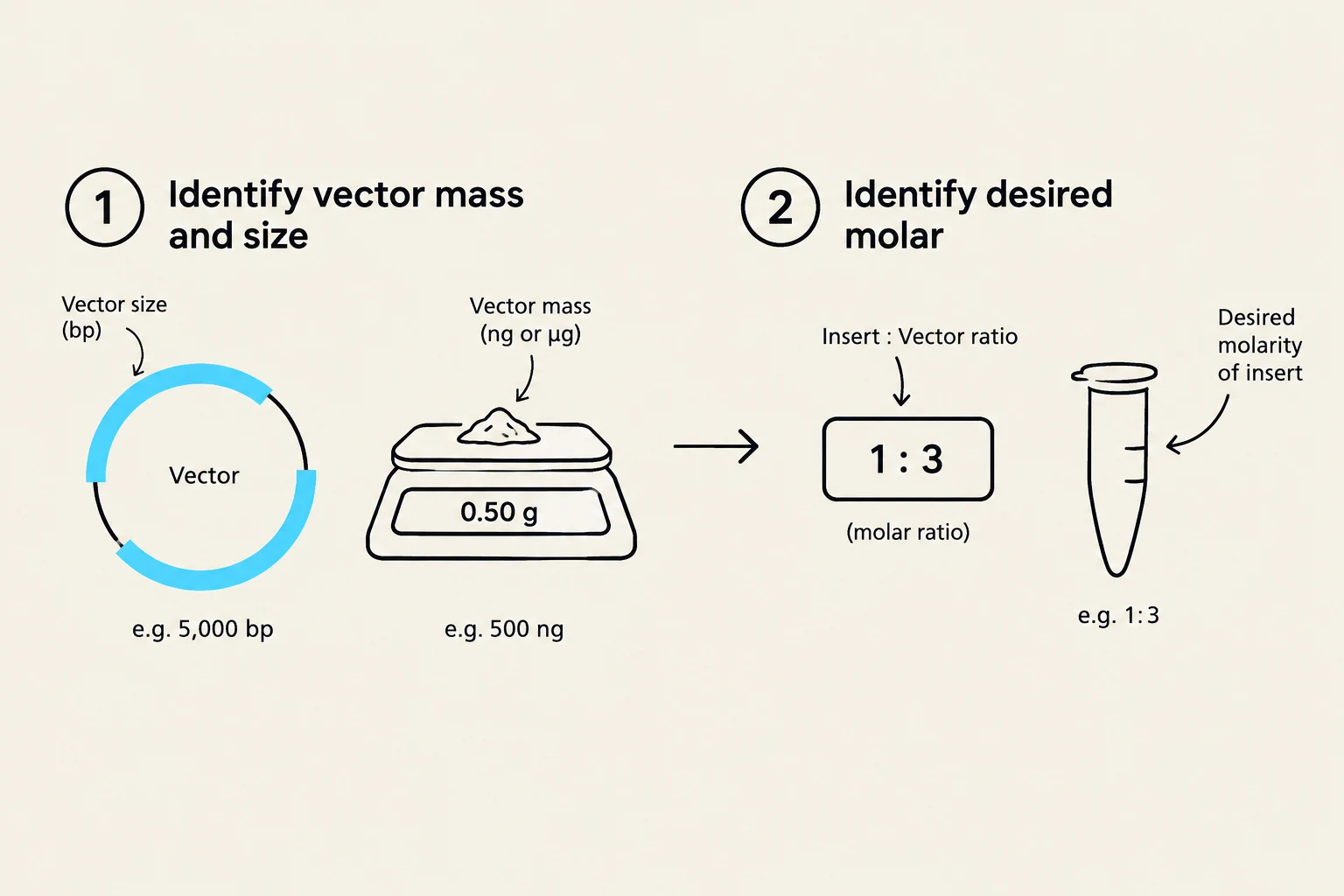
This diagram illustrates the steps for identifying vector mass and size, and determining the desired molar ratio for an experiment, likely in molecular biology or genetic engineering.
Preparing the Ligation Reaction
Once you have calculated the required mass of your insert, you must prepare the reaction tube. In a laboratory setting, ligation reagents are typically added directly to the tube containing your digested plasmid (the Restriction Digest or "RD" tube).
Determining Reagent Volumes
When filling out a ligation protocol, you must calculate several distinct volumes to reach a final target volume (often 20 µL):
Vector Volume: This is the volume of the digested plasmid already present in your RD tube. If you need 50 ng and your plasmid is 25 ng/µL, you would use 2 µL.
Insert Volume: This is calculated based on your molar ratio math. Note that if your insert is in a different buffer (like TE), you must account for that volume.
Buffer Volume: Ligation buffers are often supplied at a concentrated 5X concentration. To ensure the final reaction is at the correct 1X concentration, you must calculate the volume based on the total reaction volume.
Volume of Buffer=Buffer ConcentrationTotal Reaction Volume
Ligase Volume: This is a fixed amount defined by the manufacturer's protocol.
dH2O Volume: This is the "filler" volume. You calculate this last to ensure the total volume reaches your target (e.g., 20 µL).
Summary Table for Protocol Preparation
When setting up your experiment, it is helpful to organize your values before pipetting.
Component
Source of Value
Calculation Method
Vector
Digested Plasmid
ConcentrationDesired Mass
Insert
Prepared Insert
Molar Ratio Formula
Buffer
5X Ligation Buffer
5Total Volume
Ligase
Manufacturer Protocol
Fixed Volume
dH2O
N/A
Total Volume−(Sum of all other volumes)
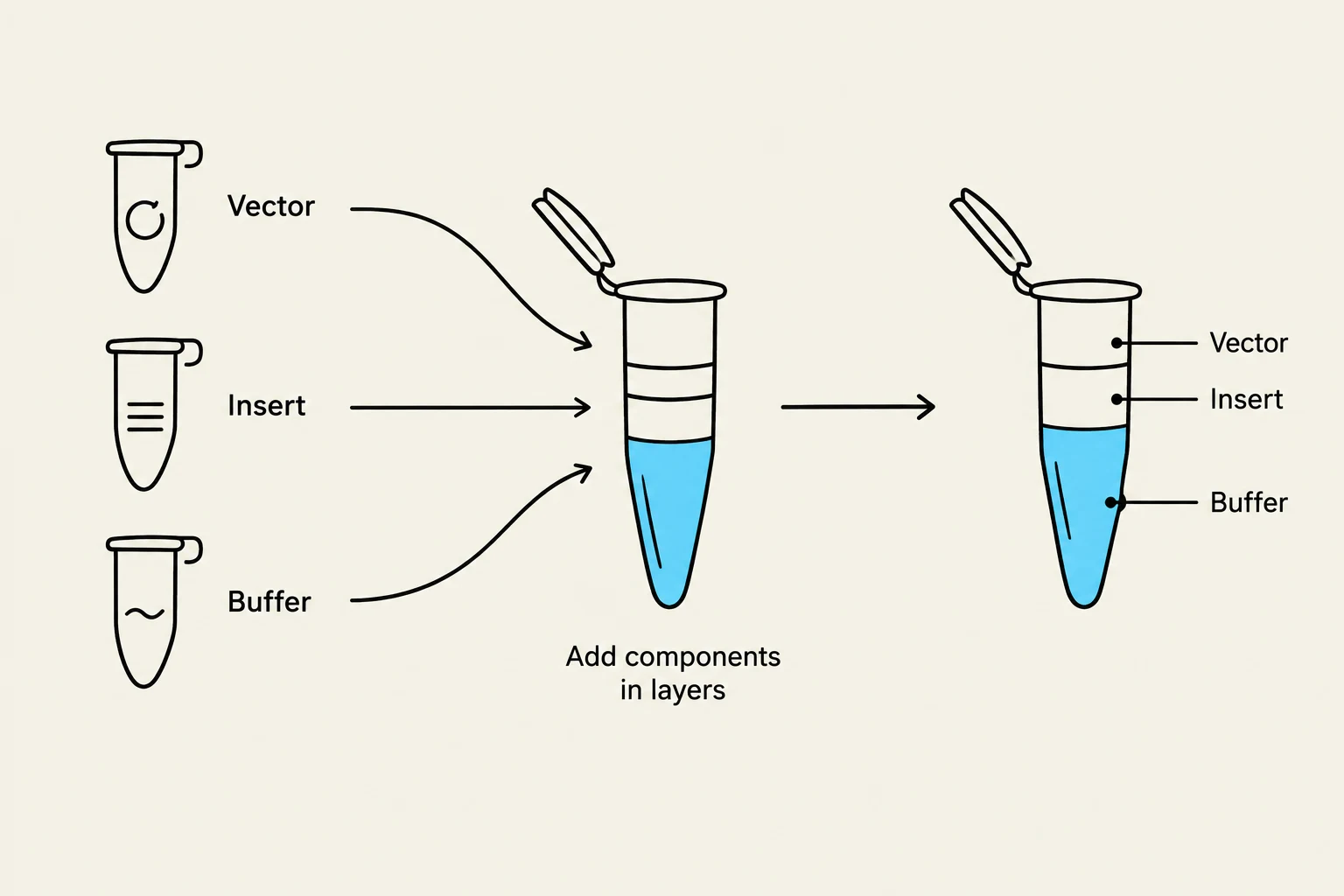
Diagram illustrating the layering of vector, insert, and buffer components into a tube.
Experimental Controls
To ensure your results are valid, you must include technical controls in your experiment:
Sample of Interest (SOI): The reaction containing both the digested plasmid and the insert.
Ligation Technical Control: A reaction used to verify that the ligase enzyme and buffer are actually working.
Transformation Technical Control: A reaction used to verify that your bacteria are capable of taking up DNA.
By following these precise calculations and including the necessary controls, you can maximize the efficiency of your cloning attempts.
Keep reading for free.
Create an account to finish this reading and make it part of your study routine.