


DNA (Deoxyribonucleic acid) is the fundamental hereditary material of life. It is characterized by its remarkable stability, its ability to replicate information with high accuracy, and its capacity for low-level mutations that drive evolutionary change. To understand how life functions, we must look at DNA across multiple levels of organization: from the chemical composition of a single nucleotide to the massive, complex packaging of chromosomes within a eukaryotic nucleus.
The Building Blocks: Nucleotides and Monomers
The basic unit of DNA is the nucleotide. Each nucleotide is a monomer consisting of three essential components:
- A phosphate group.
- A deoxyribose sugar (a five-carbon sugar).
- A nitrogenous base.
The nitrogenous bases are categorized into two groups based on their chemical ring structure: purines, which have a double-ring structure (Adenine and Guanine), and pyrimidines, which have a single-ring structure (Cytosine and Thymine).
Individual nucleotides are linked together by phosphodiester linkages to form a continuous sugar-phosphate backbone. This backbone gives the DNA strand a distinct directionality based on the carbon numbering of the deoxyribose sugar. The 5’ end of a strand terminates with a phosphate group, while the 3’ end terminates with a hydroxyl (-OH) group.
Exam Tip: When studying DNA synthesis, remember that new nucleotides are always added to the 3' end. This means DNA synthesis always proceeds in a 5' to 3' direction.
The Double Helix and Alternative Forms
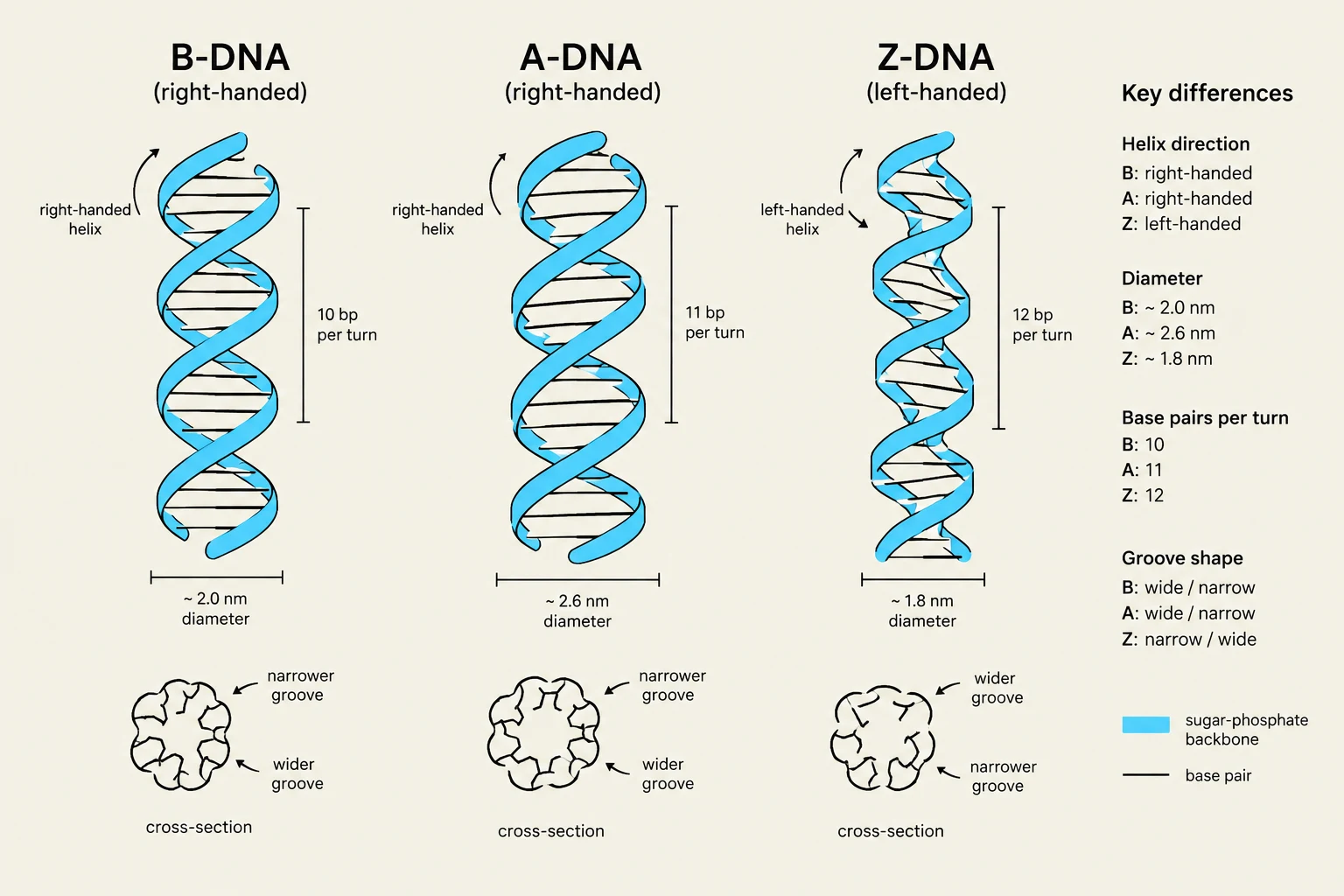
In its secondary structure, DNA typically forms a double helix consisting of two antiparallel strands. "Antiparallel" means that if one strand runs in the 5' to 3' direction, its partner runs in the 3' to 5' direction. The helix is held together by two primary forces: hydrogen bonding between complementary nitrogenous bases (the "rungs" of the ladder) and base-stacking (pi-stacking) interactions between the aromatic rings of the bases, which helps minimize contact with water.
Keep reading for free.
Create an account to finish this reading and make it part of your study routine.
Continue reading freeAlready have an account? Log in
Updated