Divided Attention and Automaticity: The Science of Multitasking
Explores the cognitive psychology behind multitasking, distinguishing between controlled and automatic processing, and the implications for attention and inattention blindness, particularly in contexts like driving.
Have you ever wondered how you can hold a conversation with a friend while simultaneously driving a car down a familiar route? To most, it feels like you are doing two things at once without much effort. However, cognitive psychology suggests that we aren't actually "splitting" our consciousness in the way we think; rather, we are leveraging different levels of cognitive processing. Understanding the relationship between divided attention and automaticity is crucial, not just for academic success, but for understanding the life-threatening risks of inattention in high-stakes environments like driving.
The Spectrum of Processing: Controlled vs. Automatic
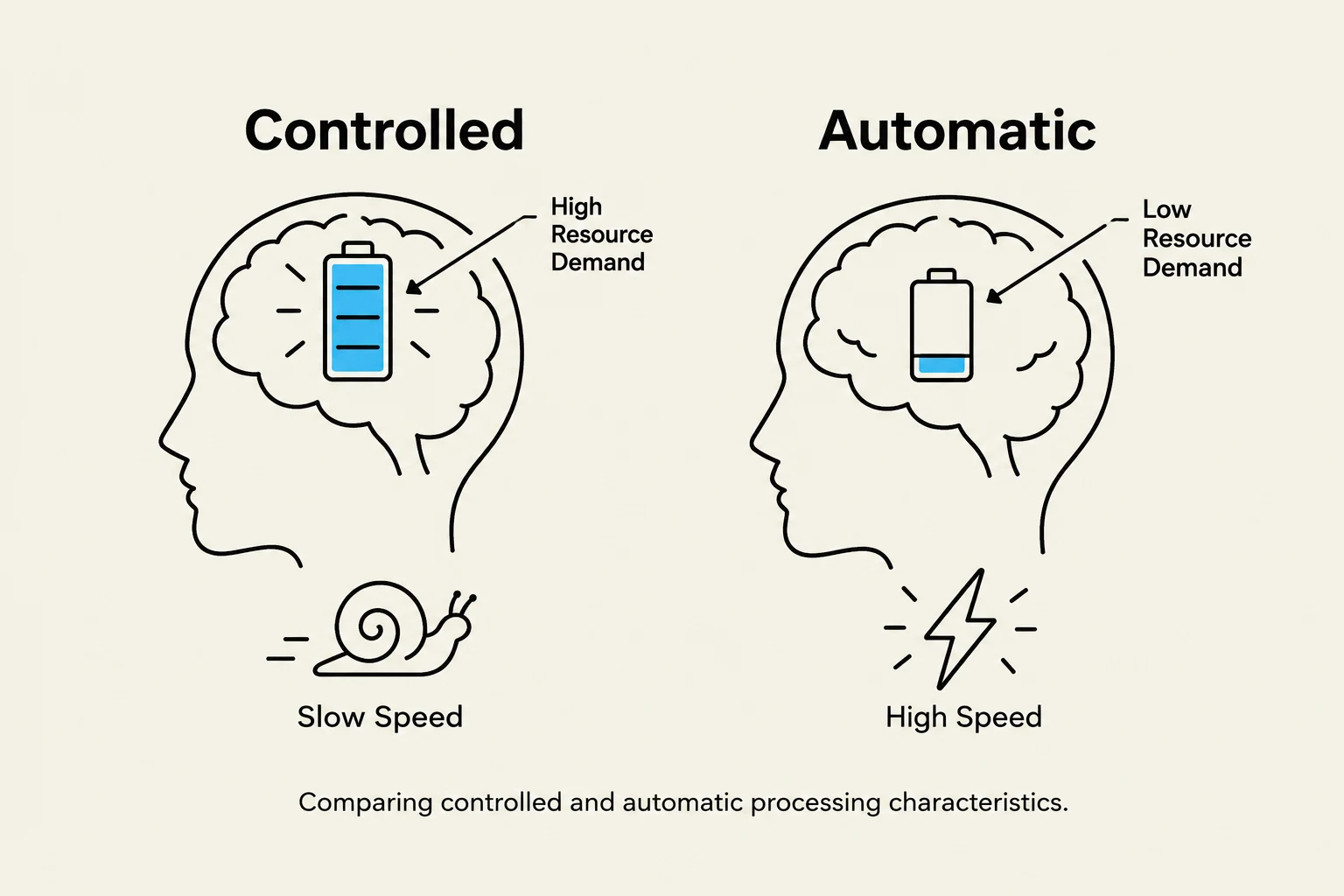
This illustration compares controlled and automatic processing characteristics, showing that controlled processing requires high resource demand and results in slow speed, while automatic processing has low resource demand and high speed.
To understand why some tasks can be performed simultaneously while others cause a total cognitive breakdown, we must distinguish between two primary modes of mental processing: controlled processing and automatic processing.
Controlled Processing
Controlled processing refers to mental activities that require conscious, deliberate effort. When you encounter a task that is new, complex, or difficult, your brain engages in controlled processing. This mode is characterized by:
High Resource Demand: It consumes a significant amount of working memory and cognitive energy.
Slow Speed: Because the brain must carefully evaluate rules and patterns, these tasks cannot be done quickly.
Limited Capacity: You can only perform one highly demanding controlled task at a time before performance on either task begins to degrade.
Automatic Processing
In contrast, automatic processing occurs when a task has been practiced so extensively that it requires little to no conscious oversight. Think of reading words on a page; you don't "sound out" every letter anymore—you simply see the word and know its meaning. Characteristics include:
Low Resource Demand: It uses very little of your active working memory.
High Speed: These processes happen almost instantaneously.
Involuntary Nature: Once the stimulus is present, the process often triggers without you "deciding" to do it.
Exam Tip: If a question asks why a person can perform two tasks at once, look for the presence of automaticity. Multitasking is generally only possible when one task is automatic and the other is controlled, or when both tasks are automatic and do not compete for the same cognitive resources.
The Mechanics of Divided Attention
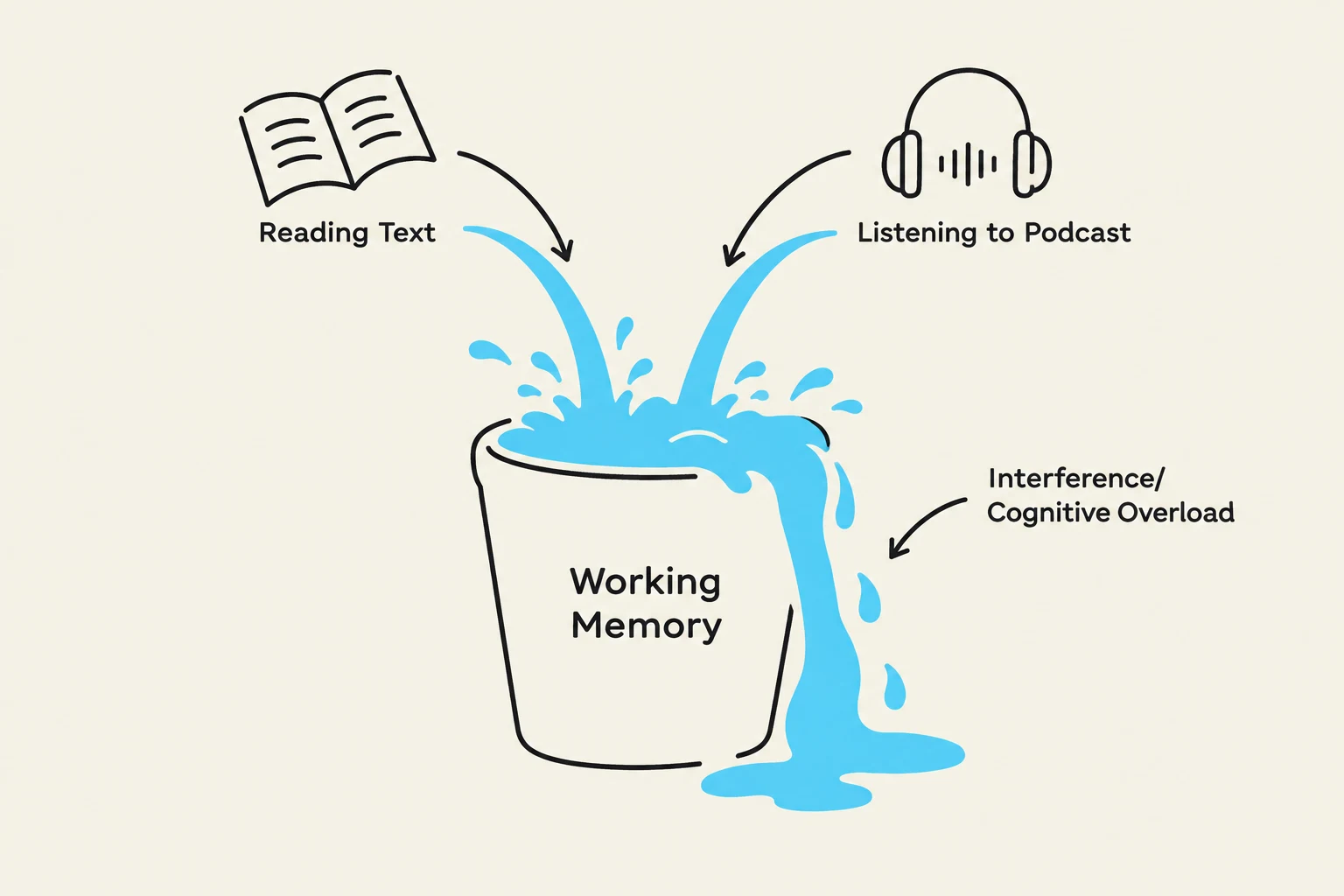
This diagram illustrates how reading text and listening to podcasts can lead to interference or cognitive overload in working memory, causing information to overflow.
Divided attention is the ability to distribute cognitive resources across multiple tasks or multiple aspects of a single task. The success of divided attention depends heavily on the "load" placed on the individual.
When tasks are "compatible," they can be managed together. For example, walking and talking are compatible because walking becomes an automatic process for most adults, leaving the controlled processing capacity free to handle the nuances of conversation.
However, when two tasks require the same type of cognitive resource—such as two tasks that both require verbal processing—we encounter interference. This is why you cannot easily read a book while listening to a podcast with heavy dialogue; both tasks are competing for the same "verbal" slot in your working memory.
Worked Example: The Driving Scenario
Consider a driver navigating a busy intersection:
Scenario A (Automatic): The driver is on a straight, empty highway they have driven a thousand times. Steering and maintaining speed have become automatic. They can listen to a podcast (controlled/automatic) with minimal risk.
Scenario B (Controlled): The driver enters a construction zone with new lane markings and heavy pedestrian traffic. Suddenly, driving is no longer automatic; it requires intense, controlled processing. If the driver tries to continue a complex phone conversation, their performance on both driving and talking will plummet.
The Dangers of Inattention: The "Automaticity Trap"
This illustration depicts the difference in response time between automatic and controlled driving modes when an obstacle appears. The "Response Lag" indicates the delay in reaction.
While automaticity is a survival mechanism that allows us to function efficiently, it creates a dangerous phenomenon known as "inattention blindness" or "cognitive tunneling" in high-stakes environments.
The Illusion of Competence
The greatest danger in driving is the false sense of security provided by automaticity. Because a driver can steer, brake, and accelerate without "thinking" about it, they may believe they have ample mental capacity to engage in other activities, such as texting or eating.
However, driving is not a static task. It is a dynamic environment that constantly shifts from automatic to controlled processing. A sudden obstacle (a child running into the street or a car braking ahead) requires an immediate shift to controlled processing. If the driver's cognitive resources are currently tied up in a secondary task (like a complex conversation or a mobile device), they will experience a response lag. This delay in shifting from automatic to controlled mode is often the difference between a near-miss and a fatal accident.
Summary Table: Task Comparison
Feature
Controlled Processing
Automatic Processing
Effort
High / Conscious
Low / Unconscious
Speed
Slow
Fast
Capacity
Limited
Virtually Unlimited
Error Rate
Low (if focused)
High (if interrupted)
Example
Learning to drive
Driving a familiar route
Conclusion
Multitasking is a misnomer; we are actually switching between tasks or utilizing different processing modes. While automaticity allows us to navigate the world with efficiency, it also masks the true cognitive load we are under. By recognizing when a task requires controlled processing, we can better manage our attention and avoid the catastrophic errors that occur when our mental resources are spread too thin.
Keep reading for free.
Create an account to finish this reading and make it part of your study routine.