This content explains the physiological mechanisms of thermoregulation and sleep, detailing various disorders related to body temperature imbalances and disruptions in sleep cycles.
Maintaining a stable internal environment is a fundamental requirement for human survival. The body must constantly balance the production of heat with its dissipation to maintain a core temperature within a narrow, healthy range. When this balance is disrupted—either by environmental extremes, metabolic changes, or pharmacological interventions—the result can range from mild discomfort to life-threatening emergencies. Similarly, the brain must transition through highly regulated cycles of sleep to ensure cognitive and physiological recovery.
The Physiology of Thermoregulation
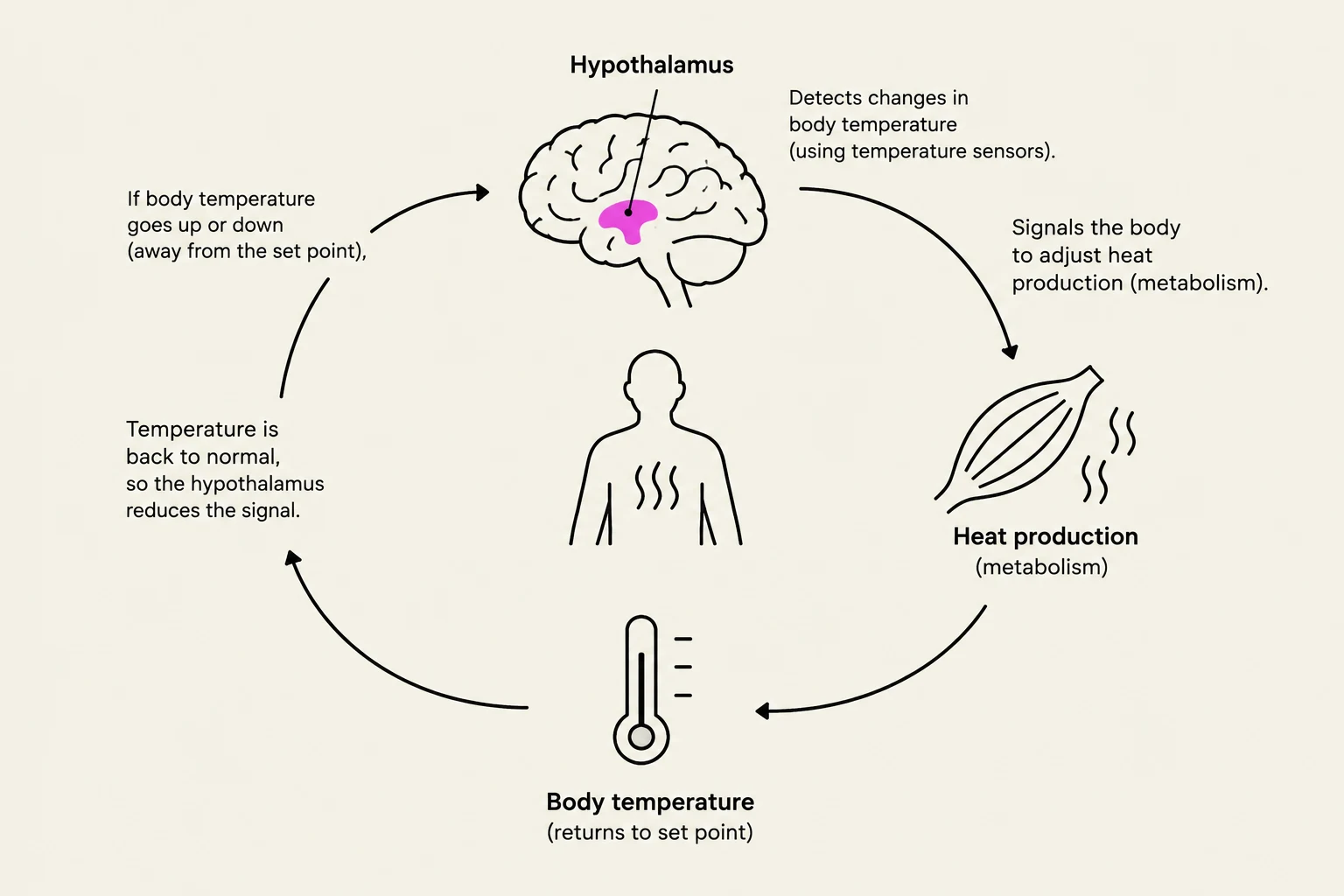
The body's "internal thermostat" is located in the anterior hypothalamus. Specifically, the pre-optic nuclei within this region sense the temperature of the blood and integrate this information with sensory input from temperature receptors in the skin.
Heat Production and Loss
Heat is produced through several mechanisms, including:
Metabolism: The basal metabolic rate and the conversion of food into energy (ATP).
Endocrine Influence: Hormones such as thyroxine.
Adrenergic Influence: The release of epinephrine.
Skeletal Muscle Activity: Such as shivering to generate heat.
To prevent overheating, the body utilizes various mechanisms of heat loss:
Convection: Heat loss via air or water movement (e.g., wind exposure).
Conduction: Direct contact with cold surfaces or immersion in cold water.
Radiation: Heat loss through vasodilation.
Evaporation: Heat loss through perspiration and respiration.
This diagram illustrates the role of the hypothalamus in regulating body temperature through feedback mechanisms involving heat production and detection of temperature changes.
Disorders of Thermal Regulation
Thermal disorders arise when there is an imbalance between heat production and dissipation.
Fever vs. Hyperthermia
It is clinically vital to distinguish between fever and hyperthermia, as their underlying mechanisms are fundamentally different.
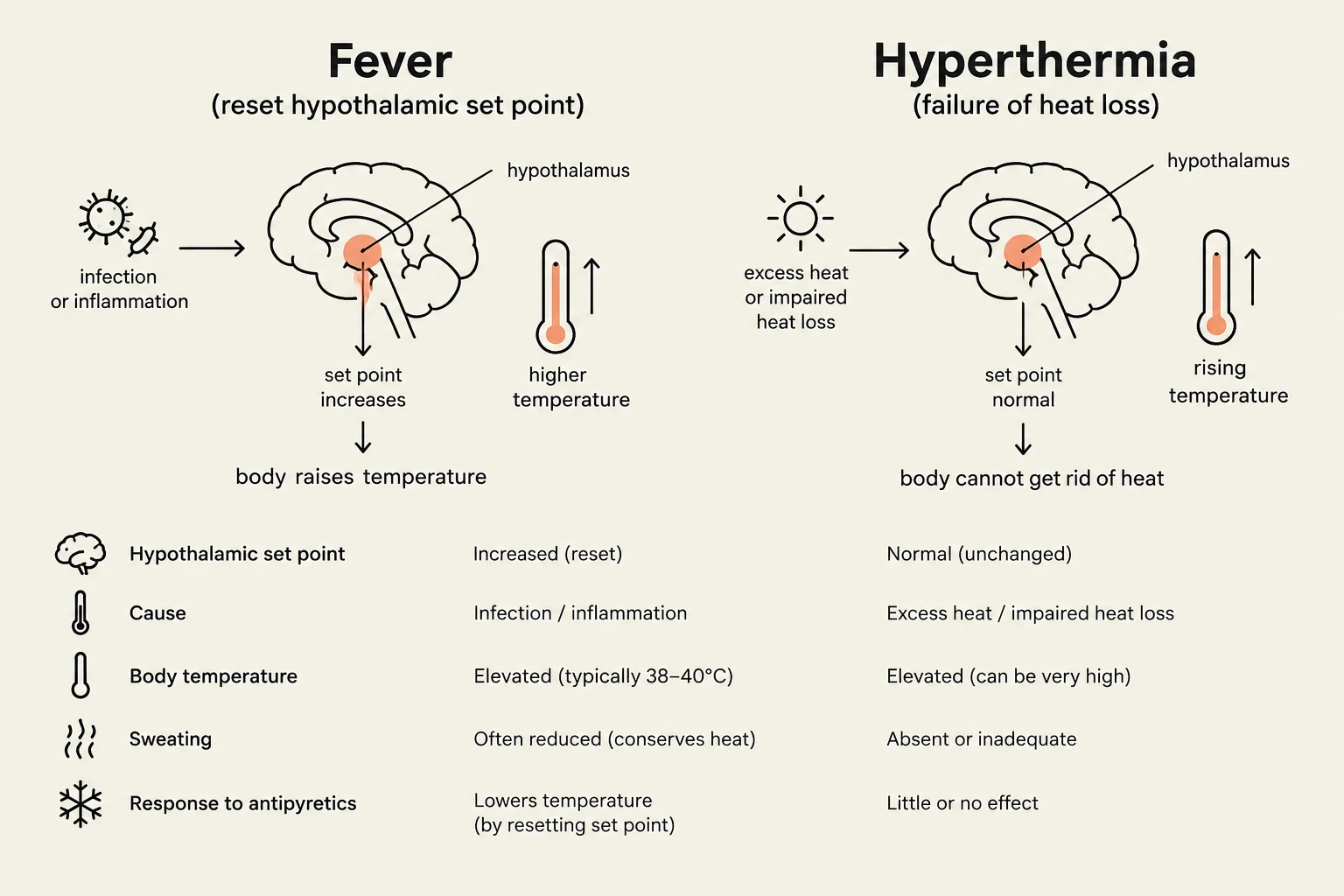
Fever: This is a regulated increase in body temperature. It occurs when pyrogens trigger the hypothalamus to "reset" its set point to a higher level. The body then actively works to reach this new set point through increased metabolic rate and shivering.
Hyperthermia: Unlike fever, the hypothalamic set point is not reset. Hyperthermia occurs when heat production or environmental absorption exceeds the body's ability to dissipate it.
Exam Tip: If a patient has a high temperature but the hypothalamus is functioning normally, it is hyperthermia. If the hypothalamus has intentionally raised the "target" temperature, it is a fever.
Clinical Manifestations of Hyperthermia
Hyperthermia can present in several stages:
Heat Syncope: Fainting caused by peripheral vasodilation in hot conditions.
Heat Cramps: Muscle cramping often linked to electrolyte imbalances like hyponatremia.
Heat Exhaustion: Characterized by fatigue, weakness, and dizziness due to dehydration and vasodilation.
Heat Stroke: A medical emergency involving rapid cardiovascular and cerebral collapse, with core temperatures exceeding 104.9∘F (40.5∘C). Symptoms include delirium, lethargy, and coma.
Drug-Induced Hyperthermia
Certain medications can trigger dangerous temperature spikes:
Malignant Hyperthermia: A genetic abnormality of the skeletal muscle sarcoplasmic reticulum triggered by volatile anesthetics. It causes massive intracellular calcium shifts, leading to uncoordinated muscle contractions and lactic acidosis. It is treated with dantrolene.
Neuroleptic Malignant Syndrome (NMS): Associated with antipsychotic use or the withdrawal of dopaminergic agents. It is thought to result from dopamine D2 receptor antagonism.
Serotonin Syndrome: Caused by excessive serotonin accumulation, often from SSRIs. Management involves removing the causative agent.
Hypothermia
Hypothermia is defined as a core body temperature below 95∘F (35∘C).
Primary Hypothermia: The thermoregulatory responses are intact, but the body is overwhelmed by extreme cold.
Secondary Hypothermia: The thermoregulatory mechanisms are impaired, making the individual unable to compensate for even mild cold. This is common in the elderly or those with chronic disease.
Severe hypothermia (82.4–86∘F) leads to the cessation of shivering, a 50% decrease in basal metabolic rate, and profound bradyarrhythmias. Extreme cases (below 82.4∘F) may present with an apparent absence of life signs, including apnea and nonreactive pupils.
This diagram illustrates the physiological differences between fever and hyperthermia, focusing on the role of the hypothalamus and heat regulation mechanisms.
Normal Phases of Sleep
Sleep is not a uniform state but a series of distinct cycles involving different neurological processes and neurotransmitters.
Non-REM Sleep
Non-REM sleep accounts for approximately 75–80% of the sleep cycle and is divided into stages I through IV. This phase is characterized by:
The withdrawal of neurotransmitters from the reticular formation.
Inhibition of arousal mechanisms in the cerebral cortex.
Physiological depression, including decreased cerebral blood flow and the release of growth hormone during Stage IV.
Key Neurotransmitters: Serotonin, tryptophan, GABA, and melatonin.
REM Sleep
REM (Rapid Eye Movement) sleep, also known as "paradoxical sleep," accounts for 20–25% of the cycle. Despite the body being in a state of rest, the brain shows high activity. Characteristics include:
Increased cerebral blood flow and brain activity.
Variable changes in vital signs due to increased catecholamine release.
Short bursts of steroid release.
Key Neurotransmitters: Glutamate and acetylcholine.
Summary of Sleep Disorders
While the cycles above represent normal physiology, several disorders can disrupt these patterns:
Insomnia: Difficulty initiating or maintaining sleep.
Sleep Apnea: Interruption of breathing, which can be central (respiratory center failure) or obstructive (physical airway blockage).
Parasomnias: Undesirable physical phenomena like sleepwalking (somnambulism) or night terrors.
Keep reading for free.
Create an account to finish this reading and make it part of your study routine.