Explore the key dimensions of organizational culture, including its role as a behavioral compass, its impact on decision-making (autonomy vs. hierarchy), and the orientation towards individuals versus teams.
Imagine walking into a large corporation. There are no written rules posted on the walls telling you whether to shout greetings across the hall or whisper in the corridors, yet everyone seems to know exactly how to behave. This "unwritten rulebook" is what we call organizational culture. Rather than being a static set of values, culture acts as a psychological compass, guiding employee behavior, shaping how decisions are made, and defining the very nature of work life.
Understanding the dimensions of culture is essential for leaders and students of management alike, as these dimensions dictate whether an organization thrives through innovation or maintains stability through strict adherence to protocol.
Culture as a Behavioral Compass
Organizational culture is often described as the "shared values, beliefs, and norms" that influence how employees perceive, think, and react to various situations. It serves as a compass because it provides a sense of direction even in the absence of direct supervision. When an employee faces a dilemma that isn't covered in the employee handbook, they look to the culture to decide the "right" way to act.
For example, in a culture that prizes "customer obsession," an employee might go out of their way to solve a client's problem at a high cost to the company, knowing that their leadership will reward the outcome rather than punish the expense. Conversely, in a culture focused on "cost-containment," that same employee would likely prioritize following the budget over the individual customer's immediate satisfaction.
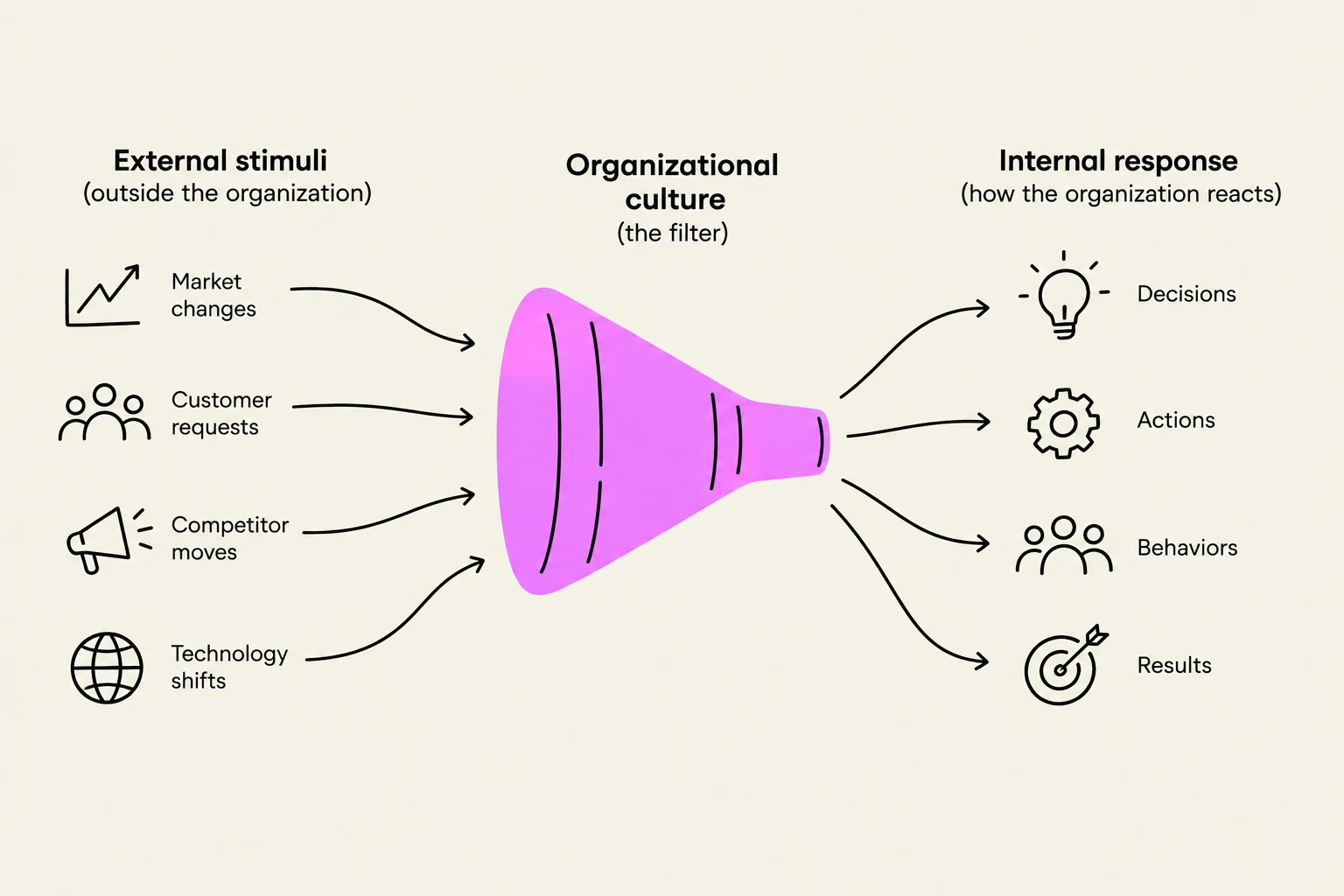
This diagram illustrates how external stimuli such as market changes, customer requests, competitor moves, and technology shifts are filtered through an organization's culture to produce internal responses like decisions, actions, behaviors, and results.
Exam Tip: When analyzing a case study, don't just look at what the company says its values are (the espoused values). Look at how employees actually behave when no one is watching (the enacted values). The gap between these two is often where cultural conflict resides.
The Decision-Making Impact: Autonomy vs. Hierarchy
One of the most critical dimensions of culture is how it influences decision-making power. This dimension can be viewed as a spectrum ranging from high centralization to high decentralization.
Empowerment and Decentralization
In cultures that emphasize empowerment, decision-making is pushed down to the lowest possible level. This is common in tech startups or creative agencies where speed and innovation are paramount. Employees are encouraged to take risks and "own" their results. This fosters a sense of psychological ownership, which can lead to higher engagement and faster response times to market changes.
Control and Centralization
On the other end of the spectrum are cultures characterized by high control and centralized decision-making. These are often found in highly regulated industries like banking, aerospace, or nuclear energy, where the cost of error is catastrophic. In these environments, culture emphasizes precision, hierarchy, and strict adherence to established protocols. While this may slow down innovation, it ensures a high degree of predictability and risk mitigation.
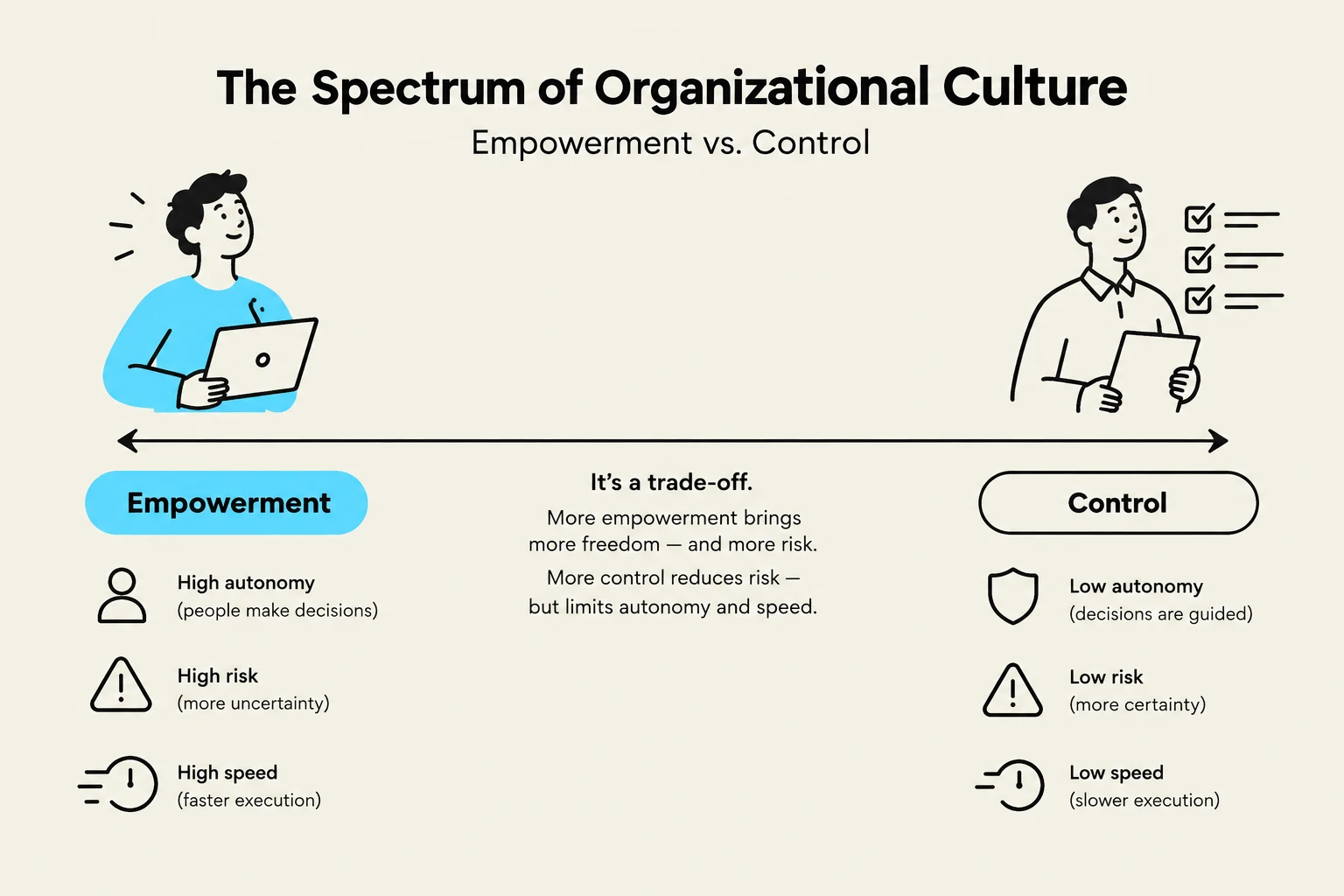
This diagram illustrates the spectrum of organizational culture, contrasting empowerment with control. Empowerment is associated with high autonomy, high risk, and high speed, while control is linked to low autonomy, low risk, and low speed. The text explains that empowerment offers more freedom and risk, whereas control reduces risk but limits autonomy and speed.
Individual vs. Team Orientation
Another fundamental dimension is how the organization views the "unit of success." Does the company reward the "star performer," or does it celebrate the "winning team"?
Individual Orientation
In an individualistic culture, performance metrics are often tied to personal achievements. This can drive intense competition and high levels of individual productivity. However, the downside is the potential for "siloing," where employees withhold information from one another to maintain a competitive edge, or where teamwork suffers because helping a colleague might diminish one's own relative standing.
Team Orientation
In contrast, a team-oriented culture focuses on collective goals and collaborative processes. Success is measured by the output of the group, and rewards are often distributed based on team milestones. This orientation fosters knowledge sharing and social support, which are vital for complex problem-solving. However, it can sometimes lead to "groupthink," where the desire for harmony prevents individuals from voicing dissenting, yet necessary, opinions.
Dimension
High Focus on Individual
High Focus on Team
Primary Driver
Personal achievement & competition
Collective goals & collaboration
Communication
Often vertical or competitive
Horizontal and collaborative
Risk
Silos and internal conflict
Groupthink and social loafing
Summary of Cultural Dimensions
To master the concept of organizational culture, one must view it as a multi-dimensional construct. It is not just "good" or "bad"; rather, it is a set of orientations that must align with the organization's strategic goals. A company aiming to disrupt a market needs a culture of empowerment and individual initiative, whereas a company aiming to provide the safest medical devices in the world needs a culture of control and team-based verification.
By recognizing these dimensions, managers can more effectively "engineer" a culture that serves as a reliable compass, guiding their workforce toward the organization's ultimate destination.
Keep reading for free.
Create an account to finish this reading and make it part of your study routine.