Learn how to accurately calculate medication dosages using dimensional analysis, a single-step method for determining the correct amount of medication to administer. This guide covers calculations for tablets, capsules, oral liquids, and weight-based dosages, along with essential nursing rounding rules for safe patient
In the clinical setting, precision is the cornerstone of patient safety. Calculating the correct amount of medication to administer is a critical skill for healthcare professionals. One of the most efficient and reliable methods for ensuring accuracy is dimensional analysis. Unlike traditional multi-step methods that require several intermediate calculations, dimensional analysis allows for a single-step calculation using ratios, reducing the risk of mathematical errors.
Understanding Dimensional Analysis
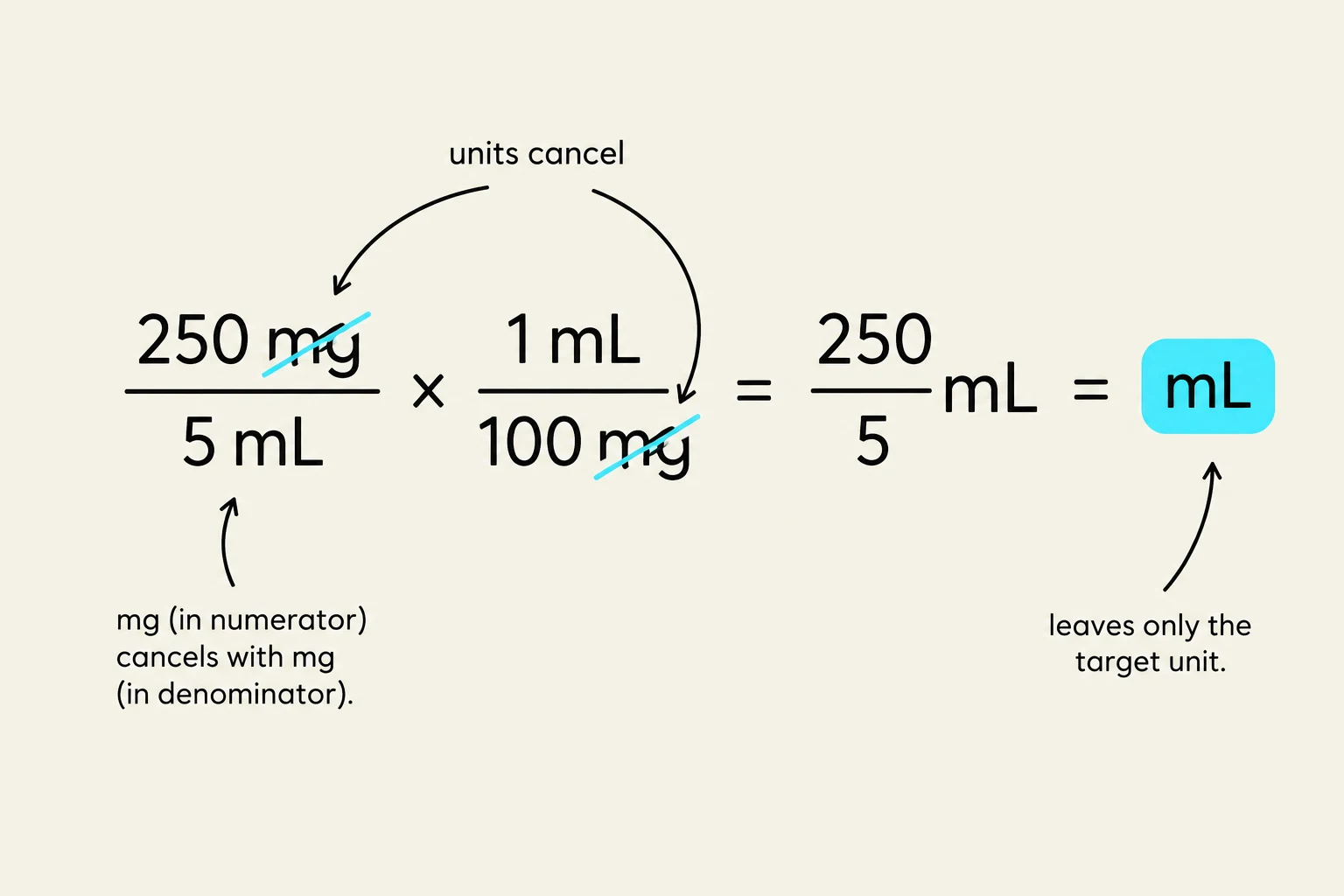
This illustration demonstrates how to cancel units in a calculation to determine the final unit. It shows the cancellation of milligrams (mg) in a fraction when multiplying by another fraction, resulting in the target unit of milliliters (mL).
Dimensional analysis is a mathematical technique that uses conversion factors (ratios) to move from a known value to a desired unit of measurement. By treating units like algebraic variables, you can "cancel out" unwanted units until only the target unit remains.
The Step-by-Step Process
To master this method, follow these systematic steps:
Identify the Goal: Determine the final unit of measurement you need (e.g., tablets, mL, or kg) and write it down first.
Set up the Equation: Write an equals sign followed by a ratio that includes the unit you are looking for in the numerator.
Add Ratios: Include additional ratios (conversion factors) until all units except your target unit are cancelled out.
Multiply Numerators: Multiply all values located in the top part of the fractions.
Multiply Denominators: Multiply all values located in the bottom part of the fractions.
Solve: Divide the total numerator by the total denominator.
Round: Apply nursing rounding rules to your final answer.
Pro-Tip: Never round your numbers in the middle of a calculation. Wait until you have reached your final answer to apply rounding rules to maintain maximum accuracy.
Calculating Tablets and Capsules
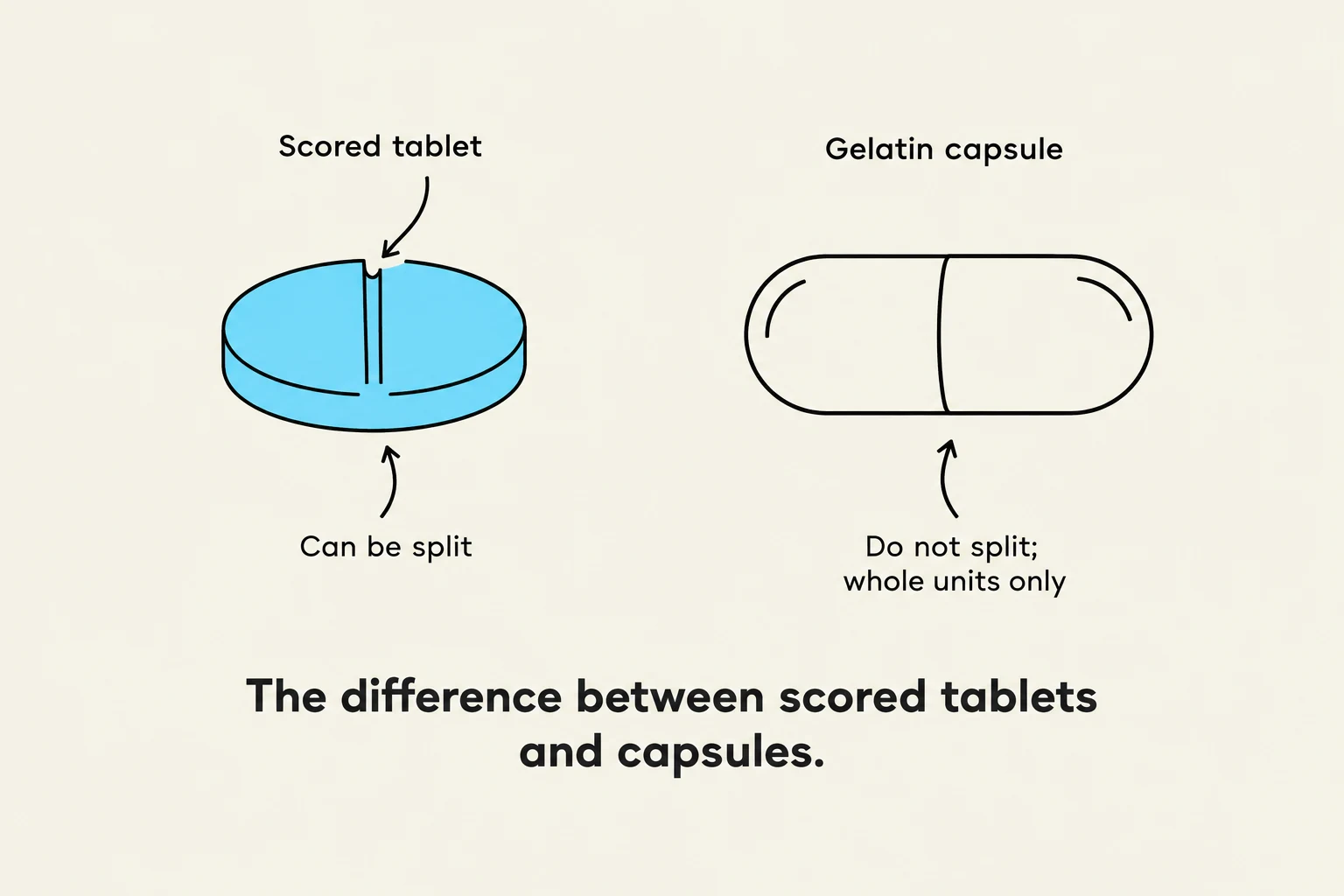
The difference between scored tablets and capsules.
When administering solid oral medications, the goal is often to determine how many individual units (tablets or capsules) to provide.
Tablet Calculations
Tablets are frequently available in various strengths. If a physician prescribes a dose that differs from the strength available on hand, you must use a ratio to find the correct number of tablets.
Example:
A physician prescribes 500 mg of Keflex. The pharmacy provides 125 mg tablets. How many tablets will you give?
To solve this, start with the desired unit (tablets) and use the ratio of the dose to the available strength:
Tablets=125 mg1 tab⋅500 mg
After cancelling "mg" and multiplying:
Tablets=125500=4 tabs
Capsule Calculations
Capsule calculations often involve unit conversions, such as converting grams (g) to milligrams (mg).
Example:
A physician prescribes 2000 mg of azithromycin. The pharmacy sends 1 g capsules. How many capsules will you give?
First, recognize that 1 g=1000 mg. Set up the calculation to cancel the mg and g units:
Capsules=1000 mg1 cap⋅2000 mgCapsules=2 caps
Important Clinical Rule: Tablets can sometimes be given in half doses if they are "scored" (have a line down the middle). However, capsules can only be given in whole units.
Oral Liquid Calculations
Liquid medications are measured in volume, typically milliliters (mL). These must be administered using a calibrated medicine cup or a calibrated oral syringe to ensure accuracy. The setup for liquid calculations is identical to the tablet/capsule method.
Example with Conversion:
The physician prescribes 25 mcg of fentanyl. The pharmacy sends a liquid concentration of 1 mg/mL. How many mL will you administer?
Since the order is in micrograms (mcg) and the supply is in milligrams (mg), you must include a conversion ratio (1 mg=1000 mcg):
mL=1 mg1 mL⋅1000 mcg1 mg⋅25 mcg
mL=1⋅1000⋅11⋅1⋅25=100025=0.025 mL
According to nursing rounding rules, values less than 1 mL are rounded to the nearest hundredth.
0.025 mL→0.03 mL
Medications Based on Weight
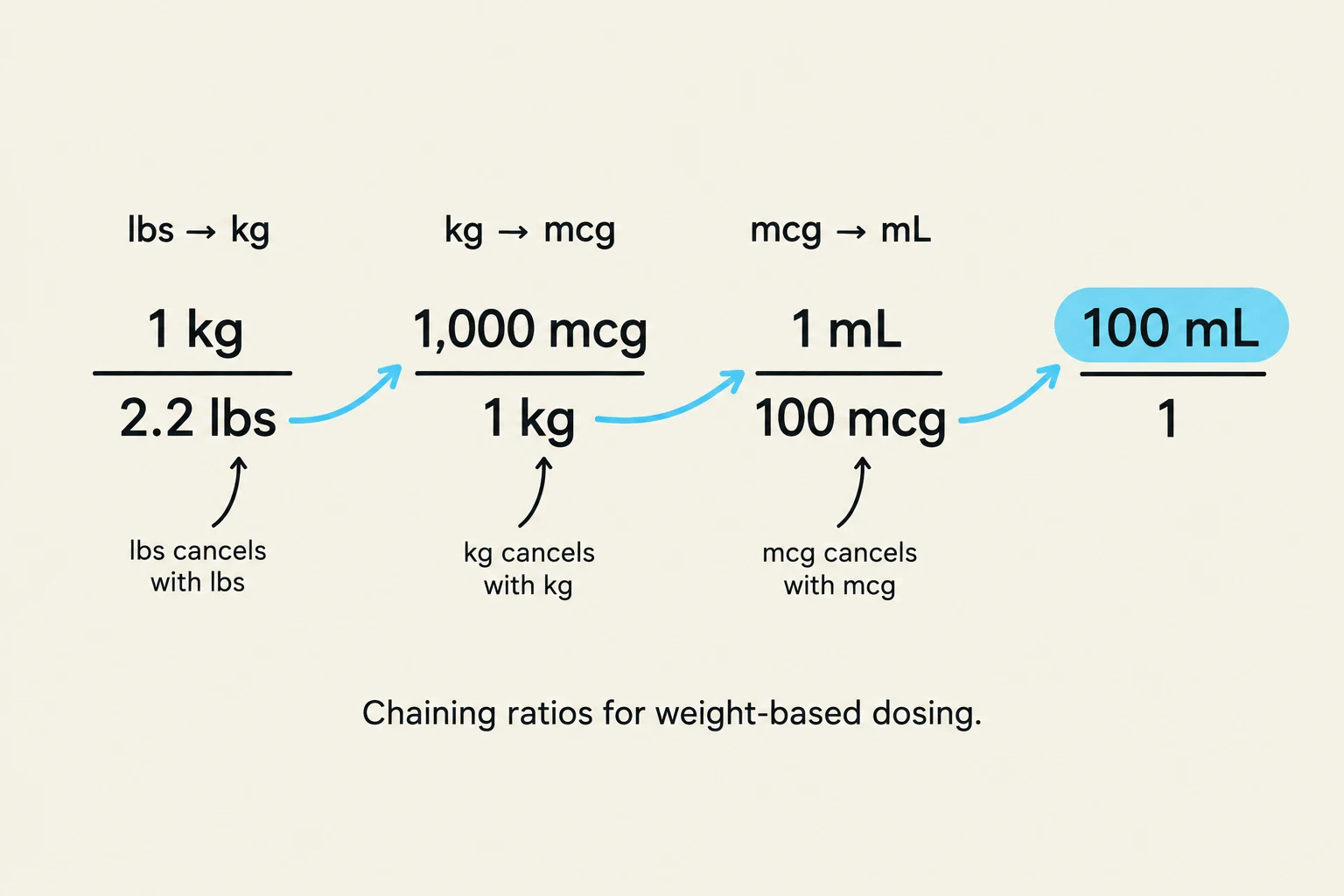
This diagram illustrates how to chain conversion ratios for weight-based dosing calculations, converting between pounds (lbs), kilograms (kg), micrograms (mcg), and milliliters (mL).
Some medications are not prescribed as a flat dose but are instead based on the patient's body weight (e.g., mg/kg). This requires converting the patient's weight (often from pounds to kilograms) before calculating the dose.
Complex Example:
The physician orders filgrastim 10 mcg/kg/day for a client weighing 180 lbs. The available medication is 480 mcg/1.6 mL. How many mL will you give?
To solve this, you must chain several ratios: the weight conversion (lbs to kg), the dose calculation, and the concentration conversion. (Note: 1 kg≈2.2 lbs).