Learn how to calculate medication dosages using dimensional analysis, a method that uses ratios to streamline calculations for tablets, capsules, oral liquids, and weight-based doses. This guide covers the fundamentals, step-by-step examples, and important rounding rules for accurate medication administration.
In the clinical setting, calculating the correct medication dose is a critical skill that directly impacts patient safety. While there are various mathematical methods to determine dosages, Dimensional Analysis is a highly efficient approach used to calculate medication dosages using a series of ratios. Unlike traditional methods that may require several separate, disconnected steps, dimensional analysis allows for a singular, streamlined calculation. This reduces the potential for mathematical errors and ensures that all unit conversions are handled within a single, cohesive equation.
The Fundamentals of Dimensional Analysis
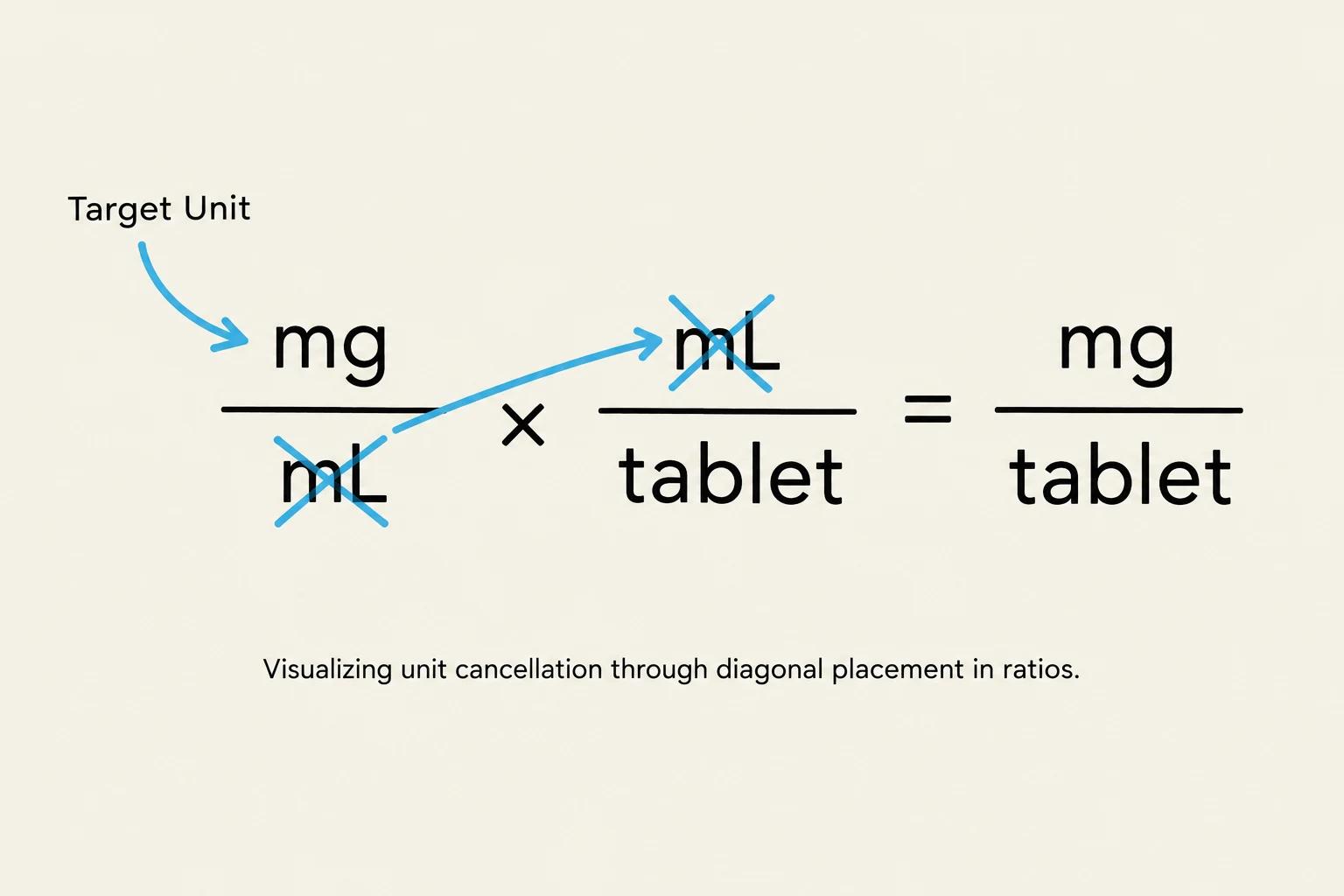
This diagram illustrates how to cancel units in a ratio calculation to determine the target unit.
The core of dimensional analysis is the systematic cancellation of units until only the desired unit remains. To master this method, you must follow a specific logical sequence:
Identify the Target Unit: Determine the final unit of measurement required for your answer (e.g., tablets, mL, or kg) and place it at the beginning of your equation.
Set Up Ratios: Create a series of fractions (ratios). To ensure units cancel correctly, place the unit you wish to eliminate in the denominator (bottom) of the next ratio, and place the unit you wish to keep in the numerator (top).
Continue Until Completion: Add additional ratios until all unwanted units have been cancelled out, leaving only your target unit.
Solve the Equation:
Multiply all values in the numerators together.
Multiply all values in the denominators together.
Divide the total numerator by the total denominator to reach your final result.
Pro-Tip: Always write out your units during the setup phase. If you don't see the units cancelling out diagonally, your ratio is set up incorrectly.
Calculating Solid Oral Medications: Tablets and Capsules
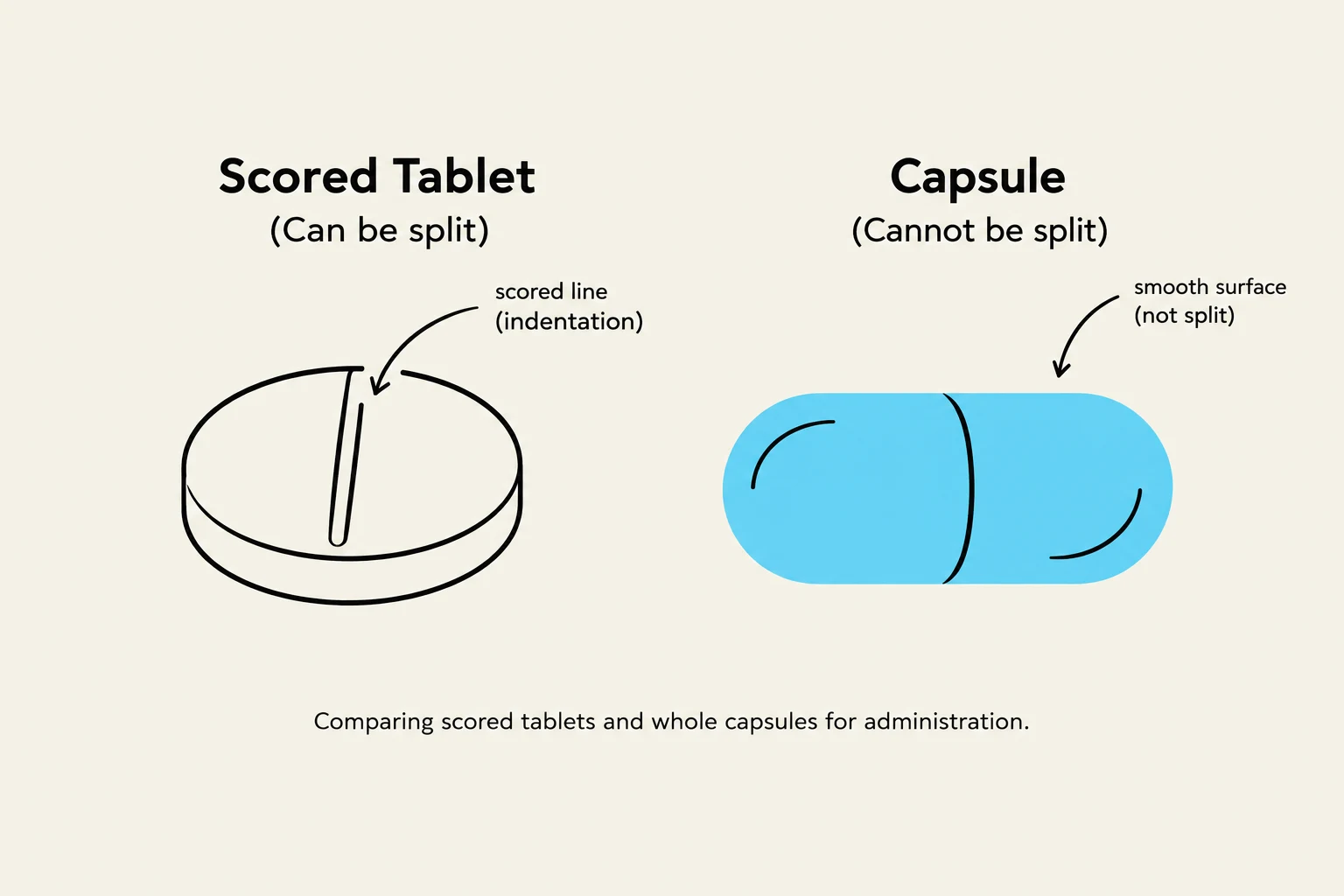
Comparison of a scored tablet, which can be split, and a capsule, which cannot be split, for administration.
When dealing with solid medications, the mathematical setup remains the same, but clinical rules regarding the form of the medication must be strictly observed.
Tablets
Tablets are often available in various strengths. When calculating a dose, you will use the ratio of "1 tablet per [available dose]".
Example: A physician prescribes 500 mg of Keflex. The pharmacy provides 125 mg tablets.
To solve this, set up the equation to find the number of tablets:
Desired Dose=500 mg⋅125 mg1 tabletResult=125500=4 tablets
Clinical Rule: Tablets may be administered in half doses, but only if the tablet is scored.
Capsules
Capsule calculations often require unit conversions (such as grams to milligrams) before the final division.
Example: A physician prescribes 2000 mg of azithromycin. The pharmacy provides 1 g capsules.
Desired Dose=2000 mg⋅1 g1 capsule⋅1000 mg1 gResult=10002000=2 capsules
Clinical Rule: Unlike tablets, capsules must always be administered as whole units. You cannot split a capsule to achieve a partial dose.
Oral Liquid Calculations
The setup for liquid medications is identical to that of tablets and capsules, but the final unit of measurement is typically milliliters (mL).
Example: The physician orders 10 mg of dexamethasone. The pharmacy sends a liquid concentration of 2 mg/mL.
Desired Dose=10 mg⋅2 mg1 mLResult=210=5 mL
Safety Alert: Oral liquid medications must be measured using a calibrated medicine cup or a calibrated oral syringe to ensure accuracy.
Weight-Based Calculations
In many clinical scenarios, especially in pediatrics or critical care, medications are ordered based on the patient's body weight (e.g., $mcg/kg/day$). These problems are more complex because they require additional conversion ratios to reconcile the patient's weight (often converting lbs to kg) and the medication concentration.
Example: The physician orders filgrastim 10 mcg/kg/day for a client weighing 180 lbs. The available medication is 480 mcg/1.6 mL.
To solve this, you must include the weight conversion (1 kg=2.2 lbs):
Desired Dose=1 kg⋅1 day10 mcg⋅2.2 lbs1 kg⋅180 lbs⋅480 mcg1.6 mLResult=1⋅2.2⋅1⋅48010⋅1⋅180⋅1.6=10562880≈2.7272... mL
Rounding Rules
One of the most important aspects of medication safety is knowing when and how to round. A critical rule is to never round intermediate values during the calculation process. You should only apply rounding rules to the final answer to maintain maximum accuracy.
Specific rounding depends on the volume being administered:
Volume Range
Rounding Rule
Example
Less than 1 mL
Round to the nearest hundredth
0.39 mL
1 mL to 10 mL
Round to the nearest tenth
5.6 mL
Greater than 10 mL
Round to the whole mL
13 mL
Note: Always follow the specific instructions provided in a problem or by a facility, as they may specify a different decimal place (e.g., nearest tenth or hundredth).
In the weight-based example above, the raw result was $2.7272...$ mL. Following the rule for values between 1 mL and 10 mL, we round to the nearest tenth, resulting in 2.7 mL.
Keep reading for free.
Create an account to finish this reading and make it part of your study routine.