


In the study of biology, understanding how substances move in and out of cells is fundamental to understanding life itself. Cells are not open containers; they are highly regulated environments protected by a barrier that controls the entry and exit of various molecules. This article explores the mechanics of diffusion, the role of selectively permeable membranes, and how physical properties like molecular weight and concentration gradients dictate the movement of solutes.
The Mechanics of Diffusion
At the microscopic level, molecules are in constant, random motion, a phenomenon known as Brownian motion. Because molecules are continuously bumping into one another like colliding billiard balls, they naturally tend to spread out from areas where they are crowded to areas where they are less crowded.
Diffusion is defined as the net movement of solute particles (the substances being dissolved) from an area of higher concentration to an area of lower concentration. This process is "passive," meaning it requires no external energy to occur; the movement is driven entirely by the natural tendency of molecules to move down their concentration gradient.
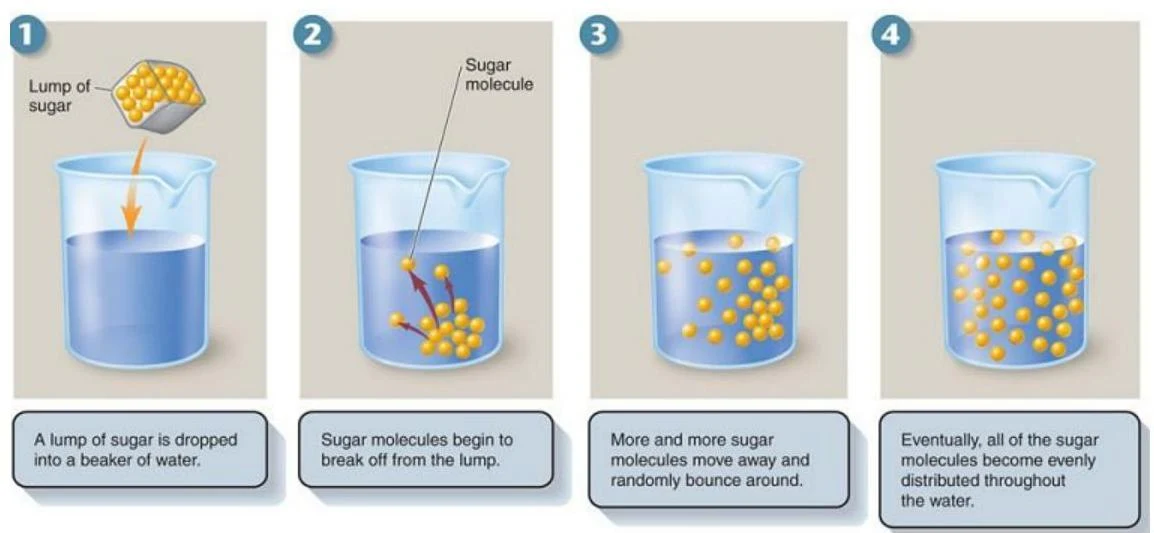
Exam Tip: Remember that diffusion is a net movement. While individual molecules move randomly in all directions, the overall statistical result is a movement from high to low concentration.
Selectively Permeable Membranes
In biological systems, the plasma membrane acts as a gatekeeper. It is selectively permeable, meaning it allows certain substances to pass through while restricting others. This selectivity is crucial for maintaining the internal environment of the cell.
Keep reading for free.
Create an account to finish this reading and make it part of your study routine.
Continue reading freeAlready have an account? Log in
Updated