Explains the fundamental biological processes of diffusion and osmosis, detailing the factors influencing their rates and their importance in cell function and homeostasis. Covers concepts like kinetic energy, concentration gradients, selective permeability, and tonicity with examples like plasmolysis.
In the microscopic world of biological systems, molecules are never truly still. They are in a constant state of motion, driven by the energy inherent in their own structure. This continuous movement is essential for life, allowing nutrients to enter cells, waste products to exit, and signals to be transmitted across vast biological distances. Understanding how these molecules move—specifically through the processes of diffusion and osmosis—is fundamental to understanding how cells maintain homeostasis and interact with their environments.
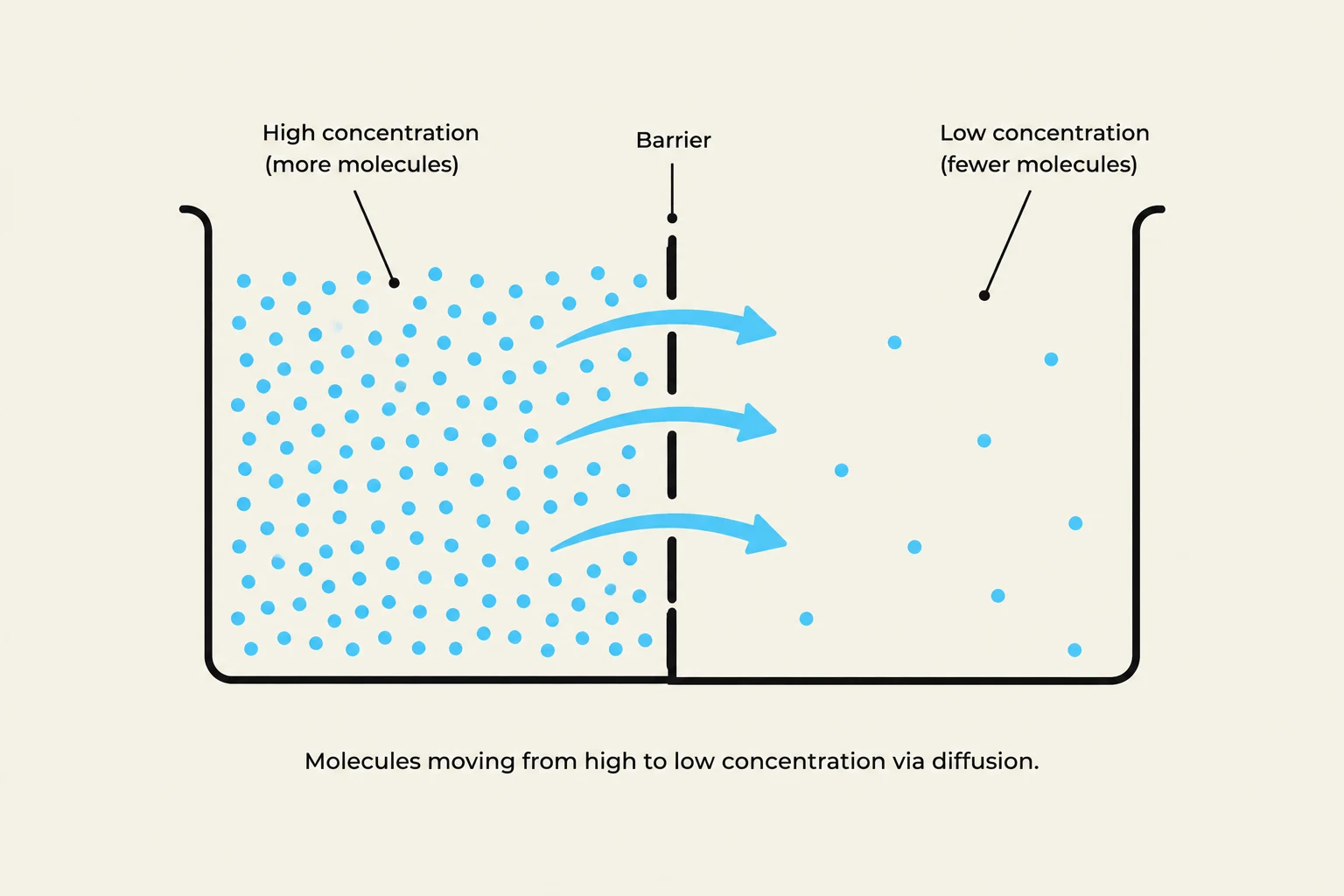
Diagram illustrating diffusion, where molecules move from an area of high concentration to an area of low concentration across a barrier.
The Mechanics of Passive Movement
At the heart of molecular transport is the concept of passive movement. Unlike active transport, which requires the cell to expend metabolic energy (ATP), passive movement occurs naturally without the input of cellular energy. This movement is driven by kinetic energy, also known as thermal energy.
All molecules display random thermal motion. Because molecules are constantly vibrating and colliding, they tend to spread out from where they are crowded to where they are less crowded. While individual molecules move in unpredictable, random directions, the net movement of a group of molecules follows a predictable pattern: they move from an area of high concentration to an area of low concentration until they reach a homogenous distribution.
Brownian Movement
A fascinating microscopic manifestation of this kinetic energy is Brownian movement. While we cannot see individual molecules with a standard light microscope, we can observe the random, jerky motion of small particles suspended in a fluid. This happens because the fast-moving, invisible molecules of the fluid constantly collide with the larger, visible particles, knocking them around.
Diffusion: Driving Forces and Constraints
Diffusion is defined as the directional, passive movement of molecules across membranes or through solutions. The primary driver of diffusion is the concentration gradient—the difference in the concentration of a substance between two areas.
The rate at which a substance diffuses is not uniform; it depends on several critical variables:
The Gradient: The steeper the difference in concentration between two points, the faster the rate of diffusion.
Molecular Characteristics:
Molecular Weight (Size): Smaller molecules generally diffuse more rapidly than larger, heavier ones.
Polarity: Whether a molecule has charged areas (polar) or no charge (nonpolar) significantly impacts its movement.
Solubility: A molecule's ability to dissolve in a particular solvent or lipid affects its speed.
Environmental Factors: Temperature and pressure also influence the rate of dispersal. For instance, increased heat increases the kinetic energy of molecules, thereby speeding up diffusion.
Exam Tip: While temperature and pressure affect the rate of diffusion, concentration is considered the best predictor of the direction in which a substance will move.
Selective Permeability of Biological Membranes
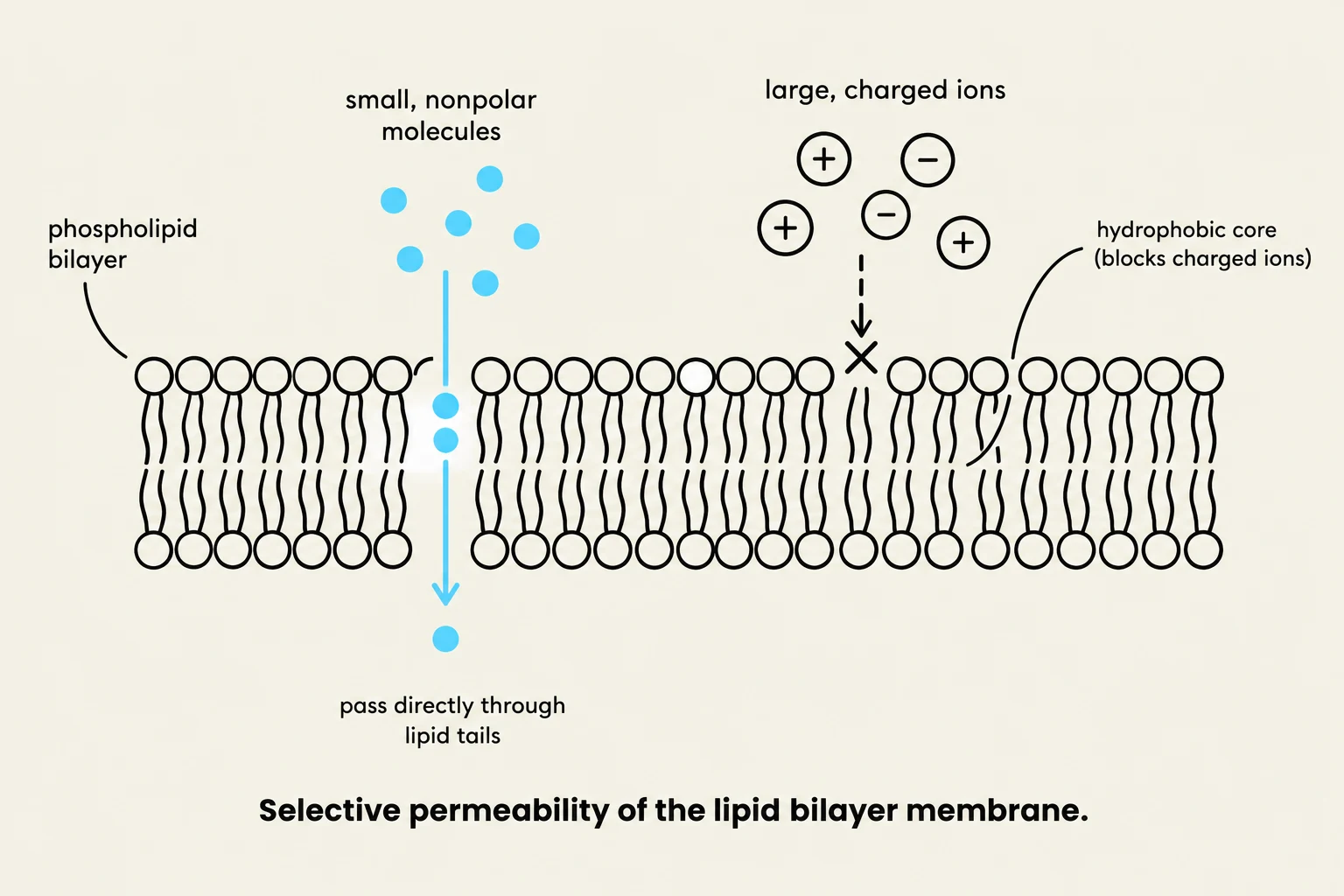
Selective permeability of the lipid bilayer membrane, illustrating how small, nonpolar molecules can pass through lipid tails, while large, charged ions are blocked by the hydrophobic core.
In living organisms, cells are not open containers; they are bounded by membranes that organize complex chemical reactions. These membranes are differentially permeable (or selectively permeable), meaning they act as gatekeepers, allowing certain substances to pass through while blocking others.
This selective permeability is a direct result of the membrane's chemical structure. Because the core of the membrane is composed of lipids, the ability of a solute to cross depends on its chemical properties:
High Permeability: Small, uncharged, nonpolar, and lipid-soluble molecules pass through the lipid core most easily.
Low Permeability: Large molecules, ions (charged particles), and highly polar molecules face significant resistance when attempting to cross the membrane.
Osmosis and Tonicity
The effect of tonicity on cell volume through osmosis.Osmosis is a specialized form of diffusion. While "diffusion" can refer to any molecule, "osmosis" refers exclusively to the movement of water across a differentially permeable membrane. In biological systems, water is the principal solvent, and its movement is vital for maintaining cell volume and pressure.
Water moves from areas of low solute concentration (where there is more water) to areas of high solute concentration (where there is less water). To describe the relationship between a cell and its surrounding fluid, biologists use the term tonicity:
Term
Definition
Effect on Cell
Hypotonic
A solution with a lower concentration of solutes relative to the cell.
Water enters the cell; cell may gain weight or swell.
Hypertonic
A solution with a higher concentration of solutes relative to the cell.
Water leaves the cell; cell may lose weight or shrink.
Isotonic
Two solutions with equal solute concentrations.
No net movement of water; cell weight remains stable.
Real-World Example: Plant Cells and Plasmolysis
The impact of osmosis is clearly visible in plant cells. When a plant cell is placed in a hypertonic environment (such as a high-salt solution), water diffuses out of the cell to balance the concentration gradient.
As water leaves the central vacuole and cytoplasm, the cell contents shrink and the cellular membrane pulls away from the rigid cell wall. This specific biological phenomenon is known as plasmolysis.
Summary Table: Osmotic Movement
If a cell is in a Hypertonic solution → Water moves OUT→ Cell shrinks (Plasmolysis).
If a cell is in a Hypotonic solution → Water moves IN→ Cell swells.
Keep reading for free.
Create an account to finish this reading and make it part of your study routine.