Learn about the FITT-VP principle for designing effective cardiorespiratory exercise programs, including warm-up, cool-down, intensity, duration, and progression strategies.
Designing a cardiorespiratory exercise program is often described as an art. While it requires scientific precision, it also demands the ability to tailor a plan to the unique goals, lifestyle, and physiological needs of an individual. Whether the objective is to improve cardiorespiratory fitness (CRF) or to reduce the risk of chronic disease, the prescription must be individualized.
A fundamental tool in this process is the FITT-VP principle, which provides a structured framework for organizing the components of an exercise session and a long-term training plan.
The Structure of a Single Workout
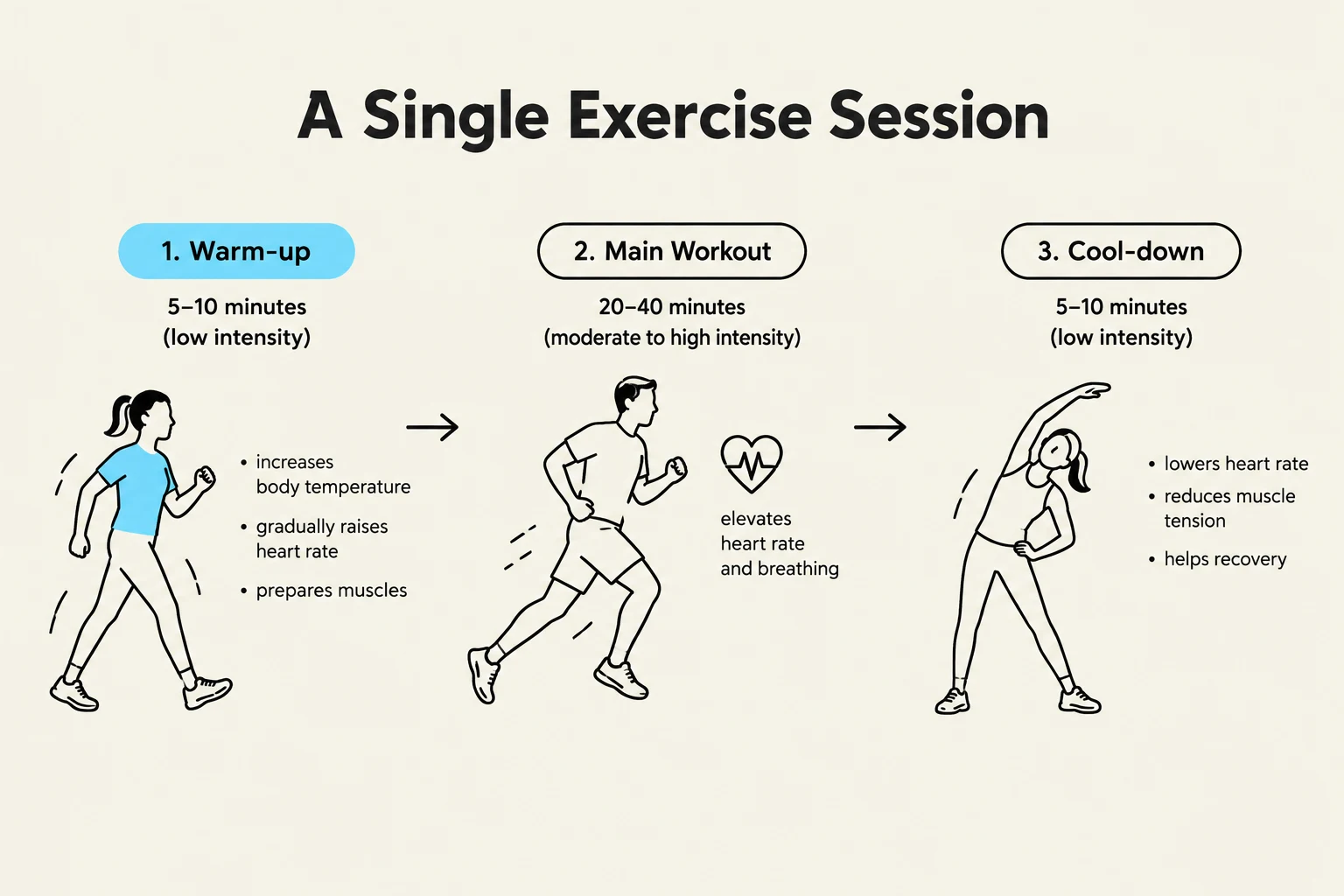
A well-rounded cardiorespiratory session is more than just the period of active movement. To ensure safety and maximize effectiveness, a single session should include four distinct elements: a warm-up, endurance conditioning, a cool-down, and stretching.
Warm-Up and Cool-Down
The warm-up should last between 5 to 10 minutes at a low to moderate intensity. Its primary purpose is to increase blood flow and core temperature, which decreases the likelihood of injury and reduces the risk of cardiac arrhythmias.
Following the main activity, a cool-down is essential. This 5 to 10-minute period of low-intensity exertion allows heart rate (HR) and blood pressure (BP) to return toward pre-exercise levels. Crucially, a cool-down maintains venous return to the heart, preventing blood pooling in the extremities, which can cause dizziness or fainting.
Stretching
Finally, stretching for 5 to 10 minutes targeting major muscle groups can be incorporated to help reduce muscle soreness and cramping.
A single exercise session is divided into three phases: warm-up, main workout, and cool-down, with recommended durations and intensities for each.
The FITT-VP Principle
To design a long-term program, professionals use the FITT-VP principle to manipulate variables that drive physiological adaptation.
Frequency: How often one exercises. For health, this might involve 5 days of Moderate-Intensity Physical Activity (MIPA) per week, whereas improving fitness might require a combination of MIPA and Vigorous-Intensity Physical Activity (VIPA).
Intensity: How hard the body is working. This is often measured via %VO2R, $%HRR$, or METs.
Time (Duration): The length of the exercise bout. For example, a goal might be ≥150 min/wk of MIPA.
Type (Mode): The kind of activity performed (e.g., walking, cycling, or swimming).
Volume: The total amount of work performed, often expressed as energy expenditure (e.g., ∼1,000 kcal/wk) or in MET-minutes per week.
Progression: The systematic increase in workload to continue challenging the body.
Understanding Intensity: METs, VO2 Max, and Heart Rate
Intensity is the most critical variable for targeting specific goals. For health improvements, moderate intensity is sufficient, but to improve VO2 max (the maximum amount of oxygen the body can utilize during intense exercise), higher intensities are required.
Intensity can be quantified using METs (Metabolic Equivalents) or percentages of oxygen reserve (%VO2R). For instance, MIPA is typically defined as 3–6 METs, while VIPA is >6 METs.
Exam Tip: When calculating intensity using the Heart Rate Reserve (HRR) method, also known as the Karvonen method, ensure you use the formula:
%HRR=[target%×(HRmax−HRrest)]+HRrest
This method is often more accurate than using a simple percentage of maximum heart rate (HRmax).
Monitoring Intensity in Real-Time
Because physiological responses vary by individual and modality, practitioners use several methods to monitor intensity during exercise:
Heart Rate (HR): Using wearable devices or manual checks.
Rating of Perceived Exertion (RPE): Subjective scales like the Borg (6–20) or OMNI (0–10).
Talk Test: A simple way to gauge intensity based on the ability to carry on a conversation.
Progression and Volume
A program must evolve through three distinct stages to ensure continuous adaptation: Initial Conditioning, Improvement, and Maintenance.
Initial Conditioning (1–6 weeks): The goal is to establish a baseline, such as sustaining 55%–60% HRR for 30 continuous minutes.
Improvement (4–6 months): The workload is increased to reach goals like sustaining MVPA (Moderate to Vigorous Physical Activity) for 20 to 60 minutes, 5 days per week.
Maintenance: Once goals are met, the focus shifts to maintaining the achieved fitness level and weekly caloric expenditure.
When progressing, it is generally recommended to increase duration first, and then increase intensity.
Selecting the Right Mode
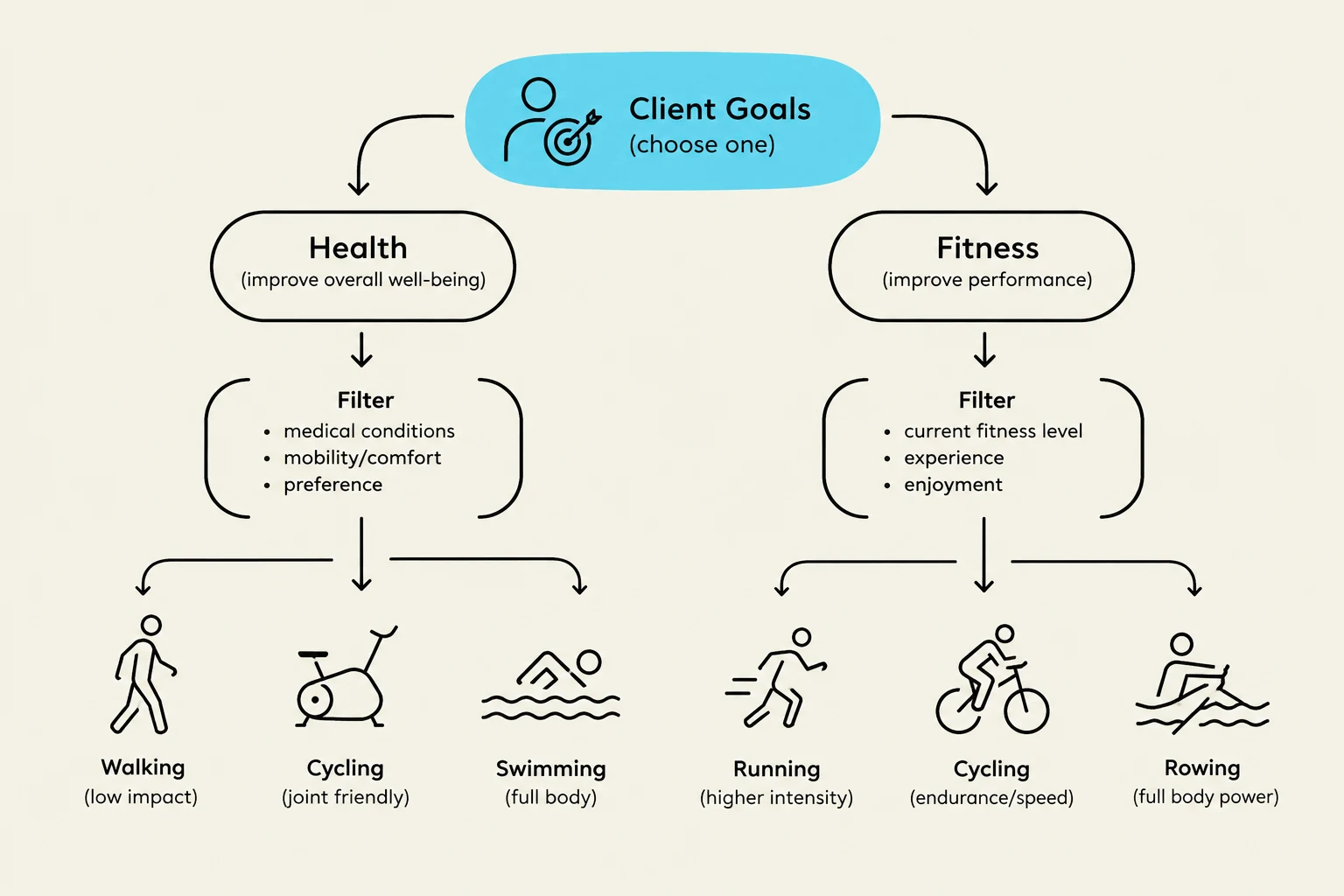
The "Type" or mode of exercise should be selected based on the client's ability, enjoyment, and safety. Modes can be categorized by the skill level required:
Type A: Minimal skill/fitness required (e.g., walking, cycling).
Type B: Vigorous, minimal skill, average fitness (e.g., jogging, spinning).
Type C: Requires skill and average fitness (e.g., swimming, skating).
Type D: Recreational activities (e.g., soccer, basketball).
Multimodal training (cross-training) is highly recommended because it increases adherence through variety and enjoyment. However, note that heart rate responses will vary between modalities; for example, weight-bearing exercises typically produce a higher HR response than non-weight-bearing exercises at the same relative intensity.
This diagram illustrates how client goals for health or fitness can be filtered based on various factors to suggest suitable activities such as walking, cycling, swimming, running, or rowing.
Keep reading for free.
Create an account to finish this reading and make it part of your study routine.