An overview of descriptive research methods in psychology, including naturalistic observation, case studies, and surveys. It emphasizes the importance of sampling techniques, particularly random sampling, to ensure representative data and avoid bias.
In the field of psychology, researchers often face a fundamental question: "What is happening?" Before we can determine why a behavior occurs (causation), we must first accurately describe how it occurs in the real world. This is the primary goal of descriptive research. Unlike experimental research, which manipulates variables to find cause and effect, descriptive research aims to provide a clear, detailed picture of phenomena, behaviors, or characteristics as they exist naturally.
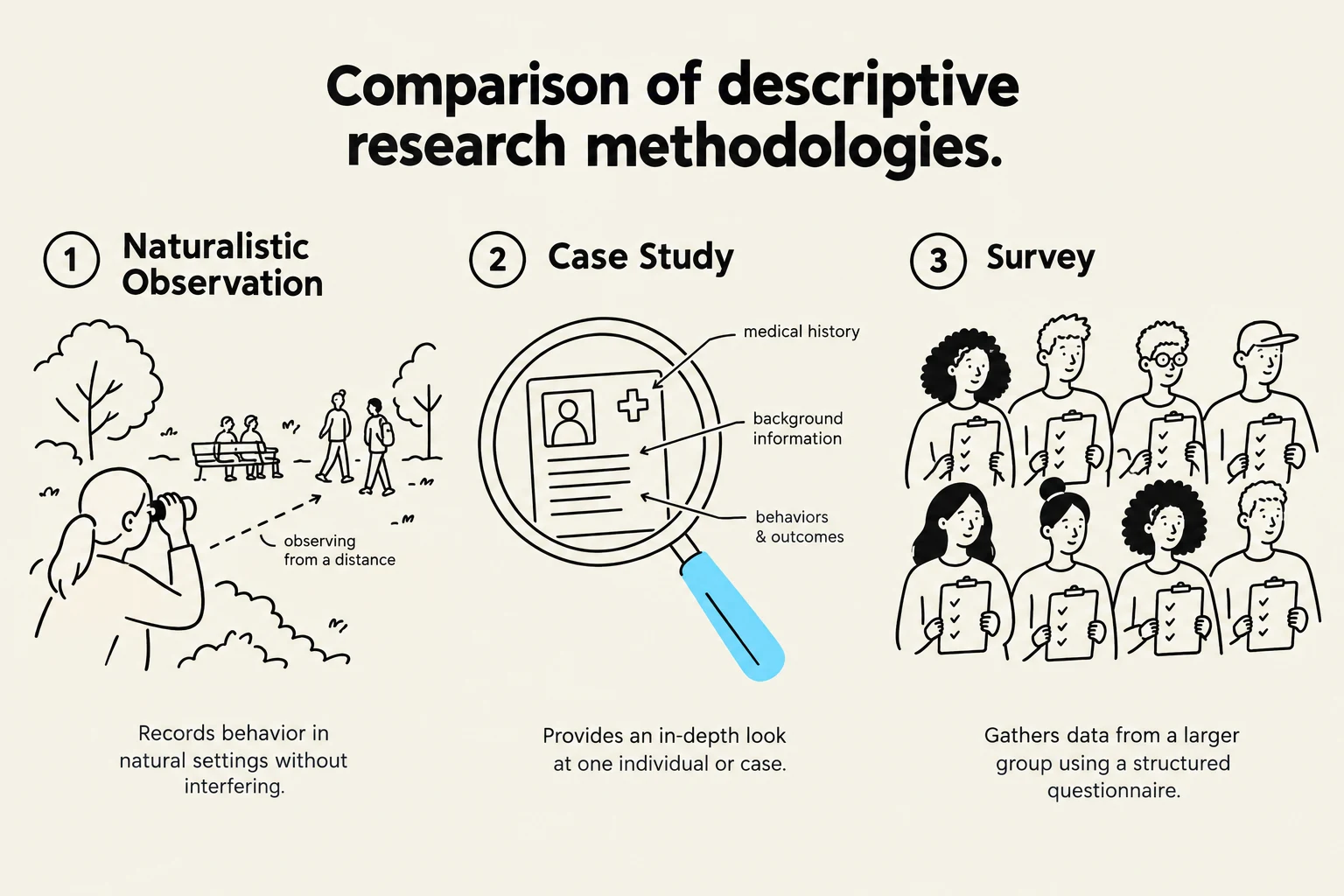
This illustration compares three descriptive research methodologies: Naturalistic Observation, Case Study, and Survey. Naturalistic Observation involves observing behavior in natural settings without interference. A Case Study provides an in-depth look at one individual or case, examining medical history, background information, and behaviors/outcomes. A Survey gathers data from a larger group using a structured questionnaire.
To do this effectively, researchers must choose the right tools for observation and, perhaps more importantly, ensure that the people they are studying actually represent the larger population they wish to understand.
Core Methods of Descriptive Research
Descriptive research relies on several key methodologies, each suited to different types of questions. The three most common are naturalistic observation, case studies, and surveys.
Naturalistic Observation
Naturalistic observation involves watching subjects in their natural environment without any interference from the researcher. This method is invaluable for studying behaviors that might change if a person knew they were being watched in a laboratory setting.
Example: A researcher sitting on a park bench to record how many people interact with their smartphones while walking, or an ethologist observing chimpanzee social hierarchies in the wild.
Strength: It provides high ecological validity, meaning the behavior is "real" and not artificial.
Weakness: Researchers have no control over variables, and it can be difficult to determine the underlying motivation behind a behavior just by watching it.
Case Studies
A case study is an in-depth investigation of a single individual, group, or event. These are often used when studying rare phenomena that would be unethical or impossible to replicate in a lab.
Example: Studying a patient with a unique brain injury to understand how a specific part of the brain functions.
Weakness: Because the subject is unique, the findings cannot easily be generalized to the rest of the population.
Surveys
Surveys use questionnaires or interviews to gather self-reported data from a large number of people. This is one of the most efficient ways to collect data on attitudes, beliefs, and reported behaviors.
Strength: Allows for the collection of vast amounts of data very quickly and relatively cheaply.
Weakness: It relies on "self-reporting," which can be problematic. People may provide "socially desirable" answers (lying to look better) or may simply have inaccurate memories.
Exam Tip: If a question asks which method is best for studying a rare neurological disorder, look for "Case Study." If it asks how to gather data on the political opinions of an entire nation, look for "Survey."
The Science of Sampling
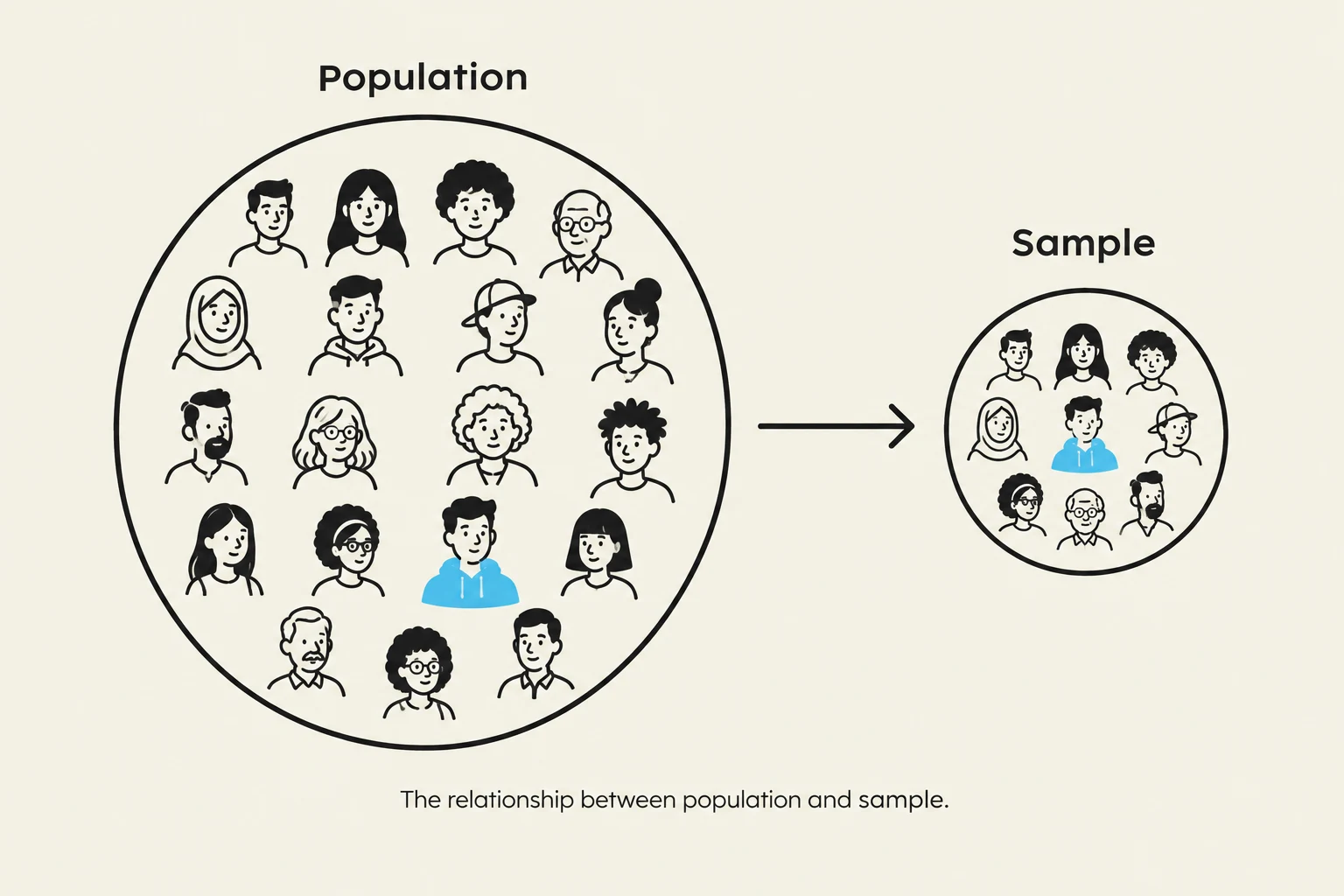
This diagram illustrates the relationship between a population and a sample, showing how a smaller group (sample) is selected from a larger group (population).
Even the best survey or observation is useless if the people being studied do not represent the group the researcher is interested in. This brings us to the concept of sampling.
In research, we distinguish between two groups:
The Population: The entire group of people that the researcher is interested in (e.g., all college students in the United States).
The Sample: The smaller subset of the population that actually participates in the study.
The goal is to take a sample that is a "microcosm" of the population—meaning the sample should have the same characteristics (age, gender, ethnicity, socioeconomic status) as the larger group.
Random Sampling: The Gold Standard
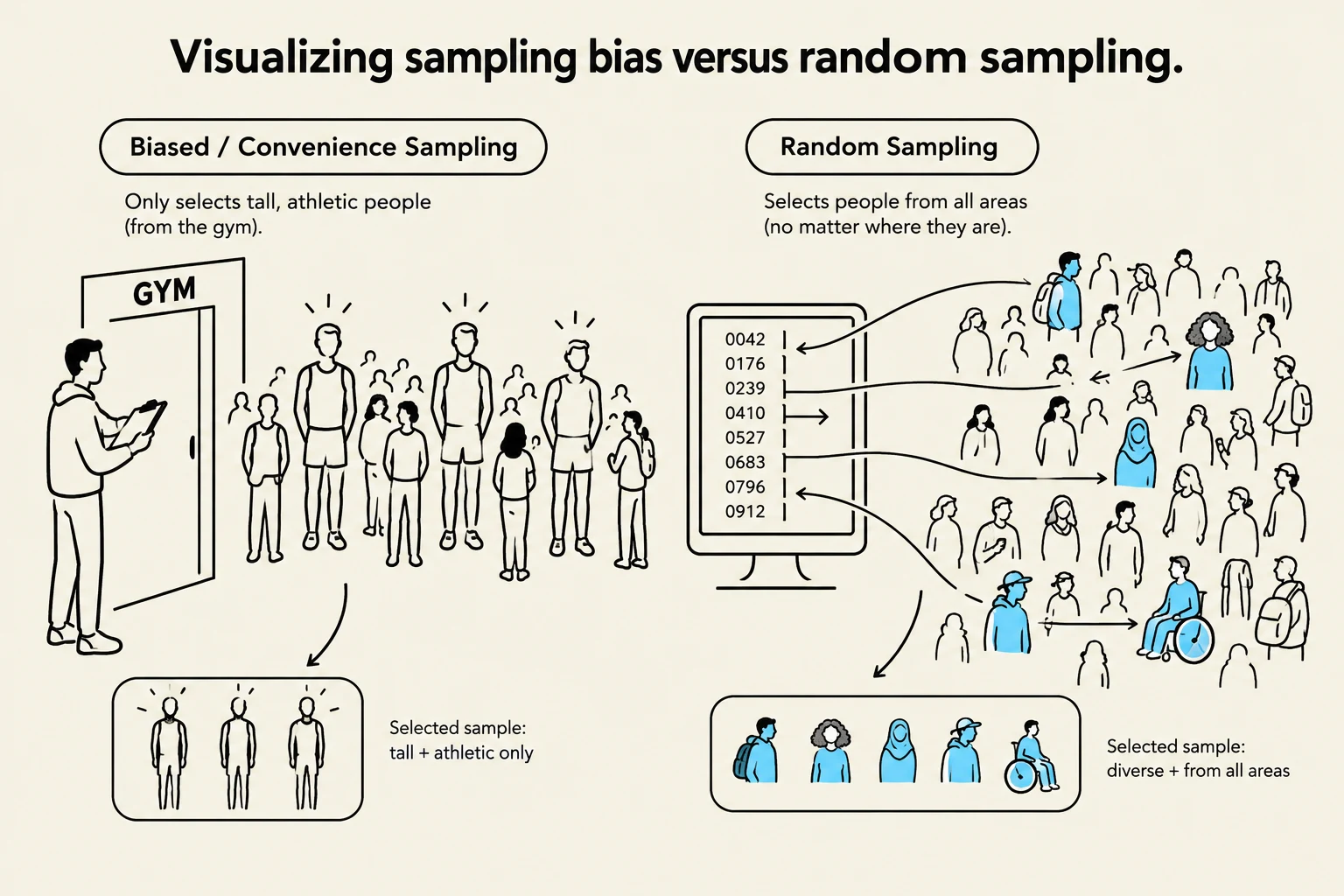
This illustration contrasts biased sampling, which selects individuals based on convenience (e.g., only tall, athletic people from a gym), with random sampling, which aims to select a diverse group from all areas.
To achieve a representative sample, researchers use random sampling. In a truly random sample, every single member of the population has an equal chance of being selected.
Imagine you want to know the average height of students at a university with 10,000 students.
Non-random approach: You stand outside the gym and measure the first 50 people you see. This is biased because athletes might be taller than the average student.
Random approach: You assign every student a number from 1 to 10,000 and use a computer program to randomly select 50 numbers. This gives every student, regardless of their hobbies or habits, an equal shot at being picked.
Avoiding Bias and Error
If a sample is not representative, the research suffers from sampling bias. Bias occurs when certain members of a population are systematically more likely to be included in a study than others, leading to results that are skewed and inaccurate.
Common Pitfalls to Watch For:
Convenience Sampling: Choosing participants who are easiest to reach (e.g., a professor using their own students for a study). While easy, this rarely represents the general public.
Self-Selection Bias: This occurs when participants volunteer themselves for a study. People who volunteer for studies often have different personality traits or stronger opinions than those who do not, which can skew the data.
Response Bias: In surveys, this happens when participants answer in a way they think the researcher wants them to, or in a way that makes them look good.
Summary Checklist for Researchers:
Method: Did I choose the right tool (Observation vs. Survey vs. Case Study)?
Representation: Does my sample actually look like my population?
Randomization: Did I use random sampling to minimize bias?
Honesty: Am I accounting for the fact that people might lie on my surveys?
By mastering these descriptive techniques and prioritizing random sampling, researchers can move from mere anecdotes to reliable, scientific descriptions of human behavior.
Keep reading for free.
Create an account to finish this reading and make it part of your study routine.