Dental anatomy is the study of the complex morphological landmarks that define the structure, shape, and function of teeth. To understand how teeth work together for mastication (chewing), one must first master the language of their surfaces. This involves identifying various elevations, such as ridges and cusps, and depressions, such as fossae and grooves. By understanding these landmarks, clinicians can accurately describe tooth morphology, identify developmental anomalies, and plan restorative treatments.
Growth Centres and Developmental Origins
The unique shape of every tooth is not accidental; it is the result of specific growth patterns during development. Teeth form from developmental lobes, which serve as the primary centers of calcification. As these lobes grow, they coalesce (fuse together) to form the final crown of the tooth.
The number of lobes present during development directly dictates the tooth's eventual morphology:
Anterior teeth and premolars: These generally form from four lobes (typically three facial lobes plus one lobe forming the lingual cusp or cingulum).
Molars: The number of lobes usually corresponds to the number of cusps. For example, a mandibular molar with five cusps will typically develop from five lobes.
When these lobes fuse, the lines where they meet often remain visible as shallow depressions known as developmental grooves. In some cases, these grooves can become deep or stained, which is a significant clinical consideration for caries (cavity) risk.
On freshly erupted incisors, you may observe three rounded protuberances on the unworn incisal edge called mamelons. These are remnants of the individual labial lobes before they have been worn down by functional use.
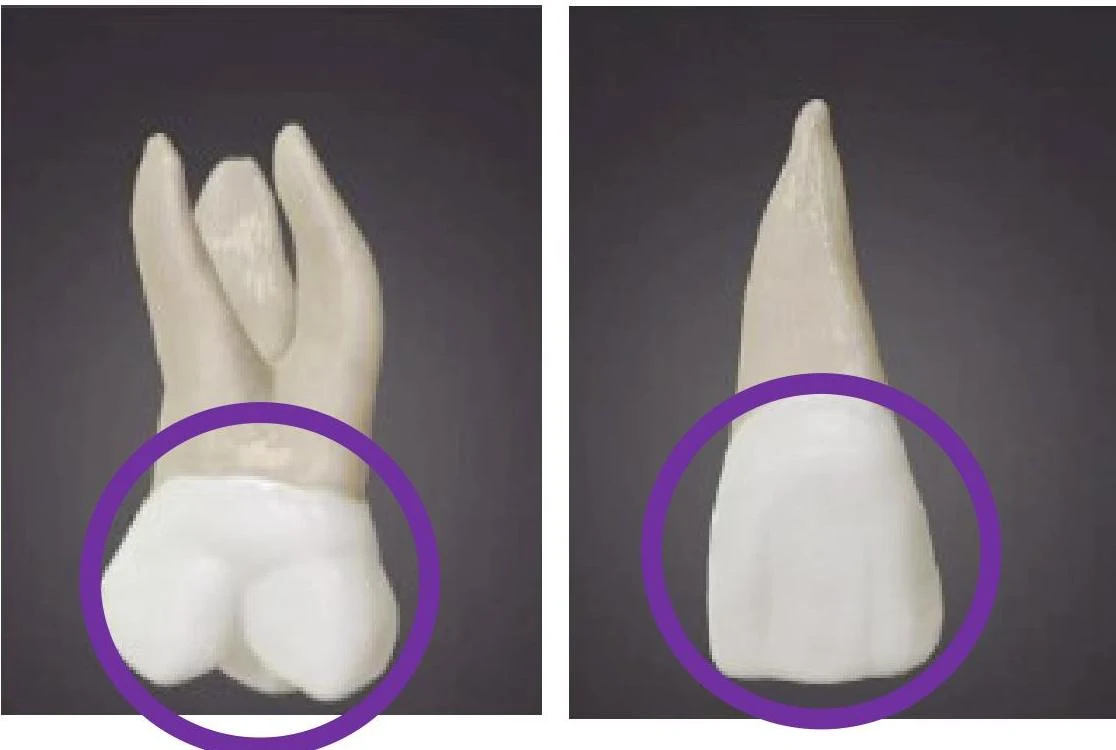
Diagrams of a molar tooth and a premolar tooth, highlighting the root structure.
Understanding Cusps and Their Ridges
Cusps are the raised, pointed elevations found on the occlusal (biting) surfaces of posterior teeth (premolars and molars). Each cusp is essentially a pyramid-shaped structure that develops from a single tooth lobe.
Cusp Nomenclature and Geometry
Cusps are named based on their location within the dental arch. Common designations include:
Mesiobuccal (MB): Located on the mesial and buccal aspects.
Distobuccal (DB): Located on the distal and buccal aspects.
Mesiolingual (ML) and Distolingual (DL): Located on the lingual aspects.
Each individual cusp is comprised of four distinct cusp ridges (slopes) that descend from the cusp tip. For example, a single buccal cusp will have a mesial cusp ridge and a distal cusp ridge.
Types of Ridges on the Occlusal Surface
Ridges are linear elevations on the tooth surface. On the occlusal surface of posterior teeth, several specific types of ridges work together to facilitate grinding:
Triangular Ridges: These are the primary ridges that descend from the cusp tip toward the central part of the occlusal surface.
Transverse Ridges: When a triangular ridge from a buccal cusp and a triangular ridge from a lingual cusp meet and join across the tooth, they form a transverse ridge.
Oblique Ridges: This is a specialized ridge found only on maxillary (upper) molars. It crosses the occlusal surface at an angle and is formed by the union of the triangular ridges of the mesiolingual and distobuccal cusps.
Exam Tip: If a question asks which ridge is unique to the maxillary molars, the answer is always the Oblique Ridge.
Surface Landmarks: Ridges and Fossae
Beyond the cusps, various other ridges define the contours of the tooth.
Marginal Ridges
Marginal ridges are rounded enamel borders that outline the mesial and distal margins of the tooth.
Mesial Marginal Ridge (MMR): Located on the mesial side.
Distal Marginal Ridge (DMR): Located on the distal side.
On anterior teeth, these ridges form the borders of the lingual fossa. On posterior teeth, they form the "shoulders" of the occlusal surface.
Other Important Ridges
Incisal Ridge: On anterior teeth, the biting edge is technically referred to as the incisal ridge.
Buccal Ridge: An elevation viewed from the buccal aspect that extends from the Cemento-Enamel Junction (CEJ) to the cusp tip.
Cervical Ridge: A ridge that runs mesiodistally along the cervical third of the buccal surface. This is found on all primary teeth and only on permanent molars.
Fossae and Pits
A fossa is an irregular, rounded depression or concavity.
Lingual Fossa: Found on the lingual surface of incisors. On canines, there are often two lingual fossae separated by a lingual ridge.
Central Fossa: A large depression located in the center of the occlusal surface of a molar.
Triangular Fossa: Smaller depressions located near the marginal ridges and between cusps.
Pits: These are small, deep depressions found where developmental grooves cross or join.
Geometric Definitions: Angles and Contours
To precisely describe a tooth, dental professionals use specific geometric terms to identify where surfaces meet.
Line Angles and Point Angles
Line Angle: The intersection of two planes (surfaces). Examples include the mesiobuccal line angle or the linguoincisal line angle.
Point Angle: The junction where three surfaces meet. Examples include the mesiolabiocincisal point angle.
Surface Contours
The "height of contour" refers to the most prominent bulge on a tooth surface.
Crest of Curvature: The highest point on a specific surface.
CEJ Curvature: The proximal cervical line (at the CEJ) generally exhibits a greater curvature on the mesial surface than on the distal surface.
Summary Table of Key Terms
Term
Definition
Location/Context
Cusp
Raised, pointed part of a tooth
Premolars and Molars
Mamelon
Rounded protuberances
Newly erupted incisors
Cingulum
Enamel bulge
Lingual cervical third of anterior teeth
Fossa
Irregular depression
Lingual (incisors) or Central (molars)
Marginal Ridge
Enamel border
Mesial and Distal margins
Transverse Ridge
Union of two triangular ridges
Occlusal surface of posterior teeth
Oblique Ridge
Ridge crossing obliquely
Maxillary Molars only
Student Pitfall: Do not confuse Attrition (normal wear) with Abrasion (mechanical wear, like toothbrushing) or Erosion (chemical loss). Understanding these distinctions is vital for diagnosing tooth wear patterns.
Keep reading for free.
Create an account to finish this reading and make it part of your study routine.