


Understanding Deformation in Solids
When we look at the world around us, many objects appear perfectly still and unyielding. We call things like wooden tables, steel balls, or brick walls "rigid" because they seem to maintain their shape regardless of what happens to them. However, in the study of physics, we learn that nothing is perfectly immovable. Every single solid object undergoes some level of change when a force is applied to it.
This change in shape is known as deformation. Whether it is a microscopic shift in the particles of a table or the dramatic shattering of a window, deformation is a universal response to force.
The Role of Applied Force and Collisions
Deformation occurs when an applied force acts upon an object. This often happens during collisions, where one object strikes another, transferring energy and force to the surface of the target.
Consider these real-world examples of force causing deformation:
- A wooden pole smashing a car window.
- A steel ball colliding with a brick wall, causing cracks.
- A massive ship colliding with an iceberg.
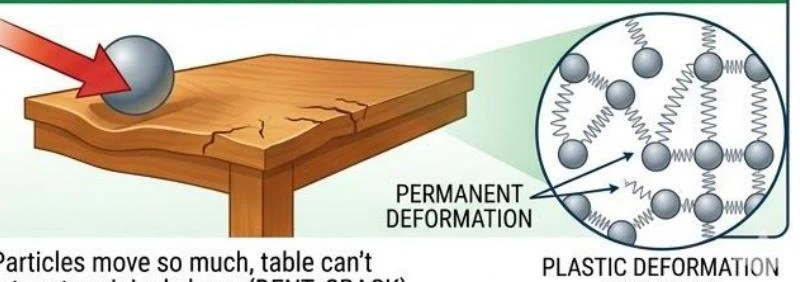
When a collision occurs, the force causes the internal particles of the object to displace. The way these particles react determines whether the deformation is temporary or permanent.
Elastic vs. Plastic Deformation
The outcome of a force applied to a solid depends on the magnitude of that force and the properties of the material. We categorize these outcomes into two main types: elastic and plastic deformation.

Keep reading for free.
Create an account to finish this reading and make it part of your study routine.
Continue reading freeAlready have an account? Log in
Updated