Defining the Environment: Nature, Culture, and Space
An exploration of the multifaceted concept of 'environment,' extending beyond natural elements to encompass the built and social structures that shape human interaction with the world.
When we hear the word "environment," our minds often jump immediately to images of lush rainforests, melting glaciers, or perhaps the smog hanging over a major city. However, in academic study—particularly within geography and environmental studies—the term is far more expansive than just "nature." Defining the environment requires us to look beyond the biological and physical to include the structures we build and the social networks we inhabit. To understand the environment is to understand the complex interplay between the natural world, human-made spaces, and the social systems that connect them.
The Natural Environment: The Physical Foundation
At its most fundamental level, the environment consists of the natural world. This includes the "abiotic" components—non-living elements like sunlight, temperature, soil, and water—and the "biotic" components, which are the living organisms such as plants, animals, and microorganisms.
The natural environment operates through complex cycles, such as the carbon cycle or the water cycle, which maintain the equilibrium of the planet. When we study the natural environment, we are often looking at how these physical systems function independently of human intervention, or how they respond to external pressures.
This diagram illustrates the basic components of an ecosystem, showing the interaction between biotic and abiotic factors. Sunlight, water, and nutrients are essential abiotic factors that support plant growth. Plants, in turn, provide food for herbivores, and waste and decay from organisms return nutrients to the environment.
Exam Tip: If a question asks you to distinguish between "nature" and "the environment," remember that "nature" often refers to the biological/physical processes themselves, while "the environment" is the broader context or setting in which these processes (and humans) exist.
The Built Environment: Human-Made Spaces
As humans have evolved, we have ceased to merely inhabit the natural environment; we have actively reshaped it. This creates what we call the "built environment." The built environment encompasses everything constructed by humans to provide shelter, facilitate movement, and support economic activity.
This includes:
Infrastructure: Roads, bridges, power grids, and telecommunications.
Urban Spaces: Buildings, parks, residential zones, and industrial districts.
Modified Landscapes: Agricultural fields, dams, and terraced hillsides.
The built environment is not just a collection of objects; it is a layer of modification that changes how natural processes function. For example, a concrete city street changes how rainwater enters the soil, turning a natural infiltration process into an urban runoff problem.
Illustration showing the spectrum from natural landscapes to built environments, with a transition zone in between, indicating varying degrees of human influence.
The Social Environment: The Invisible Framework
Perhaps the most abstract, yet equally vital, component is the social environment. While you cannot "touch" a social environment in the same way you touch a tree or a brick wall, it dictates how we interact with both the natural and built worlds.
The social environment consists of the cultural, political, and economic structures that shape human behavior. This includes:
Cultural Norms: The shared beliefs and values that determine how a society views nature (e.g., viewing a forest as a sacred space versus a timber resource).
Economic Systems: The way resources are distributed and consumed, which drives the demand for land and energy.
Political Institutions: The laws and regulations that govern land use, pollution control, and conservation.
For instance, two different cities might have the same "built environment" (similar buildings and roads), but if one has a social environment that prioritizes public transit and the other prioritizes private car ownership, the way those citizens experience their surroundings will be radically different.
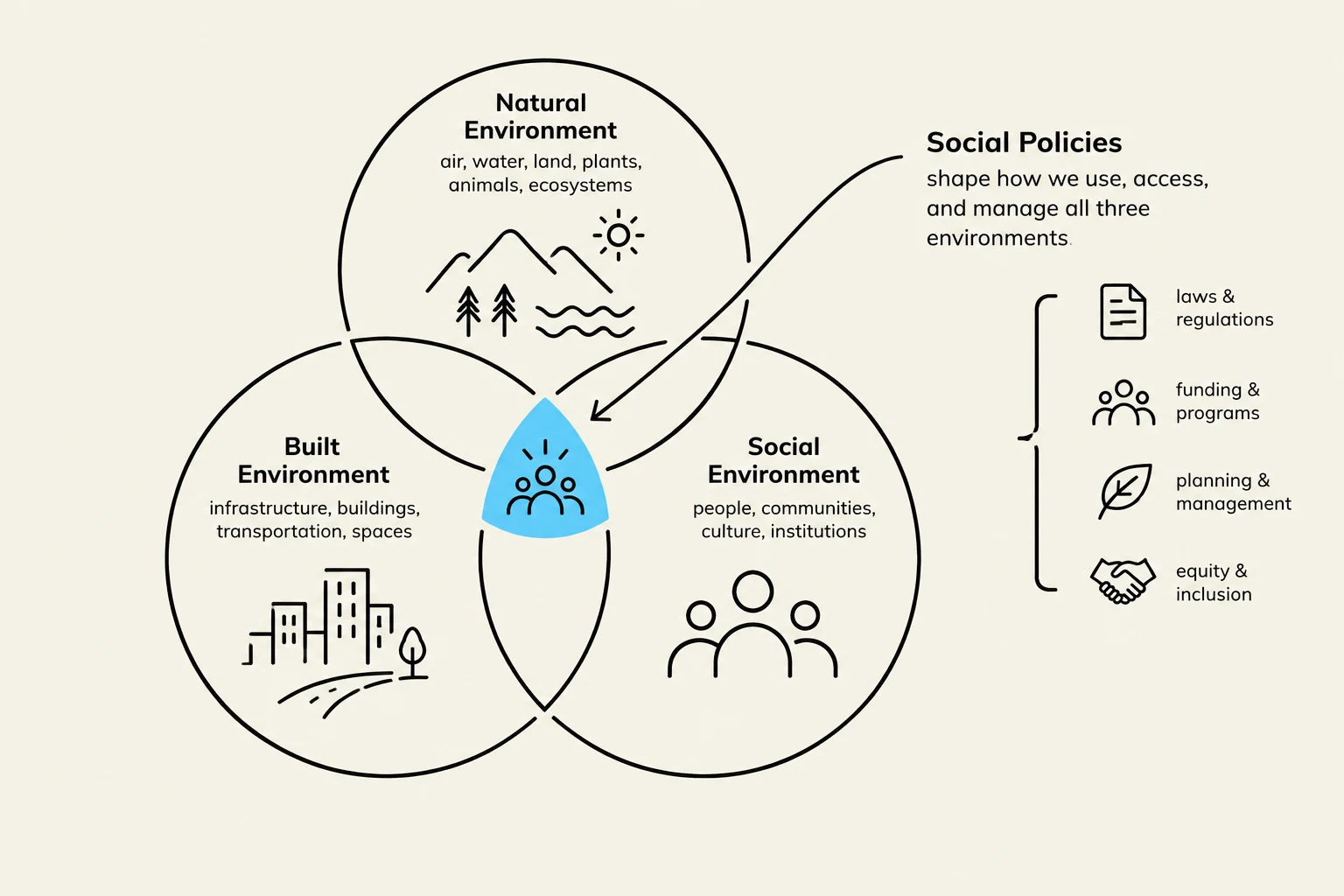
This diagram illustrates the interconnectedness of the natural, built, and social environments, and how social policies influence their management through laws, funding, planning, and equity.
Synthesizing the Three Spheres
To truly define "the environment," one must view these three spheres as an integrated system rather than isolated silos. We can represent the relationship between these spheres through the lens of human impact.
Consider the following relationship:
Human Impact=Social Drivers×(Built Modifications+Natural Resource Extraction)
In this view, the Social Environment (the drivers) dictates the scale and direction of how the Built Environment and the Natural Environment are altered.
Worked Example: The Management of a River
To apply these concepts, let's look at a single river system:
Natural Environment: The river's flow, the fish species living in it, and the surrounding riparian vegetation.
Built Environment: A hydroelectric dam built across the river and concrete embankments used to prevent flooding.
Social Environment: A government policy that mandates cheap electricity for all citizens, which justifies the construction of the dam despite its impact on fish migration.
By breaking the river down this way, we see that an environmental issue (like declining fish populations) is not just a "nature" problem; it is a complex intersection of engineering (built) and policy (social).
Keep reading for free.
Create an account to finish this reading and make it part of your study routine.