


What does it mean to "administer" a country? When we think of government, we often picture politicians debating laws in a parliament or a senate. However, once those laws are passed, the actual work of making them function—collecting taxes, managing national parks, ensuring food safety, and running schools—falls to a different group of people. This is the realm of public administration.
To master this subject, one must first understand that "Public Administration" is not a single, monolithic concept. Instead, it exists in two distinct but overlapping dimensions: it is both a professional field of practice and an academic field of study.
The Dual Nature: Field of Practice vs. Field of Study
One of the most common points of confusion for students is the distinction between what an administrator does and what a scholar studies. While they are deeply interconnected, they serve different purposes.
The Field of Practice
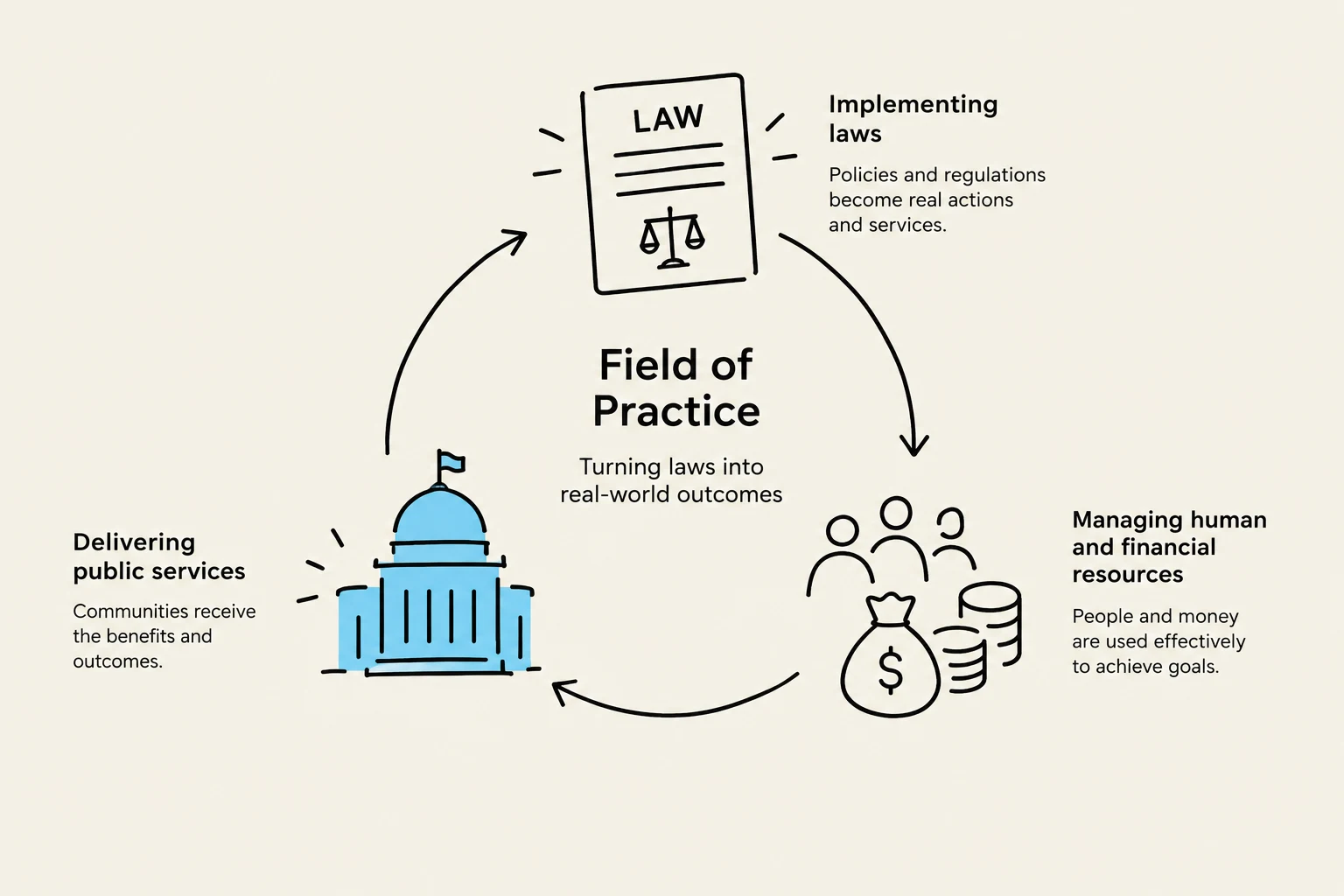
The field of practice refers to the actual implementation of public policy. It is the "doing" side of government. Practitioners—such as city managers, policy analysts, department heads, and frontline civil servants—work within government agencies to achieve specific societal goals.
In this context, administration is about efficiency, management, and the application of rules. A practitioner asks: "How can we deliver this healthcare service to 10,000 citizens using the budget we were allocated?"
The Field of Study
The field of study, or the academic discipline, is the "thinking" side. Scholars in this field examine the processes, structures, and impacts of public administration. They are not necessarily working in government offices; rather, they are analyzing how those offices work.
Keep reading for free.
Create an account to finish this reading and make it part of your study routine.
Continue reading freeAlready have an account? Log in
Updated