


In the modern world, the most pressing challenges—from climate change to social inequality—rarely fit neatly into a single academic category. While universities have historically been organized around specialized "disciplines," these narrow lenses can sometimes limit our ability to see the full picture. Interdisciplinary studies offers a way to move beyond these boundaries, providing a framework to approach complex problems by integrating diverse perspectives into a unified, comprehensive understanding.
Understanding the Spectrum: Disciplinarity to Transdisciplinarity
To understand interdisciplinary studies, one must first distinguish it from several related terms that describe how knowledge is organized and applied.
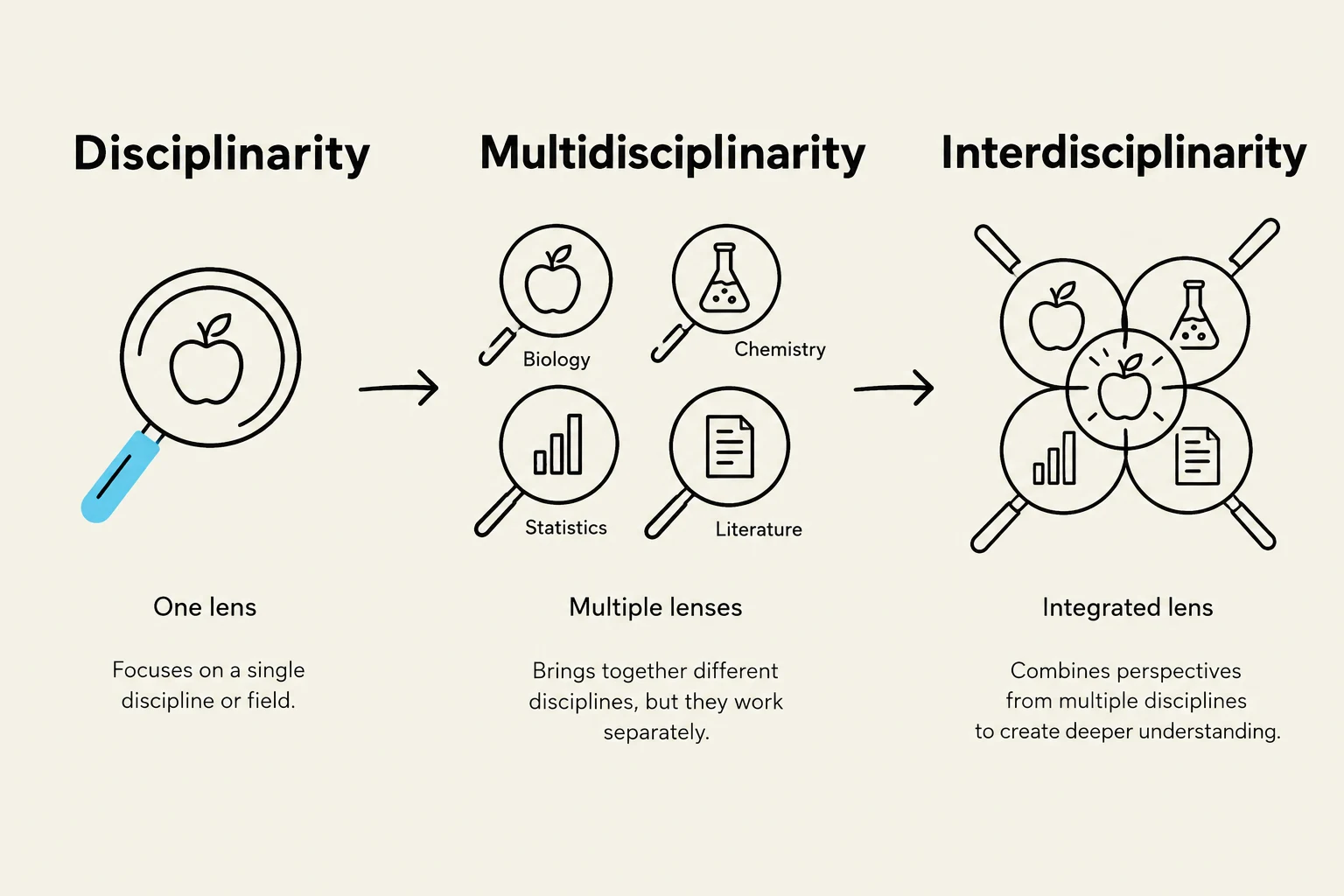
Disciplinarity refers to the system of specialized branches of learning, such as biology, history, or physics. A disciplinary approach uses a "divide and conquer" strategy, breaking a complex problem into smaller parts and studying them through a single, narrow lens. While this reductionism has produced vast amounts of specialized knowledge, it can fail when the parts are not reintegrated to understand the whole.
Multidisciplinarity occurs when insights from two or more disciplines are placed side by side to look at a common issue, but without any attempt to blend them. Think of a "bowl of fruit": you have apples, oranges, and bananas in one bowl, but they remain distinct entities.
Interdisciplinarity goes a step further by using a process of integration. It doesn't just collect insights; it synthesizes them to create something new—much like a "smoothie" where the individual fruits are blended into a single, cohesive flavor.
Transdisciplinarity is an even broader approach. It involves not only academic researchers from different disciplines but also nonacademic stakeholders, such as local government, businesses, or community members. It is a participatory, team-based approach aimed at solving real-world societal problems through public policy.
Keep reading for free.
Create an account to finish this reading and make it part of your study routine.
Continue reading freeAlready have an account? Log in
Updated