This content explains the core concepts of Generative AI, differentiating it from discriminative AI. It covers what Generative AI is, its capabilities in creating various types of content (text, images, audio, video), and contrasts it with discriminative AI models. The explanation includes mathematical underpinnings an
In the rapidly evolving landscape of artificial intelligence, few terms have captured the global imagination quite like "Generative AI." While traditional AI has long been used to power recommendations, recognize faces, or predict stock trends, a new paradigm has emerged—one that moves beyond mere analysis to active creation. Understanding this distinction is fundamental to grasping how modern machine learning is reshaping industries and human creativity.
This diagram illustrates the difference between traditional AI, which analyzes data and classifies it, and generative AI, which identifies underlying patterns to create new outputs.
What is Generative AI?
At its core, Generative AI is a subset of artificial intelligence focused on the ability to create new, original content. Unlike traditional systems that are designed to follow strict rules or classify existing data, generative models learn the underlying patterns, structures, and distributions of the data they are trained on.
Once a model has "learned" these patterns, it can use that knowledge to generate entirely new data points that look, sound, or feel like the original training set, but are not direct copies. This capability allows the AI to produce a vast array of outputs, including:
Text: Essays, poems, code, and conversational dialogue.
Images: Realistic photographs, digital art, and diagrams.
Audio: Music, voice cloning, and sound effects.
Video: Short clips and animated sequences.
Key Concept: Generative AI does not "search" for an answer in a database; it "predicts" the next logical element (like a word or a pixel) based on the statistical patterns it learned during training.
Generative vs. Discriminative AI
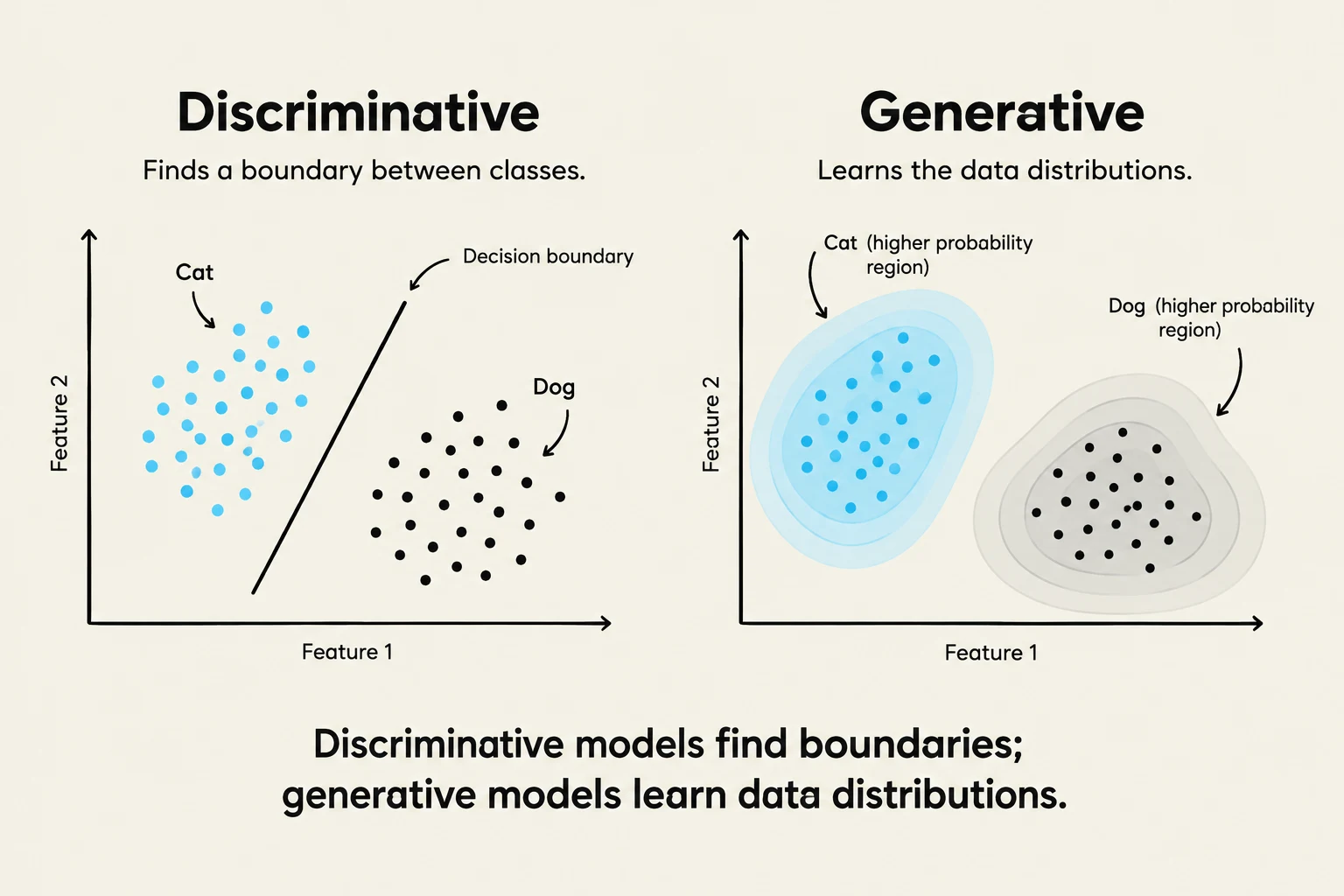
This illustration contrasts discriminative and generative models in machine learning. Discriminative models learn to find a boundary between classes, as shown by the decision boundary separating 'Cat' and 'Dog' data points. Generative models learn the data distributions, illustrating how 'Cat' and 'Dog' data points form distinct probability regions.
To truly define Generative AI, it is helpful to compare it to its predecessor: Discriminative AI. Most of the AI we have interacted with over the last decade falls into the discriminative category.
Discriminative AI: The Classifier
Discriminative models are designed to distinguish between different types of data. They look for boundaries that separate data points into specific categories. If you show a discriminative model a thousand pictures of cats and dogs, its goal is to learn the features that differentiate a cat from a dog so that when it sees a new image, it can accurately label it.
Mathematically, if we have input data x and a label y, a discriminative model attempts to learn the conditional probability P(y∣x)—the probability of a label y given the input x.
Generative AI: The Creator
Generative models take a different approach. Instead of just learning the boundary between "cat" and "dog," a generative model learns what a "cat" actually is by understanding the distribution of all cat-related data. It learns the features that make up the essence of the subject.
Mathematically, a generative model attempts to learn the joint probability P(x,y)—the probability of seeing both the data x and the label y together. By understanding this distribution, the model can sample from it to create a brand-new instance of x that has never existed before.
Feature
Discriminative AI
Generative AI
Primary Goal
Classify or predict labels
Create new data
Core Task
Find boundaries between classes
Learn the distribution of data
Output
A label or a category (e.g., "Dog")
New content (e.g., an image of a dog)
Mathematical Focus
$P(y
x)$
P(x,y) |
Exam Tip: If a question asks about an AI that identifies fraudulent transactions or detects spam emails, it is describing Discriminative AI. If it asks about an AI that writes a summary of an email or generates a fake image, it is describing Generative AI.
The Mechanics of Creation
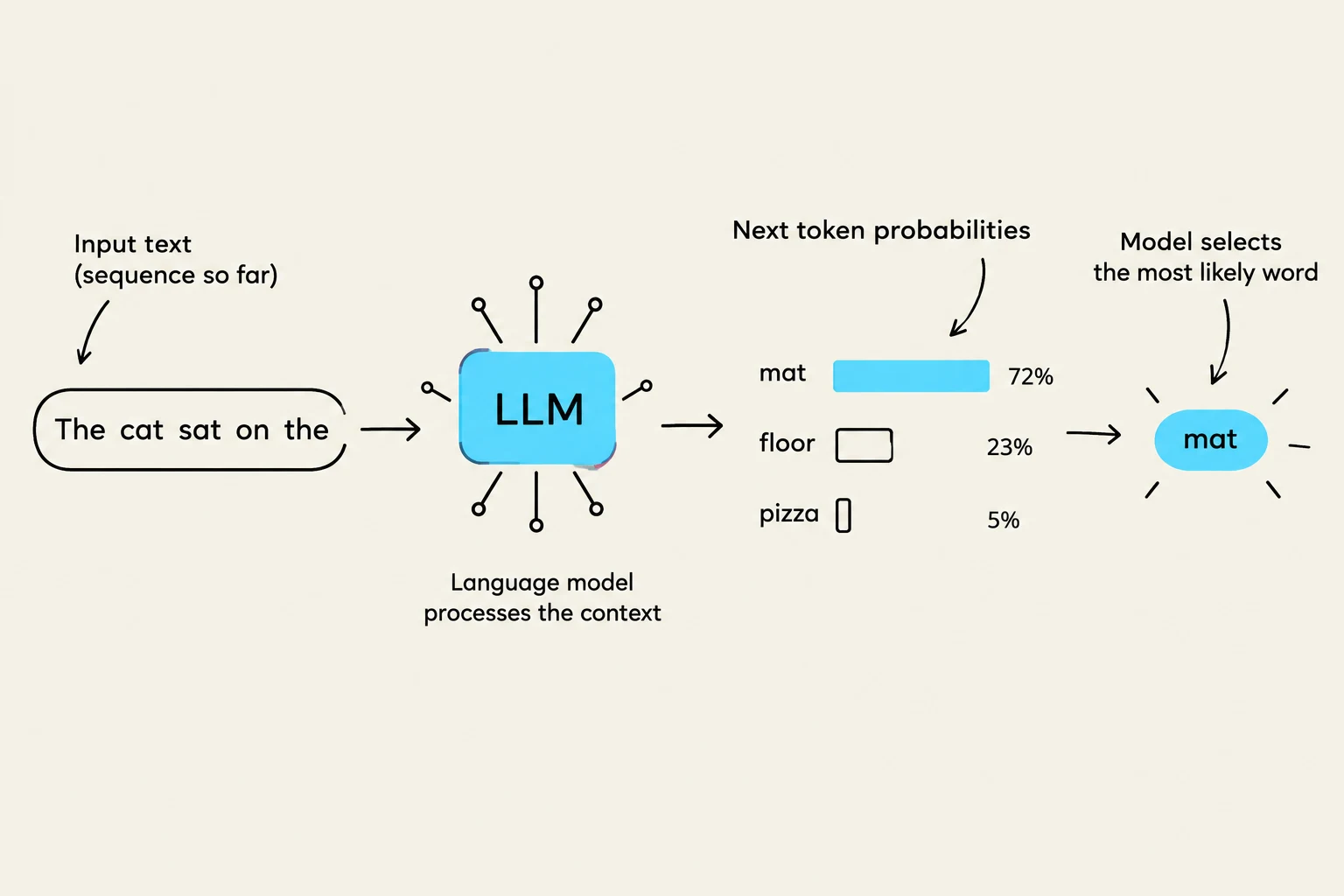
This diagram illustrates how a Large Language Model (LLM) predicts the next word in a sequence. Given the input 'The cat sat on the', the model calculates the probabilities for potential next words, selecting 'mat' as the most likely option with 72% probability.
The "magic" of generative AI lies in its ability to handle high-dimensional data. For example, a single high-resolution image contains millions of pixels, each with its own color value. For a human, describing the "pattern" of a sunset is easy, but for a computer, it is a massive mathematical challenge.
Generative models use complex architectures—such as Transformers for text or Diffusion models for images—to navigate these dimensions. They work by iteratively refining noise or predicting sequences of tokens to arrive at a coherent final product.
For instance, in Large Language Models (LLMs), the process is often viewed as a sequence of probability distributions. To generate the sentence "The cat sat on the...", the model calculates the probability of every possible next word in its vocabulary:
P(mat∣The, cat, sat, on, the)
The model then selects a word based on these probabilities, and repeats the process until the sequence is complete.
Summary
Generative AI represents a shift from AI as a tool for observation to AI as a tool for production. While discriminative AI remains essential for tasks requiring accuracy and classification, generative AI opens new frontiers in creativity, automation, and complex problem-solving by mastering the ability to synthesize new information from learned patterns.
Keep reading for free.
Create an account to finish this reading and make it part of your study routine.