This reading defines motor learning as internal processes leading to relatively permanent changes in movement capability, discusses performance characteristics like improvement and consistency, and explains methods for assessing learning through retention and transfer tests.
In the study of human movement, one of the most fundamental yet elusive concepts is motor learning. While we can easily observe a person practicing a skill—such as a basketball player shooting free throws or a pianist playing a scale—we cannot actually "see" the learning itself. Learning is an internal phenomenon. To understand how skills are acquired, we must bridge the gap between what we observe (performance) and what is actually happening within the nervous system (learning).
Defining Motor Learning
To study this phenomenon scientifically, we must move beyond vague notions of "getting better" and adopt a formal definition. Motor learning is defined as "a set of internal processes associated with practice or experience leading to relatively permanent changes in the capability for movement".
This definition contains three critical components that you should remember for exams:
Internal Processes: Learning happens in the brain and nervous system; it is not the movement itself, but the change in the underlying program.
Practice/Experience: Learning does not happen spontaneously; it requires exposure to a task or training.
Relatively Permanent Changes: If a person performs well once due to luck or high arousal, but cannot repeat it the next day, learning has not occurred. True learning implies a lasting change in capability.
Exam Tip: If a question asks you to distinguish between performance and learning, remember that performance is a temporary observation of behavior, while learning is the internal, relatively permanent change in capability.
Performance Characteristics: How We Measure Success
Since we cannot observe internal processes directly, we must infer learning by looking for specific changes in performance. Researchers look for several key characteristics to determine if a skill has been truly acquired.
The Five Pillars of Learning
Improvement: An increase in the quality of movement over time.
Consistency: A reduction in the variability of performance. If a learner hits the same target repeatedly, they are becoming more consistent.
Stability: The ability to maintain performance levels without frequent, erratic fluctuations.
Persistence: The longevity of the learned skill. How long does the skill last after practice stops?.
Adaptability: The ability to modify movement patterns to meet new environmental demands (e.g., playing tennis on grass vs. clay).
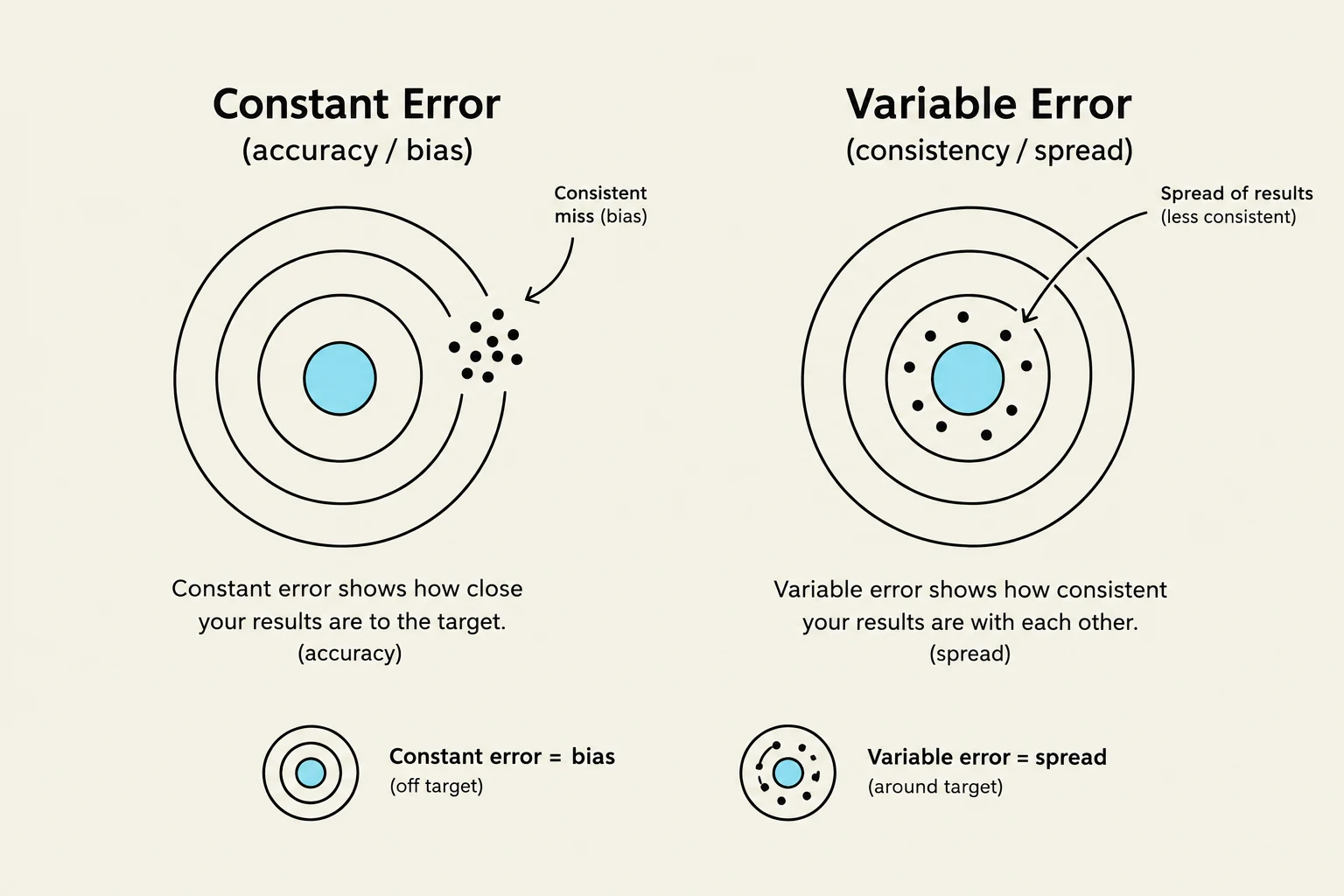
To quantify these characteristics, researchers often use error metrics. Constant Error (CE) is used to measure accuracy (how close the average movement is to the target), while Variable Error (VE) is used to measure consistency (how much the movements deviate from one another).
This illustration contrasts constant error (accuracy/bias) with variable error (consistency/spread) using target diagrams.
Analyzing Performance Curves
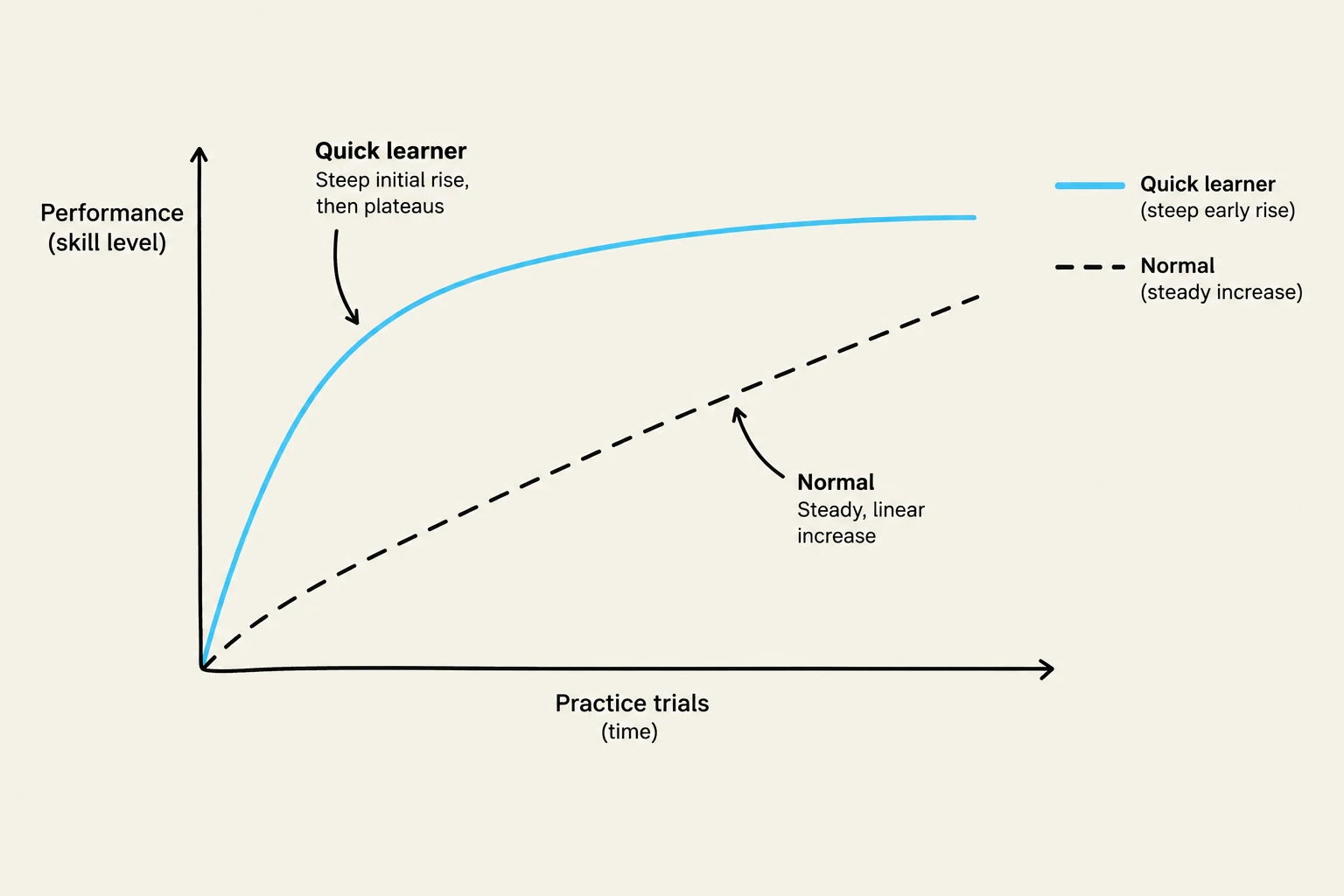
As individuals practice, their performance typically follows a trajectory known as a performance curve. By plotting performance (on the y-axis) against time or practice trials (on the x-axis), we can visualize the acquisition process.
However, not everyone learns at the same rate. This is known as between-subject variability. When looking at a group of learners, you might observe:
Quick Learners: Individuals who show a rapid increase in performance early in the practice phase.
Normal Learners: Individuals who follow a standard, steady progression.
The "Pop-corn" Effect: This refers to learners who show little to no improvement for a long period, followed by sudden, unexpected bursts of significant improvement.
A graph illustrating two learning curves: a 'Quick learner' with a steep initial rise followed by plateaus, and a 'Normal' learner with a steady, linear increase in performance over practice trials.
In addition to error metrics, researchers may use kinematic measures—the study of the geometry of motion (such as joint angles, velocity, or acceleration)—to provide a more granular look at how movement patterns change during acquisition.
Validating Learning: The Retention-Transfer Approach
The greatest challenge in motor learning research is ensuring that a high score on a test is actually due to learning and not just a "warm-up" effect or temporary practice effects. To solve this, researchers use the retention-transfer approach.
Retention Tests
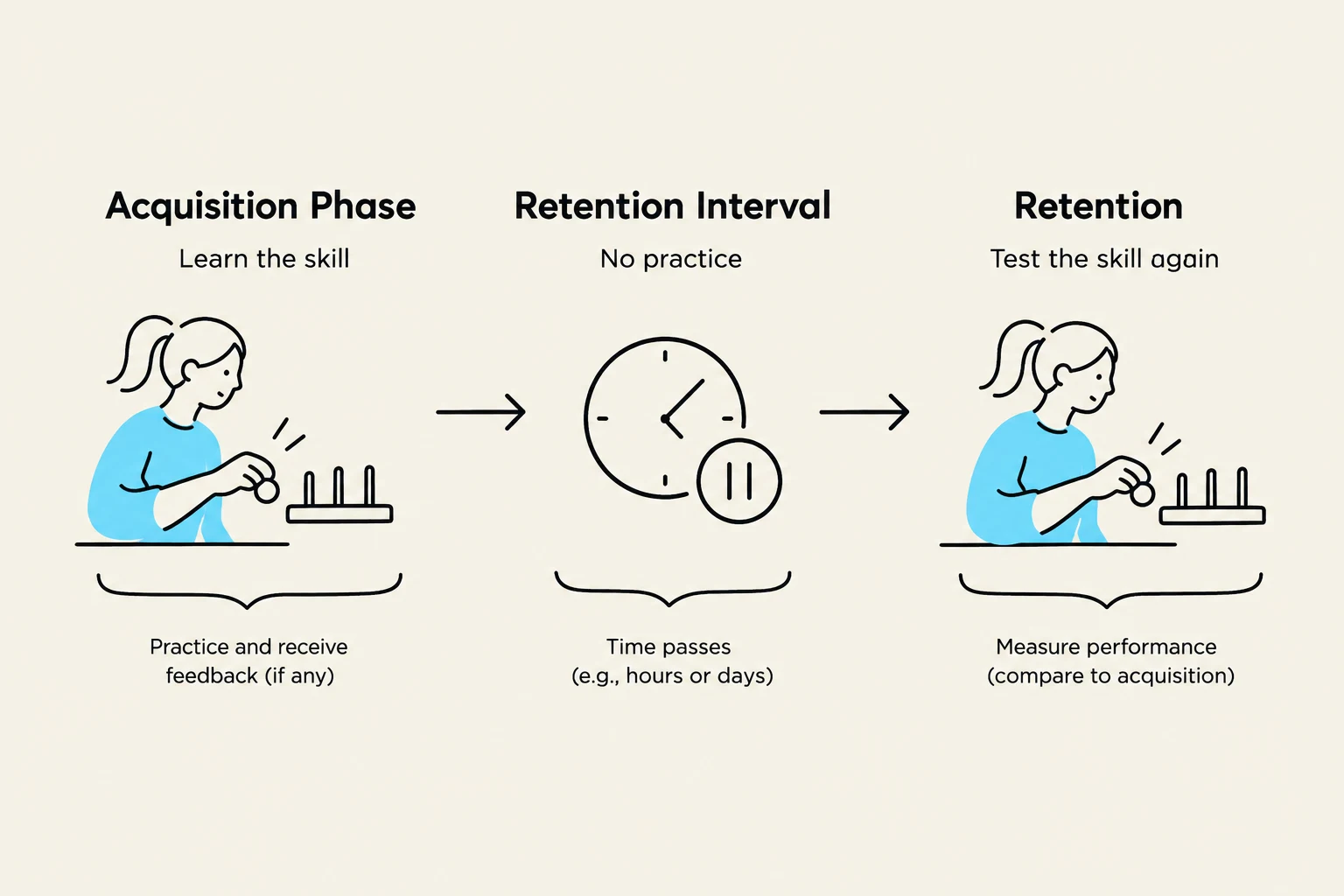
A retention test is a performance test administered after a specific retention interval—a period during which no practice occurs. If the learner can still perform the skill after a day or a week of rest, it provides strong evidence that the changes are "relatively permanent" and thus constitute true learning.
Transfer Tests
A transfer test assesses how the learning experience can be generalized to new tasks or environments. For example, if you learn to drive a car, a transfer test might involve seeing how well you can drive a truck. Transfer can be assessed with or without a delay following the acquisition phase.
Pro-Tip for Researchers: To ensure a test is truly measuring learning, researchers often use delayed tests and withhold Knowledge of Results (KR). By removing the feedback (KR) that the learner relied on during practice, researchers can see if the internal motor program has truly been established.
This diagram illustrates the three phases of skill acquisition: acquisition, retention interval, and retention. During acquisition, a skill is learned through practice and feedback. The retention interval involves a period of no practice, during which time passes. Finally, retention involves testing the skill again to measure performance compared to the acquisition phase.
By combining these methods—analyzing error metrics, observing performance curves, and utilizing retention and transfer tests—scientists can confidently distinguish between a temporary spike in performance and the profound, lasting change that defines motor learning.
Keep reading for free.
Create an account to finish this reading and make it part of your study routine.