Defining a Team: Pillars of Complementary Skills, Common Purpose, and Mutual Accountability
This content explains the fundamental differences between a group and a team from a management and organizational psychology perspective. It details the three core pillars that define a team: complementary skills, a common purpose, and mutual accountability, providing examples and a summary table of key distinctions.
In professional environments, the terms "group" and "team" are often used interchangeably. However, from a management and organizational psychology perspective, they are fundamentally different. A group is simply a collection of individuals who may work in the same department or share a common space, but they lack the structural interdependence required to function as a single unit. A true team, by contrast, is a specialized entity characterized by specific structural elements that drive collective performance.
Understanding these distinctions is critical for leaders who wish to transition their staff from a collection of individual contributors into a high-performing cohesive unit. To define a team, we must look at three core pillars: complementary skills, a common purpose, and mutual accountability.
The Three Pillars of a Team Definition
A team is not defined by its size or its physical proximity, but by the way its members interact and rely on one another. If any one of the following three pillars is missing, you likely have a group rather than a team.
1. Complementary Skills
In a group, members often possess similar skill sets and work on independent tasks. In a team, however, members bring diverse and specialized abilities that "plug into" one another. This creates a synergy where the total output of the team is greater than the sum of the individual parts. This is often expressed through the concept of synergy, where the interaction of elements produces a result that none could achieve alone.
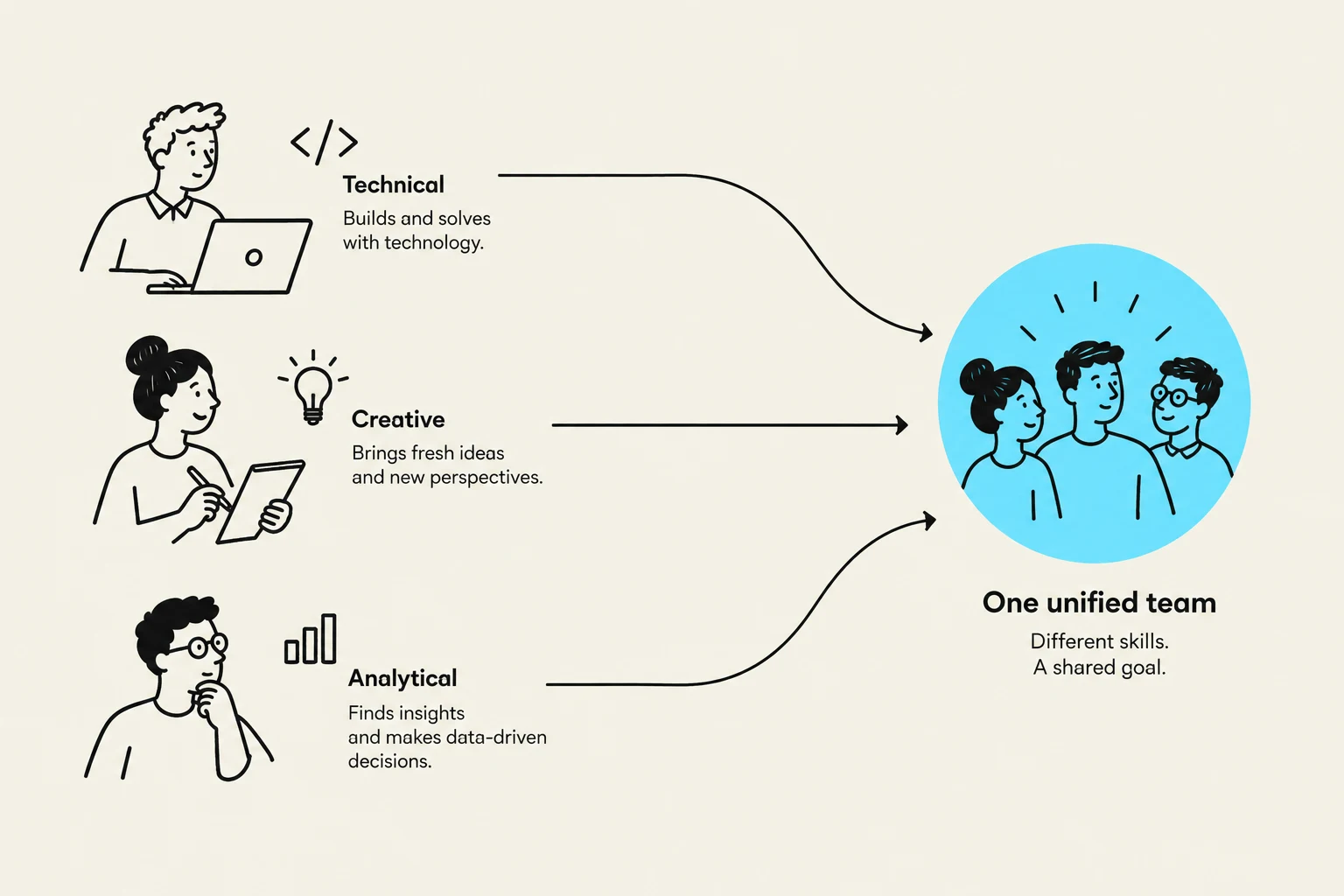
Illustration showing how technical, creative, and analytical skills contribute to a unified team with a shared goal.
For example, in a software development team, you do not just need five programmers. You need a mix of backend developers, frontend designers, quality assurance testers, and a product manager. Their skills are not redundant; they are complementary.
2. Common Purpose
A team must be unified by a shared goal or a clear mission. While group members might have individual goals that happen to align with the company's direction, team members are driven by a singular, collective objective. This purpose acts as the "North Star," guiding decision-making and resolving conflicts when members disagree on the path forward.
Exam Tip: If a question asks you to distinguish between a work group and a team, look for the "Goal" variable. A group focuses on individual accountability toward a task, whereas a team focuses on collective achievement toward a shared mission.
3. Mutual Accountability
This is perhaps the most difficult pillar to establish. In a group, if one person fails, the others are rarely affected beyond a sense of shared frustration. In a team, members hold themselves and each other responsible for the final outcome. Accountability is not just "top-down" (from a manager to a subordinate), but "lateral" (between peers).
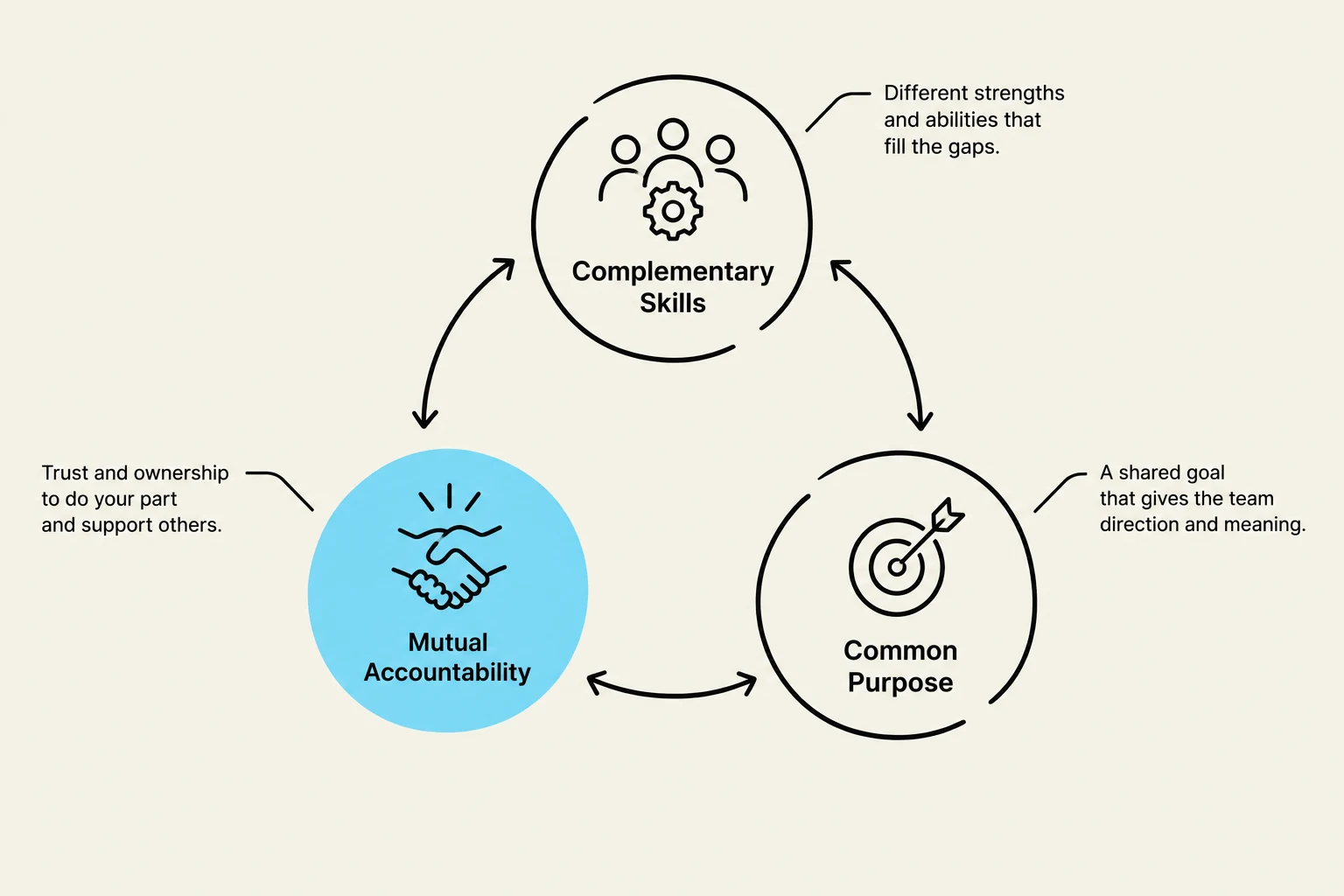
This diagram illustrates the key components of effective teamwork: complementary skills, mutual accountability, and a common purpose, highlighting how trust and shared goals contribute to team success.
When accountability is mutual, team members feel a sense of obligation to their peers. If a designer misses a deadline, the developer feels the impact immediately, and the team works together to rectify the delay because the failure is viewed as a collective setback rather than an individual's private problem.
Worked Example: Group vs. Team
To solidify these concepts, let's compare two scenarios in a corporate setting.
Scenario A: The Sales Department (A Group)
The department consists of 10 sales representatives. Each representative has their own territory, their own monthly quota, and their own commission structure. If Representative A exceeds their goal, it has no direct impact on Representative B's success. They share an office and a manager, but their work is largely independent. This is a group.
Scenario B: The Product Launch Task Force (A Team)
A company forms a special unit to launch a new smartphone. This unit includes a marketing specialist, a supply chain expert, a hardware engineer, and a financial analyst.
Complementary Skills: The engineer builds the product, the analyst ensures it's profitable, and the marketer ensures it sells.
Common Purpose: The successful launch of the smartphone on a specific date.
Mutual Accountability: If the supply chain expert fails to secure components, the launch fails, and the entire task force is held responsible for the missed milestone.
This is a team.
Summary of Key Differences
The following table summarizes the distinctions discussed above:
Feature
Work Group
True Team
Goal
Share information
Collective performance
Synergy
Neutral (sometimes negative)
Positive synergy
Accountability
Individual
Individual and Mutual
Skills
Random or similar
Complementary
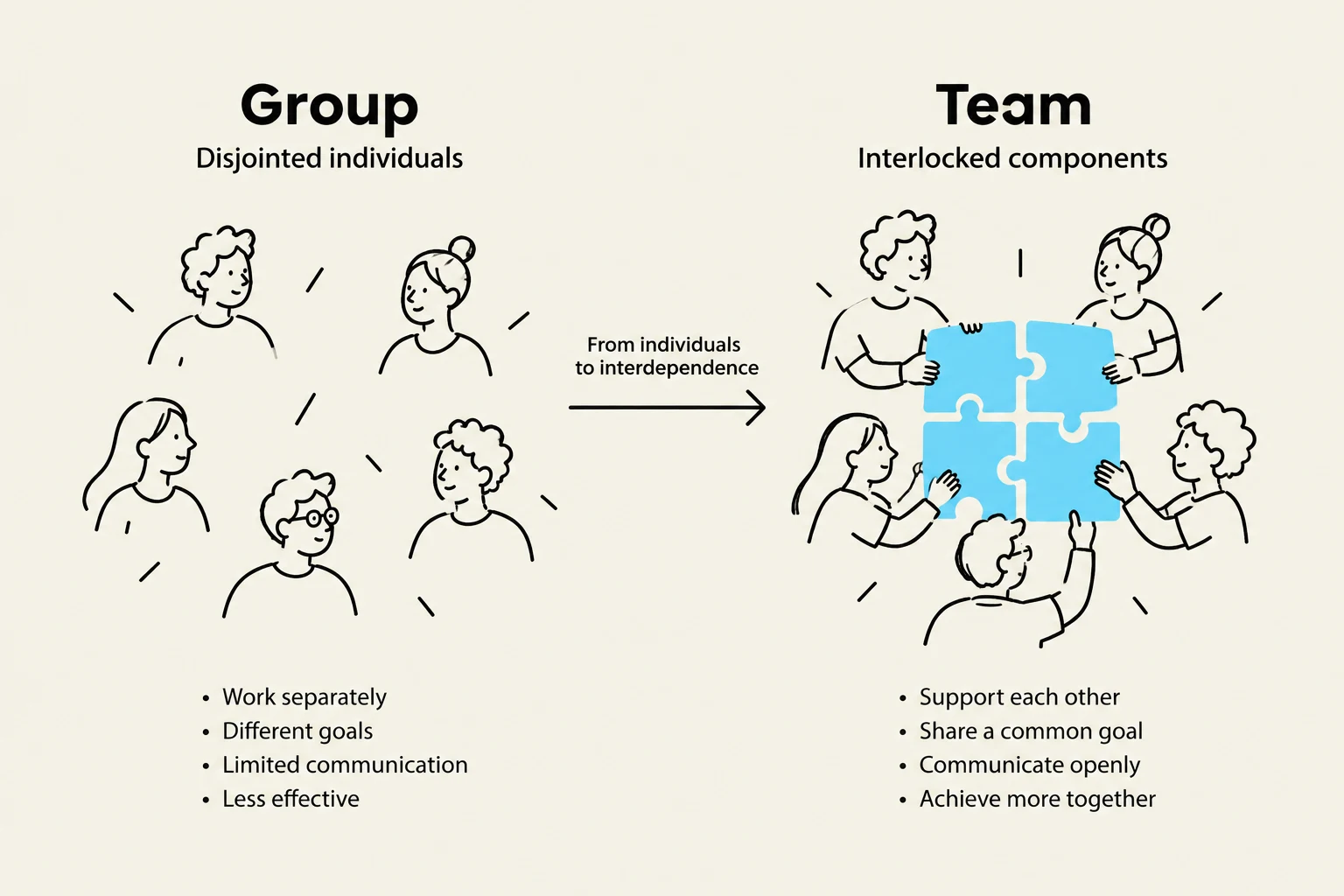
This illustration contrasts a group of disjointed individuals with a team of interlocked components, highlighting the transition from individual efforts to interdependence and collaboration.
By focusing on these three pillars—skills, purpose, and accountability—organizations can move beyond mere collections of employees and begin building the cohesive units necessary for complex problem-solving and innovation.
Keep reading for free.
Create an account to finish this reading and make it part of your study routine.