This content addresses and debunks common misconceptions about dog behavior, social order, training methods, and the science behind canine actions. It contrasts outdated theories with evidence-based principles from ethology and behavioral science.
For many dog owners and even some professionals, understanding canine behavior feels like navigating a minefield of "common sense" rules. Much of what is taught in training circles is based on outdated theories of dominance and social hierarchy that have been debunked by modern ethology and behavioral science. To truly communicate with our dogs, we must move past these myths and look toward evidence-based principles.
The Myth of Social Order and Dominance
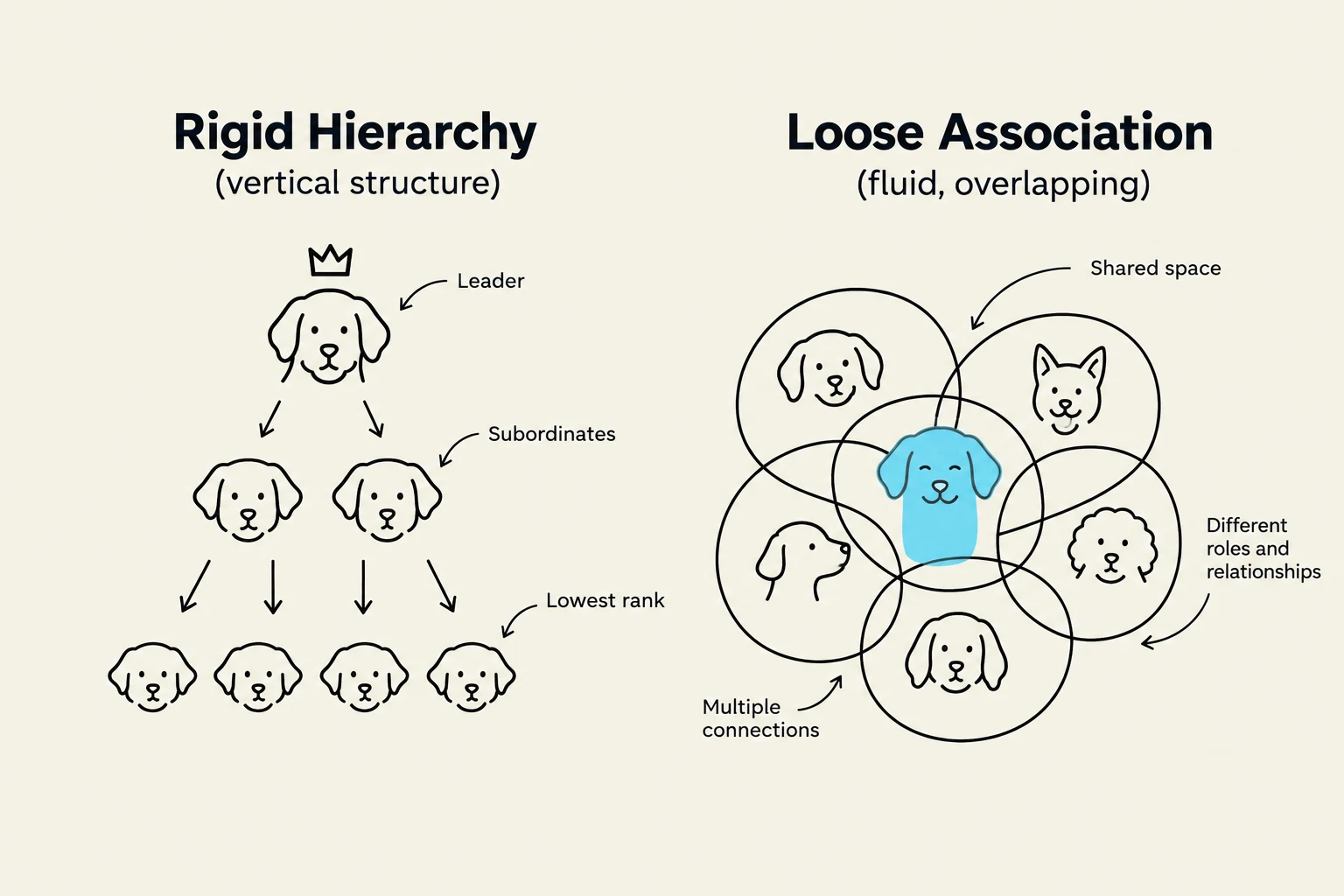
One of the most pervasive misconceptions in the canine world is the idea that dogs live in a rigid, hierarchical "pack" with a clear leader. This concept often leads to advice such as "don't let your dog exit the doorway before you" to avoid letting them be "dominant". However, studies of free-ranging, feral, and semi-feral dog populations show that they do not form structured packs; instead, they form loose, transitory, and amorphous associations.
Furthermore, the idea that a dog's position in a doorway or their order in receiving treats reflects a social rank is unsupported by evidence. A dog rushing through a door is often simply motivated by what is on the other side or is moving at a higher ambulation speed than a human.
Study Tip: When evaluating a behavior, ask if it is a "social" behavior or a "motivational" behavior. A dog running to a door is likely motivated by curiosity or excitement, not a desire to usurp your leadership.
This illustration contrasts a rigid hierarchy with a loose association, using dog illustrations to represent different organizational structures.
Reevaluating Conditioning and Reinforcement
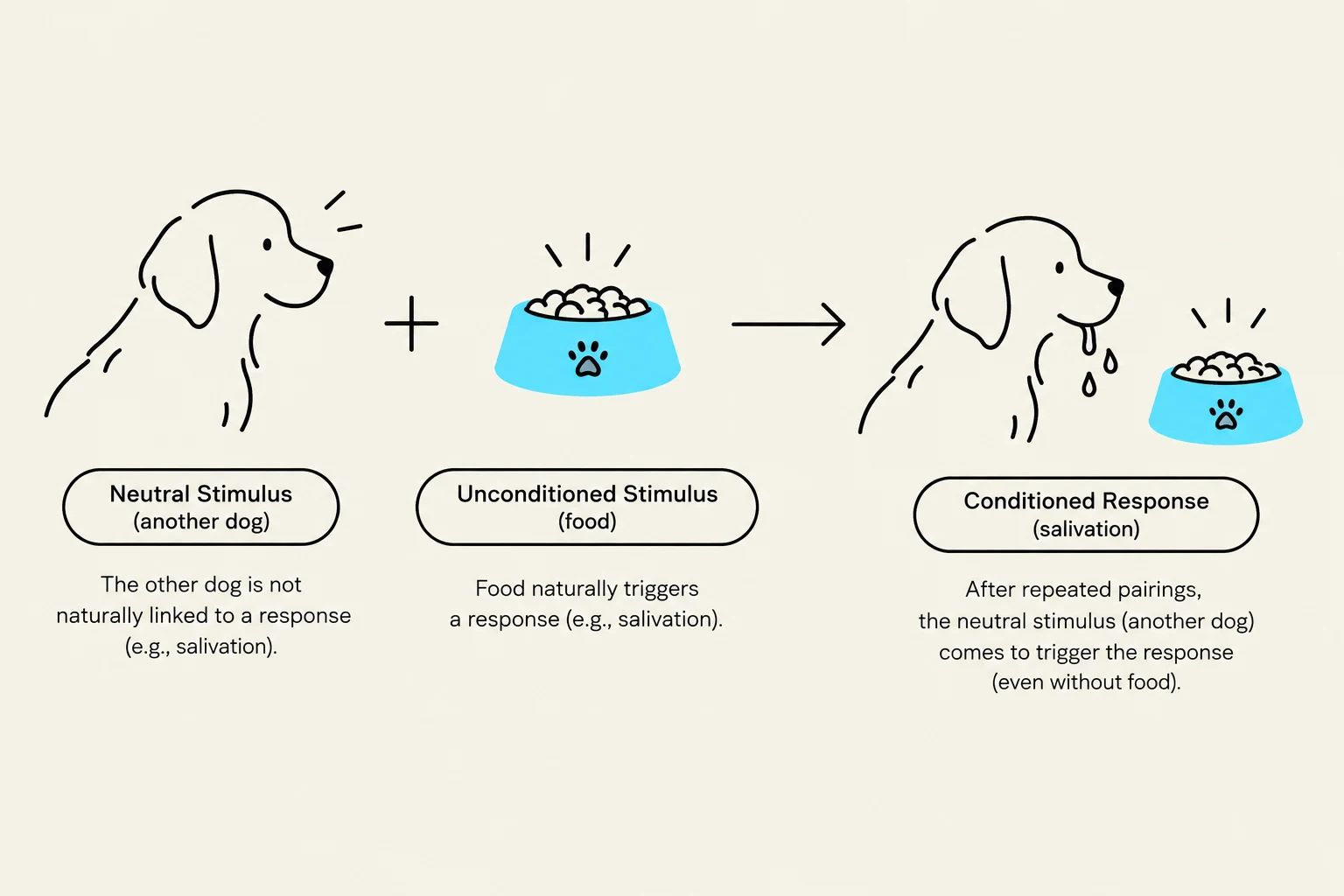
In multi-dog households, owners are often told to "support the hierarchy" by feeding the "dominant" dog first. This practice has no proven impact on inter-dog aggression. In fact, applying the laws of Pavlovian conditioning can actually lead to better results if we reverse this approach.
By using positive reinforcement—the process of providing a reward following a desired behavior—we can change a dog's emotional response to others. For example, if an aggressive dog sees another dog receiving a treat, they can be trained to associate that sight with their own upcoming reward. This creates a happy emotional response rather than a reactive one.
Bribes vs. Rewards
A common myth is that rewards are "bribes" that compromise the relationship. In behavioral science, a bribe is typically given before a behavior, whereas a reward is given after. Decades of research demonstrate that positive reinforcement actually strengthens the bond between human and dog.
This diagram illustrates classical conditioning, showing how a neutral stimulus (another dog) can become associated with an unconditioned stimulus (food) to elicit a conditioned response (salivation).
Understanding Fear and Aggression
Misunderstanding the function of certain behaviors can lead to dangerous training mistakes, particularly regarding fear and aggression.
The Danger of Suppressing Growls
Many trainers suggest punishing a dog for growling to prevent aggression. However, a growl is a vital communication tool—it is the dog's way of saying something is upsetting them. If you punish the growl, you are essentially "removing the ticker from the time bomb". The dog is still upset, but now they have lost their warning signal, which significantly increases the risk of an unprovoked bite.
Fear is Not Manipulation
There is a myth that if you comfort a dog while they are afraid, you are "rewarding the fear". This is a misunderstanding of what fear is. Fear is an emotional state, not a manipulative tactic. Just as giving a person a chocolate during a crisis doesn't make them want to be in a crisis again, comforting a dog does not cause them to seek out fearful situations.
Genetics, Environment, and Cooperative Behavior
Finally, we must address the interplay between what a dog is born with and how they are raised.
The "Desire to Please" Myth: There is no scientific definition for an innate "desire to please". Dogs are motivated by biological needs: food, water, sex, play, and social bonds.
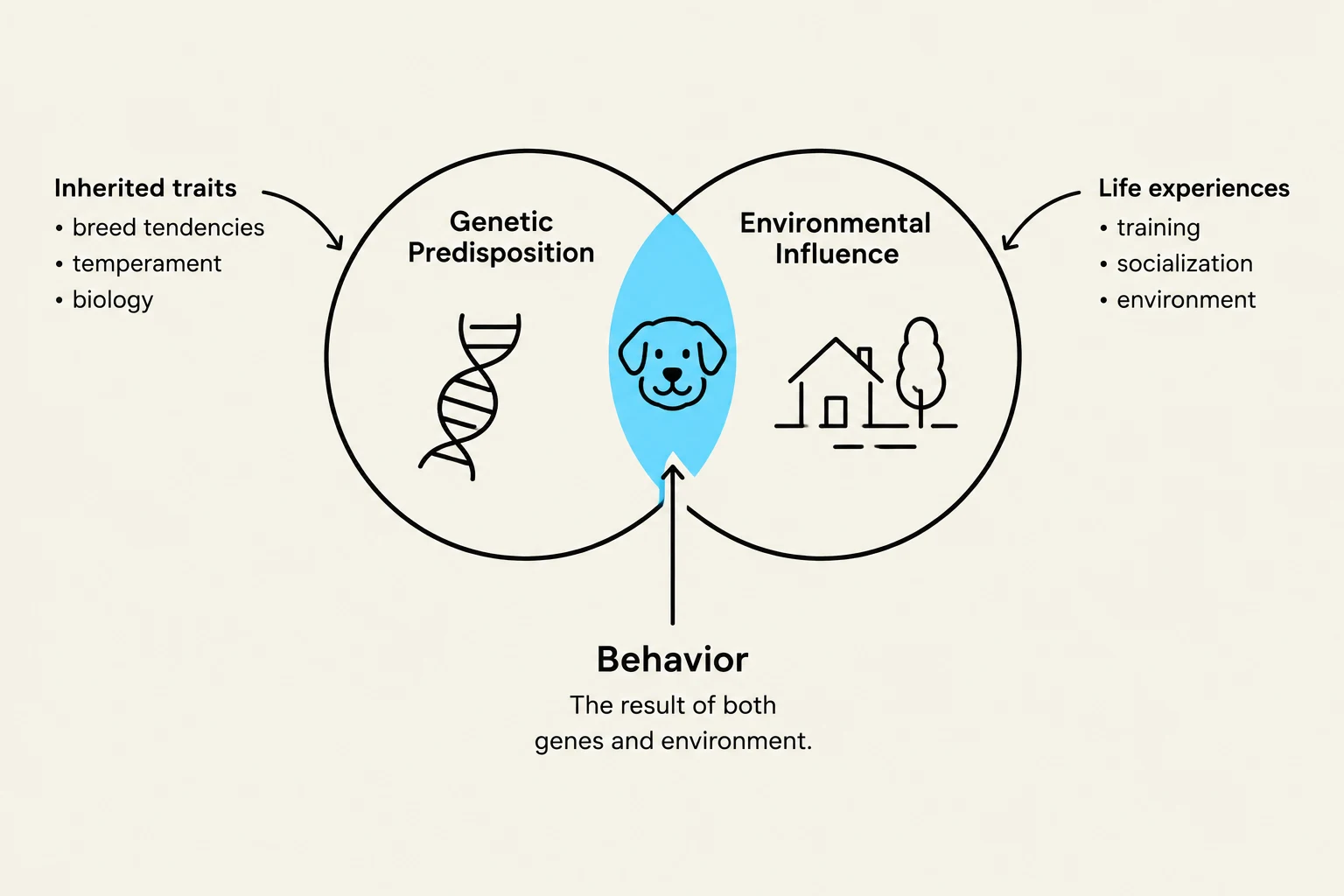
Genetic vs. Learned Behavior: It is a myth that "genetic" behaviors cannot be modified. All behavior is an interplay between genes and the environment. While some behaviors are more deeply rooted, their modifiability varies depending on the individual and the context.
Cooperative Play: Activities like tug-of-war are often wrongly accused of causing aggression. In reality, tug is a cooperative behavior directed at a simulated prey (the toy) and has no proven correlation with increased aggression.
This diagram illustrates how behavior is influenced by both genetic predisposition and environmental factors, such as inherited traits, life experiences, and the surrounding environment.
Summary Table: Myth vs. Reality
Myth
Scientific Reality
Dogs are pack animals with a hierarchy
Dogs form loose, transitory associations
Growling should be punished
Growling is a warning; punishing it increases bite risk