Darwin's Voyage and the Foundations of Evolutionary Theory
Explore Charles Darwin's transformative journey on the HMS Beagle, his key observations of fossils, geology, and species variation in South America and the Galapagos Islands, and how these laid the groundwork for his theory of evolution by natural selection.
In the mid-19th century, the scientific understanding of life on Earth was largely dominated by the idea that species were fixed and unchanging. This perspective was challenged by a young naturalist named Charles Darwin, whose five-year journey aboard the HMS Beagle would fundamentally alter the course of biological science. While Darwin did not arrive at his theory of natural selection immediately upon landing, the observations he collected during his travels provided the essential raw data required to dismantle the old paradigm and build a new one.
The Voyage of the HMS Beagle
The journey began in 1831, when the HMS Beagle set sail on a mission primarily intended for surveying coastlines and mapping the geography of South America. Darwin, a trained naturalist, accompanied the expedition to collect specimens, document geological formations, and observe the flora and fauna of the regions they visited.
This was not merely a pleasure cruise; it was a rigorous scientific undertaking. The ship traveled through vast, diverse ecosystems, exposing Darwin to environments that were vastly different from the temperate climate of England. This exposure to geographic isolation and environmental variety was the catalyst for his later insights into how life adapts to its surroundings.
Observations in South America
Comparison of the extinct Glyptodon fossil to a modern armadillo, highlighting shared features like armored carapaces, short, armored tails, and robust limb structures.
One of the most significant portions of the voyage involved exploring the coastlines of South America. During this time, Darwin made several key observations that would later serve as pillars for his theory of evolution.
Fossil Records and Extinct Species
In South America, Darwin discovered fossils of massive, extinct mammals, such as the Glyptodon (a giant armadillo-like creature). He noticed a striking similarity between these extinct giants and the smaller, living armadillos and sloths currently inhabiting the same regions.
This observation led to a profound realization: if the extinct species shared structural similarities with the living ones in the same area, perhaps they were not entirely different entities, but rather descendants that had changed over time. This provided early evidence for the concept of "descent with modification".
Geological Changes
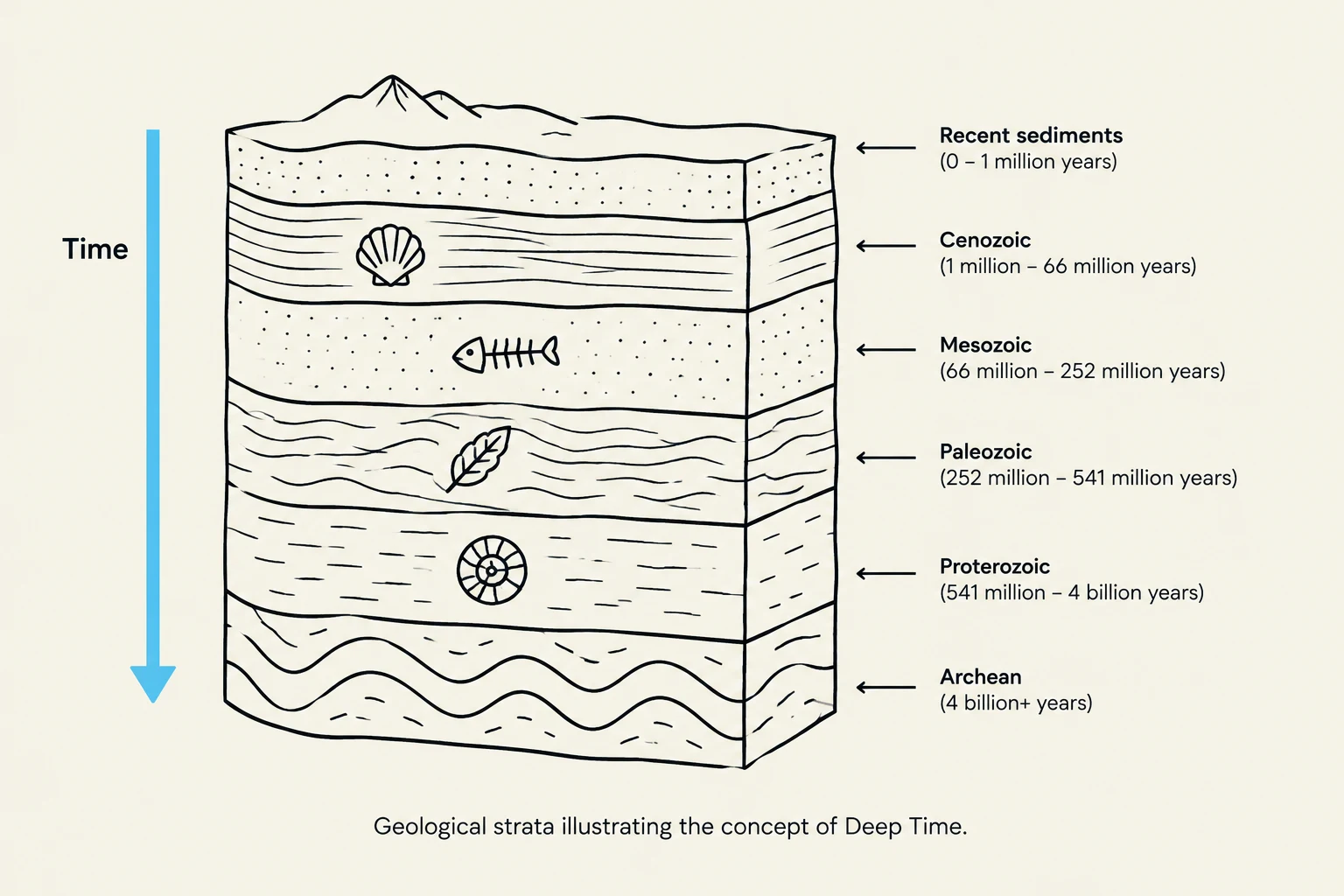
Geological strata illustrating the concept of Deep Time.
Darwin also observed how the earth's surface changed over time. By studying rock layers and the uplift of mountains, he began to understand that the Earth was much older than previously thought. A long-lived Earth provided the necessary "deep time" required for slow, incremental biological changes to occur.
Study Tip: When discussing Darwin's early evidence, always link his geological observations to his biological ones. The concept of "Deep Time" is essential; evolution requires millions of years to manifest visible changes in a species.
The Galapagos Islands: A Natural Laboratory
Perhaps the most famous leg of the voyage was the visit to the Galapagos Islands, an archipelago located in the Pacific Ocean. Because these islands are volcanic and isolated from the mainland, they acted as a natural laboratory for Darwin.
Species Variation and Isolation
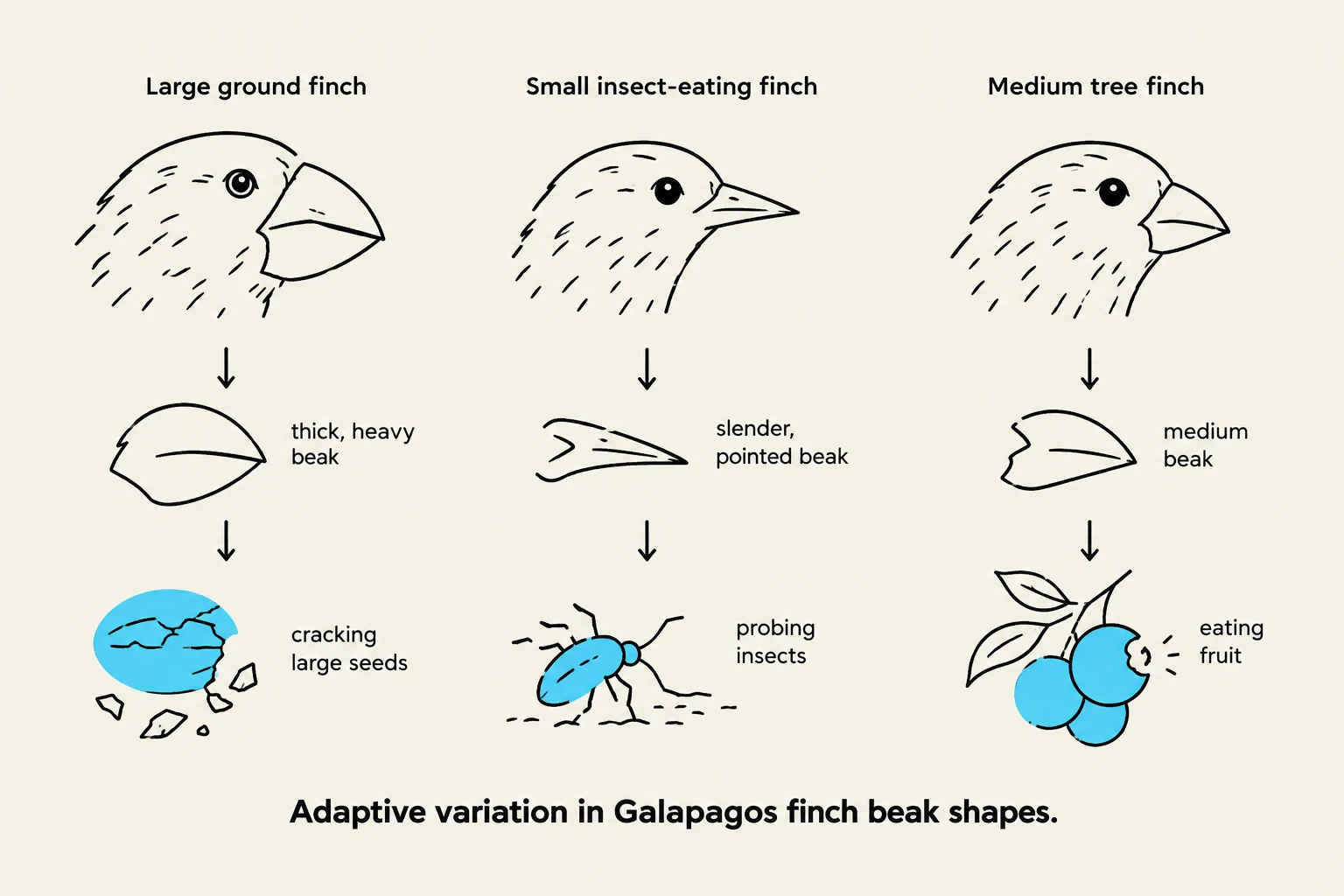
Adaptive variation in Galapagos finch beak shapes, illustrating how different beak morphologies are suited for specific food sources like seeds, insects, or fruit.
Darwin observed that different islands within the archipelago hosted slightly different versions of the same types of animals. The most notable examples were the finches and the giant tortoises.
Finches: He noticed that finches on different islands had beak shapes specifically adapted to the food sources available on those islands (e.g., some had thick beaks for cracking seeds, while others had slender beaks for eating insects).
Tortoises: Similarly, the shells of the giant tortoises varied depending on the vegetation and terrain of the specific island they inhabited.
These variations suggested that species were not "fixed" in their design. Instead, they seemed to have been shaped by the specific environmental pressures of their respective islands. This isolation allowed populations to diverge from their common ancestors as they adapted to unique ecological niches.
From Observation to Theory
It is a common misconception that Darwin "discovered" evolution the moment he saw a finch. In reality, it took years of synthesizing these observations—the fossil records of South America, the geological age of the Earth, and the specialized adaptations in the Galapagos—to arrive at his groundbreaking theory.
The connection Darwin eventually made was that these variations were not random, but were driven by a process where individuals with traits better suited to their environment were more likely to survive and reproduce. This journey from a collector of specimens to a theorist of natural selection represents one of the most significant shifts in human thought.
Observation Site
Key Finding
Implication for Evolution
South America
Fossils of extinct mammals similar to living ones
Species change over time (descent with modification)
South America
Geological uplift and rock layers
The Earth is old enough for evolution to occur
Galapagos Islands
Variation in finch beaks and tortoise shells
Species adapt to specific environmental niches
Summary Checklist for Students:
Can you explain why the HMS Beagle's route was important for Darwin's research?
Do you understand the link between the extinct Glyptodon and modern armadillos?
Can you describe how the isolation of the Galapagos Islands contributed to species divergence?
Do you recognize the importance of "Deep Time" in the context of evolutionary change?
Keep reading for free.
Create an account to finish this reading and make it part of your study routine.