Customer Relationship Management and Marketing Research
This article explores how organizations manage information through sophisticated systems, utilize big data for analytics, and conduct rigorous marketing research while navigating the critical ethical landscape of consumer privacy.
In the modern business landscape, success is no longer just about having a great product; it is about having deep, actionable insights into the people who buy it. To create value and foster long-term engagement, companies must move beyond simple transactions and strive to understand the complex motives, needs, and behaviors of their customers. This article explores how organizations manage information through sophisticated systems, utilize big data for analytics, and conduct rigorous marketing research while navigating the critical ethical landscape of consumer privacy.
The Marketing Information System (MIS)
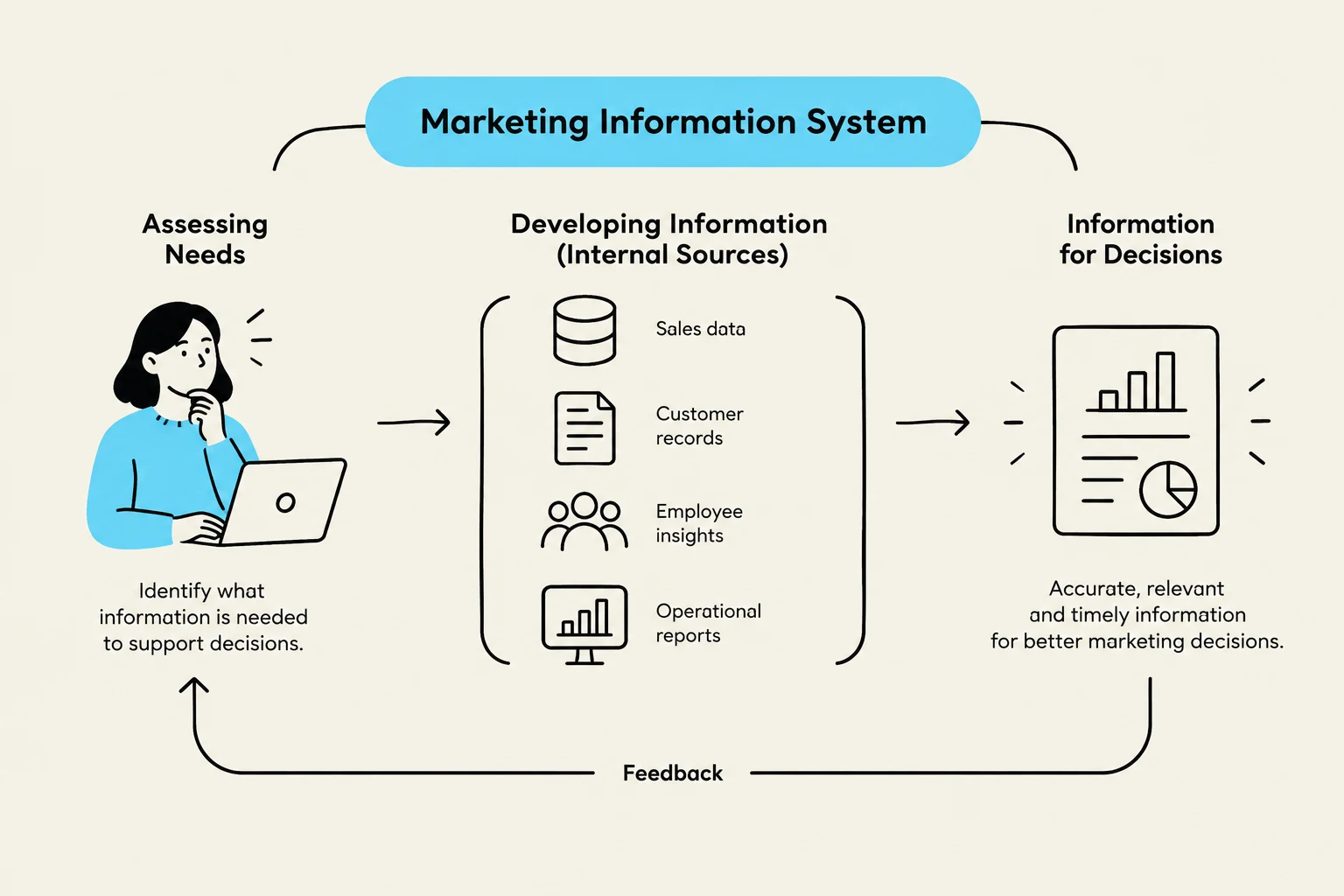
To make informed decisions, companies cannot rely on guesswork. They require a structured way to gather, analyze, and distribute information. This is achieved through a Marketing Information System (MIS), which consists of the people and procedures used to assess information needs, develop the necessary data, and help decision-makers use that information to generate actionable insights.
A functional MIS must balance what managers want to know against what is actually feasible and cost-effective to obtain. The system typically draws from three primary streams:
Internal Databases: Collections of consumer and market information obtained from sources within the company network. For example, companies like Stitch Fix use skillful database development to build high levels of customer loyalty.
Competitive Marketing Intelligence: The systematic monitoring and analysis of information regarding consumers, competitors, and the marketing environment. This includes observing consumers firsthand, benchmarking competitors, and monitoring social media buzz.
Marketing Research: Systematic design, collection, and reporting of data relevant to a specific marketing situation.
A diagram illustrating a Marketing Information System, showing the process from assessing needs to developing information from internal sources (sales data, customer records, employee insights, operational reports) and finally providing information for decisions, with a feedback loop.
Marketing Research: From Problem to Insight
While the MIS provides a continuous flow of information, Marketing Research is often a targeted response to a specific problem or opportunity. The process follows a systematic sequence:
Defining the Problem and Research Objectives: Researchers must decide if they need exploratory research (to gather preliminary info and suggest hypotheses), descriptive research (to describe market potential or demographics), or causal research (to test cause-and-effect relationships).
Developing the Research Plan: This outlines the sources of existing data and spells out specific approaches, contact methods, sampling plans, and instruments.
Implementing the Plan: This involves data collection, processing (checking for accuracy and coding), and analyzing the data (tabulating results and computing statistical measures).
Interpreting and Reporting Findings: The researcher interprets the results and draws conclusions to report back to management.
Primary vs. Secondary Data
A critical decision in the research plan is whether to use secondary data—information that already exists and was collected for another purpose—or primary data. Secondary data is often low-cost and quick to obtain, but it may be inaccurate, dated, or irrelevant. Primary data, on the other hand, is collected specifically for the current research task through methods such as:
Observational Research: Gathering data by watching relevant people and actions, including ethnographic research where observers interact with consumers in their natural environments.
Survey Research: Asking people about their knowledge, attitudes, and buying behavior.
Experimental Research: Selecting matched groups and giving them different treatments to check for differences in response.
Exam Tip: When evaluating research methods, remember that "Secondary Data" is like looking in a rearview mirror (it tells you what happened), while "Primary Data" is like looking through a windshield (it tells you what is happening right now for your specific goal).
Big Data, Analytics, and CRM
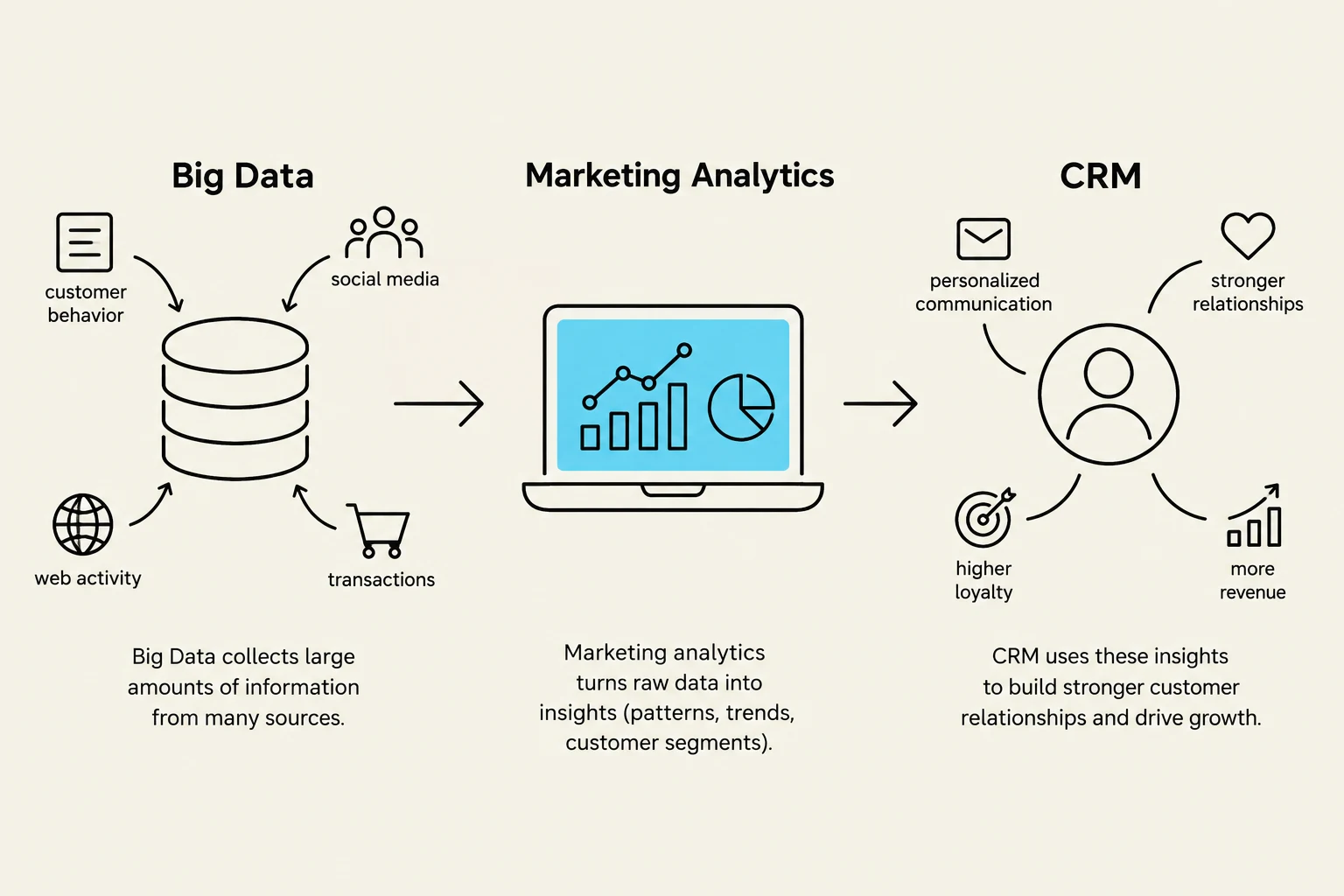
As technology has advanced, the volume of information available has exploded into what we call Big Data—huge and complex data sets generated by sophisticated collection and analysis technologies. To make sense of this, companies use Marketing Analytics, which are the tools and processes used to dig out meaningful patterns in big data to gain insights and gauge performance.
These insights are the engine behind Customer Relationship Management (CRM). CRM involves managing detailed information about individual customers and carefully managing "touch points" to maximize loyalty.
This diagram illustrates the relationship between Big Data, Marketing Analytics, and CRM, showing how data is collected, analyzed, and used to improve customer relationships and drive business growth.
A classic example is Netflix. While members are busy watching videos, Netflix is "watching them" closely. They use big data insights to understand exactly what customers want, allowing them to provide highly personalized recommendations that drive engagement.
Ethics, Privacy, and Global Challenges
With great data comes great responsibility. The ability to track consumers via online behavioral targeting (using tracking data to target ads) and social targeting (mining social connections) raises significant ethical concerns.
Consumer Privacy and Data Security
Failure to respect consumer privacy can lead to angry, uncooperative customers and increased government intervention. To maintain trust, researchers should:
Ask only for the information that is strictly needed.
Use information responsibly to provide actual customer value.
Avoid sharing information without explicit permission.
Furthermore, Consumer Data Security is paramount. Data breaches can erode trust and destroy hard-won brand relationships.
International and Small Business Research
Marketing research is not one-size-fits-all.
International Marketing Research: Researchers face unique hurdles, such as finding reliable secondary data in foreign markets, navigating cultural and language differences, and dealing with diverse attitudes toward research.
Small Businesses and Nonprofits: While they may have fewer resources, they can still obtain insights through secondary data, observation, and surveys. However, managers must be wary of biases introduced by smaller samples or less skilled researchers.
Finally, the industry must guard against the misuse of research findings, such as rigging research designs or misrepresenting results. The solution lies in the development of strict codes of research ethics and a commitment from companies to protect both the consumer and their own reputation.
Keep reading for free.
Create an account to finish this reading and make it part of your study routine.