Cultural Selection: The Evolutionary Logic of Ideas
Explores the concept of cultural selection, drawing parallels with biological evolution to explain how ideas, norms, and beliefs spread and persist within populations. It details the mechanics of variation, transmission, and differential success, and applies these principles to understanding religion and social norms.
When we think of "selection," our minds often jump to the biological realm: finches with specific beak shapes or giraffes with long necks surviving because of their physical traits. However, a parallel process occurs within the realm of human thought. Cultural selection is a framework used to understand how ideas—ranging from social norms and tool-making techniques to complex religious doctrines—are transmitted, modified, and preserved within a population.
Just as biological evolution relies on variation, inheritance, and differential fitness, cultural evolution examines how certain "memes" or cultural units outcompete others to become dominant features of a society.
The Mechanics of Cultural Evolution
To understand cultural selection, we must first identify the three fundamental pillars that allow it to function. In biology, these are mutation, inheritance, and selection. In a cultural context, these components look slightly different but follow a strikingly similar logic.
Variation: This is the source of new ideas. Variation can arise through individual innovation (a person thinks of a new way to cook) or through "errors" in transmission (a storyteller misremembers a myth, creating a new version).
Transmission (Inheritance): This is the process by which ideas move from one person to another. This can be vertical (parent to child), horizontal (peer to peer), or oblique (teacher to student).
Differential Success (Selection): Not all ideas are equally "fit." Some ideas are easier to remember, more useful for survival, or more effective at binding a group together. Those that are "fit" are transmitted more frequently, while those that are difficult to grasp or socially isolating tend to fade away.
This diagram illustrates the process of idea generation and dissemination, encompassing variation, transmission, selection, and retention.
Exam Tip: If asked to compare biological and cultural selection, remember that cultural transmission is often much faster and can occur horizontally (between peers), whereas biological inheritance is strictly vertical (parent to offspring).
Cultural Selection in Religion
One of the most profound applications of this theory is in the study of religion. Why do certain religious ideas persist for millennia while others vanish? The Cognitive Science of Religion suggests that religious ideas are not just random thoughts; they are subject to specific selection pressures.
Cognitive Fluency and "Fit"
Some religious concepts are "cognitively easy." For example, the idea of an invisible, powerful agent (a god) is very easy for the human brain to process because our brains are already hard-wired to detect agency in the world (e.g., assuming a rustle in the grass is a predator rather than just wind). Because these ideas are easy to learn and hard to forget, they have high "transmission fidelity" and are selected for by the human cognitive architecture.
Social Cohesion and Group Selection
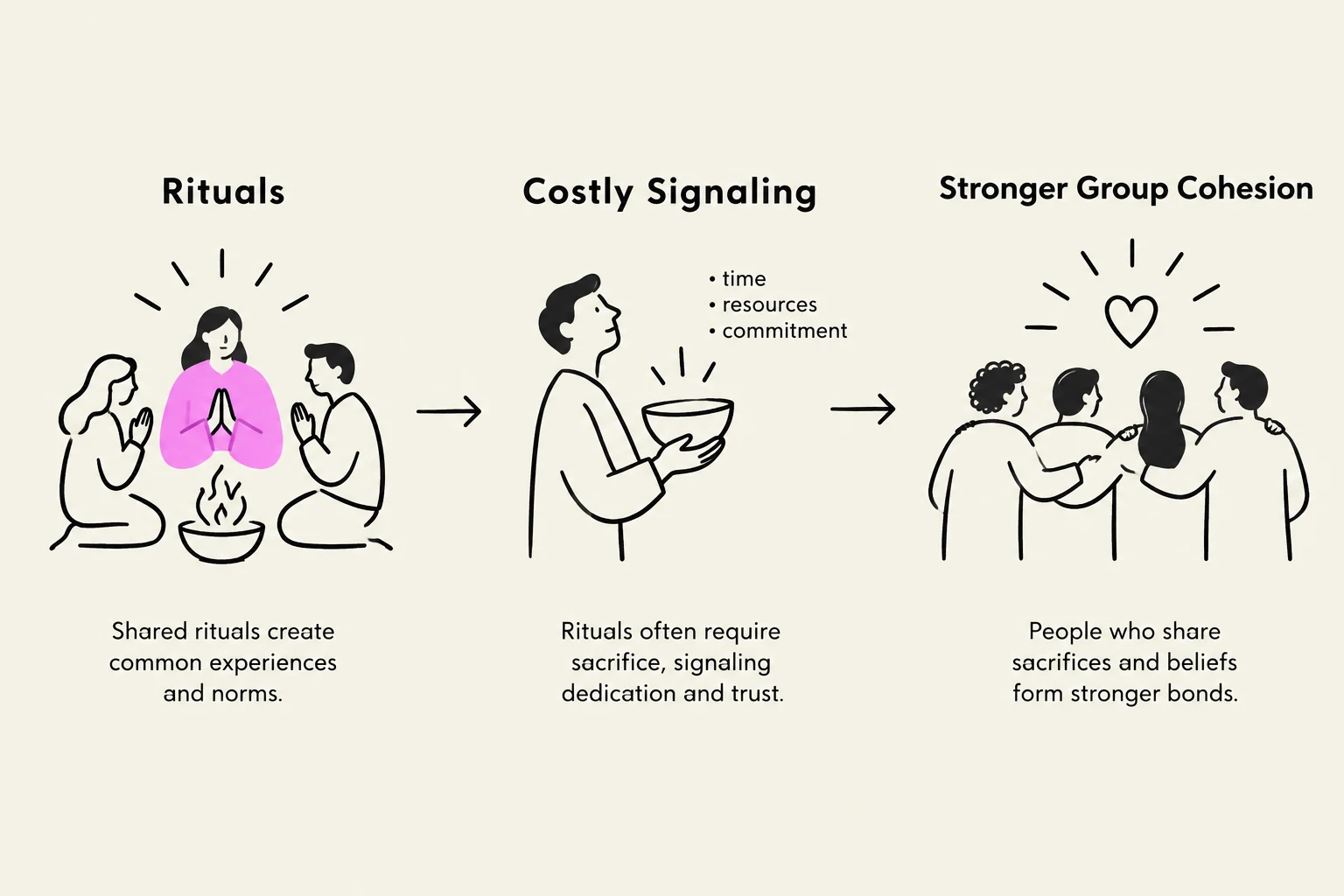
Beyond individual cognition, religious ideas often serve a social function. Ideas that demand high levels of commitment—such as dietary restrictions, specific rituals, or strict moral codes—act as "costly signals".
When individuals participate in these difficult rituals, they signal their loyalty to the group. This creates a high-trust environment, making the group more cohesive and better able to compete with other groups. Consequently, the religious ideas that promote group unity are "selected" because the groups carrying them are more likely to survive and expand.
This diagram illustrates how shared rituals can lead to costly signaling, which in turn strengthens group cohesion by fostering common experiences, norms, sacrifices, dedication, and trust.
Worked Example: The Evolution of a Social Norm
To see cultural selection in action, let's look at a hypothetical social norm regarding greeting etiquette.
Initial State: In a small village, people greet each other with a simple nod.
Variation: One person, perhaps trying to show extra respect, introduces a complex hand gesture.
Transmission: A few people see this gesture and find it meaningful. They begin teaching it to their children (vertical) and their friends (horizontal).
Selection: If the hand gesture becomes a symbol of "being a polite member of the community," those who use it are more likely to be invited to social gatherings and form alliances. Those who stick to the nod are seen as "outsiders".
Result: The hand gesture is "selected" for its social utility and becomes the new standard norm for the entire village.
Summary of Selection Pressures
The following table summarizes the different types of pressures that drive cultural selection:
Pressure Type
Mechanism
Effect on Idea
Cognitive
Ease of memory/understanding
Ideas that fit human mental architecture spread faster.
Social
Group cohesion/Signaling
Ideas that bind groups together are preserved.
Practical
Utility/Survival value
Ideas that solve problems (e.g., farming techniques) are kept.
This diagram illustrates the concepts of cognitive selection, which focuses on the individual brain, and social selection, which focuses on the group. Cognitive selection emphasizes traits that improve individual survival and success, while social selection favors ideas and behaviors that benefit the group and lead to shared ideas and culture.
By viewing culture through the lens of selection, we move away from asking "Is this idea true?" and toward asking "Why is this idea so successful at spreading?". This shift allows researchers to map the complex landscape of human belief and behavior using the rigorous tools of evolutionary science.
Keep reading for free.
Create an account to finish this reading and make it part of your study routine.