Cultural Safety in Nursing Practice: From Competence to Decolonization
This content explores the evolution of nursing care from cultural competence to cultural safety, emphasizing the importance of understanding cultural contexts, power dynamics, and Indigenous health in providing person-centred care.
In the modern healthcare landscape, nursing care extends far beyond clinical tasks like administering medication or monitoring vital signs. To provide truly effective care, nurses must navigate a complex web of cultural identities, historical legacies, and social structures. Understanding the evolution from cultural competence to cultural safety is essential for any practitioner aiming to provide person-centred care that respects the dignity and unique lived experiences of every patient.
Understanding Culture and Its Contexts
Culture is defined as the shared traits, practices, languages, and attributes of a specific group. It encompasses an individual's beliefs, values, norms, and lifeways that are learned and transmitted, ultimately influencing how a person thinks, makes decisions, and behaves in their daily life. Crucially, culture is not static; it is dynamic and must be understood through several overlapping layers of context.
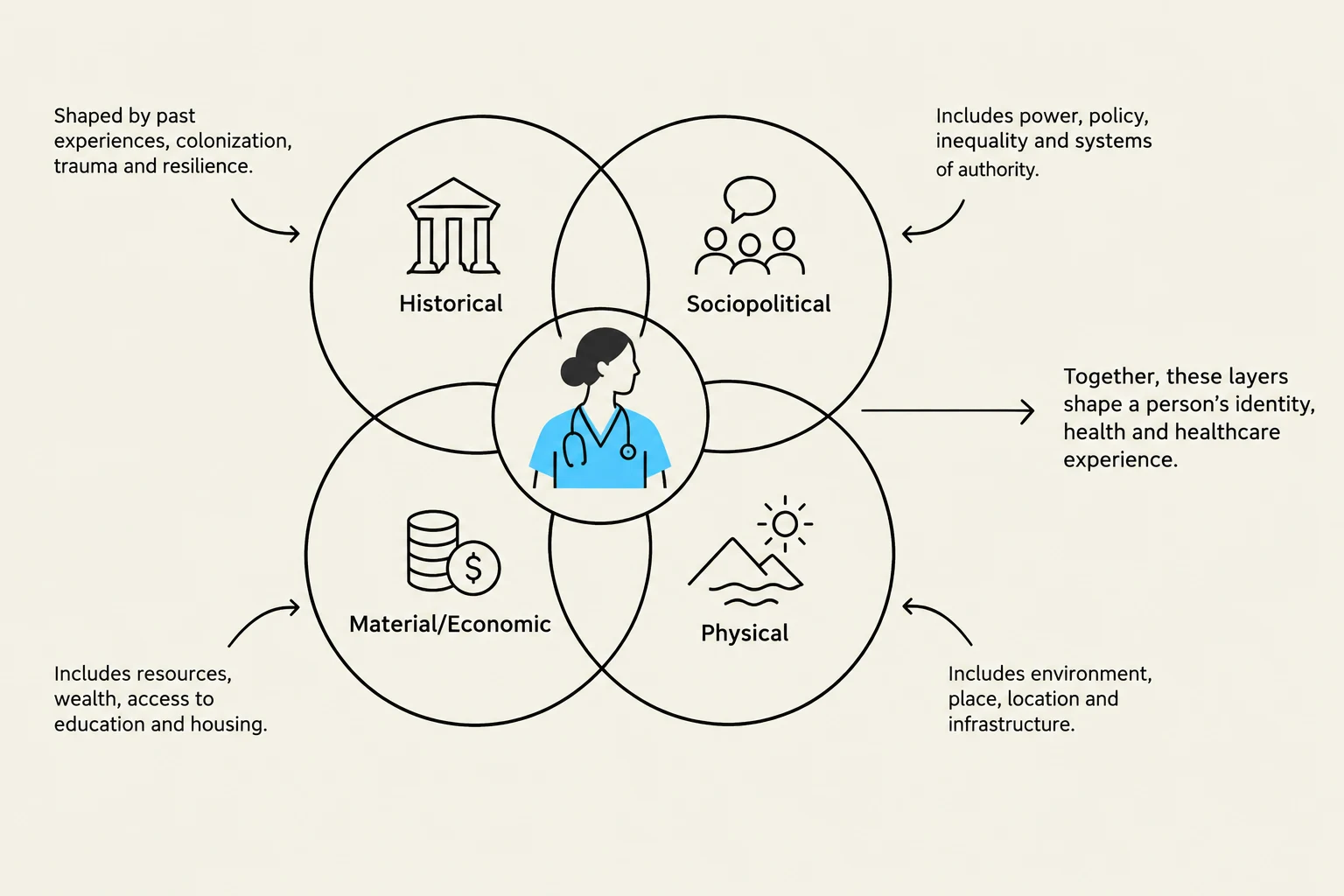
The Layers of Contextual Influence
To provide holistic care, nurses must assess the following dimensions:
Historical Context: In Canada, the dominant culture is heavily influenced by British and French colonialism, resulting in a healthcare system built upon Christian-European norms. This affects which cultural observances are honored and which are marginalized.
Sociopolitical Context: This involves the power dynamics between dominant and less powerful groups. Factors such as sexual orientation, race, and economic status influence how people access care. For example, transgender individuals often face significant barriers, including misgendering and transphobic practices, which lead many to avoid emergency departments altogether.
Material and Economic Context: Closely linked to sociopolitical factors, this includes income levels, education, housing adequacy, and food security. Low socioeconomic status is a direct predictor of poorer physical and mental health outcomes.
Physical Context: Environmental and ecological challenges, such as the social isolation and inequities highlighted by the COVID-19 pandemic, impact both physical and emotional well-being.
This diagram illustrates the interconnected factors that shape a person's identity, health, and healthcare experience, including historical, sociopolitical, material/economic, and physical elements.
The Evolution of Care: Competence, Humility, and Safety
As nursing practice has evolved, so too have the frameworks used to describe how we interact with diverse populations.
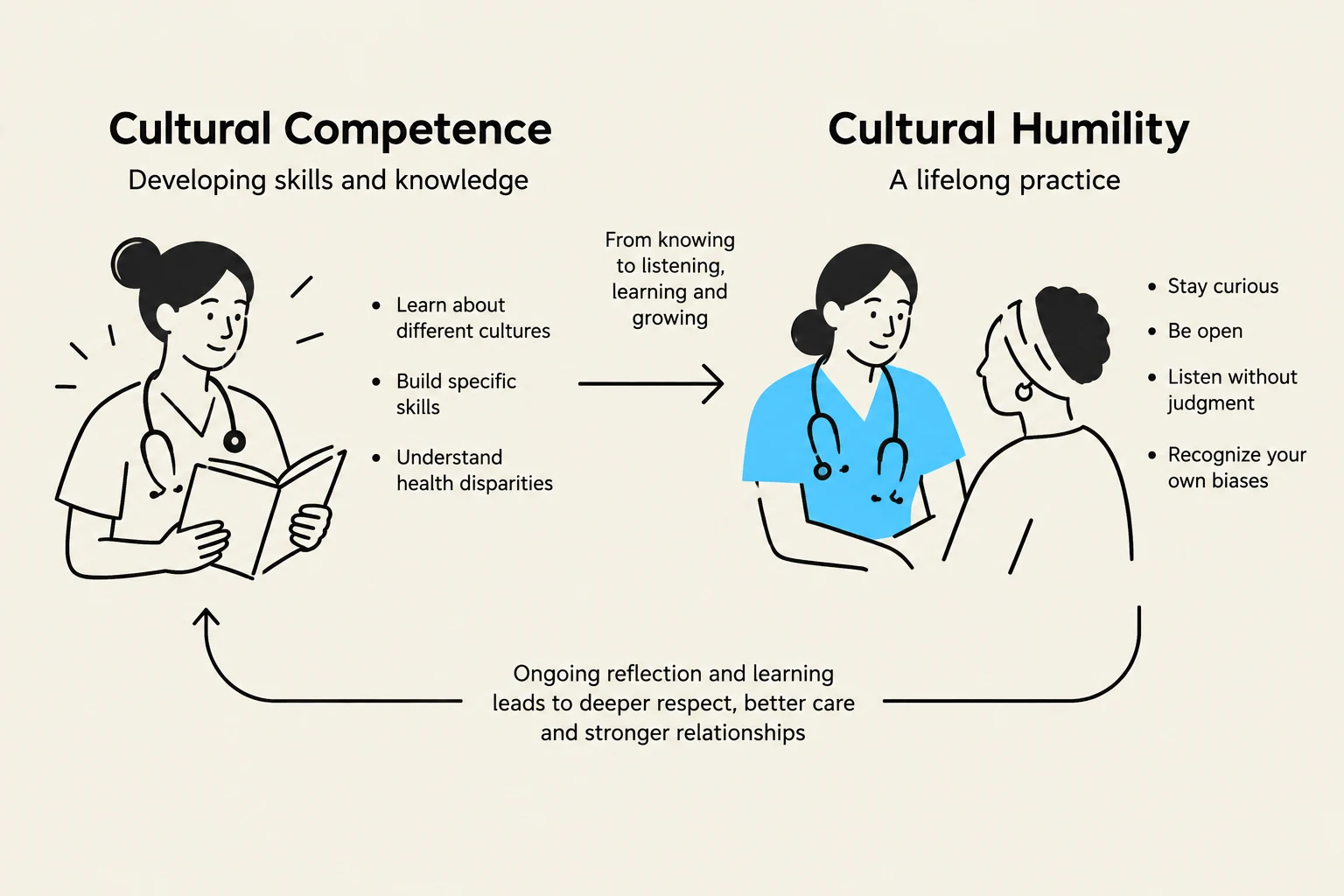
Cultural Competence
Cultural competence is often viewed as a set of attitudes, skills, and behaviors that allow professionals to work effectively with people of different cultures. However, it is important to note that cultural competence is not a "checkbox" of knowledge to be completed. It is a continuous process of developing the capacity to provide safe care through critical self-reflection on one's own values.
Cultural Humility
While competence focuses on skills, cultural humility focuses on the practitioner's mindset. It is an ongoing, lifelong commitment to self-evaluation and critique. A nurse practicing cultural humility remains egoless, recognizes the power imbalances inherent in the nurse-client relationship, and approaches the patient as an equal.
Cultural Safety
Cultural safety is the highest level of this progression. It moves beyond the individual's skills or the nurse's attitude to focus on the outcomes for the patient. Providing culturally safe care means acknowledging and supporting the patient's unique identity while actively addressing power imbalances and social injustices.
Exam Tip: Remember the "3 Rs" of promoting cultural safety: Revise your practices, Respect the individual, and uphold the Rights of the person. Conversely, be vigilant against the "3 Ds": behaviors that are Demeaning, Devaluing, or Disempowering.
This illustration contrasts "Cultural Competence," which involves developing skills and knowledge to understand different cultures and health disparities, with "Cultural Humility," a lifelong practice of staying curious, being open, listening without judgment, and recognizing one's own biases. It emphasizes that ongoing reflection and learning lead to deeper respect, better care, and stronger relationships.
Indigenous Health and the Decolonizing Approach
For Indigenous peoples in Canada—including First Nations, Inuit, and Métis—cultural safety is inextricably linked to the history of colonization. The legacy of residential schools, the Sixties Scoop, and the Indian Act has resulted in intergenerational trauma and systemic barriers to health.
Decolonization in Nursing
A decolonizing approach is required to undo the impacts of colonization. This involves:
Acknowledging historical truth: Recognizing that current health inequities are a direct result of government policies like residential schools.
Working in partnership: Moving away from paternalistic care and toward co-creating health goals with Indigenous peoples.
Respecting Protocols: Understanding that Indigenous governance and communication are often rooted in specific clan systems and cultural protocols.
Indigenous Cultural Orientations
Indigenous worldviews often emphasize the interconnectedness of all things. Many cultures utilize the Medicine Wheel, a holistic symbol representing the balance between the emotional, physical, spiritual, and mental realms. Health is viewed as a state of harmony with Mother Earth and the community, rather than just the absence of disease.
This diagram illustrates the four interconnected dimensions of well-being: physical, mental, emotional, and spiritual.
Clinical Application: Person-Centred Care
To achieve cultural safety, nurses must practice person-centred care. This means treating patients and their families as equal partners in the healthcare process.
Case Study: The Danger of Assumptions
Consider a case where an Indigenous patient presents with nausea, thirst, and fatigue. If a nurse observes slurred speech and assumes the patient is intoxicated due to racial stereotypes, they may "let the patient sleep it off". This bias can be fatal; in one instance, a patient was actually suffering from diabetic ketoacidosis, not alcohol intoxication. This highlights how bias and discrimination directly compromise patient safety.
Strategies for Effective Communication
When language barriers exist, nurses should:
Slow down speech and use simple language.
Use active listening and non-verbal cues.
Always use a trained medical interpreter rather than a family member or automated translation tools like Google Translate, which may lack medical accuracy.
By integrating cultural assessment—examining ancestry, language, religion, and previous experiences with healthcare—nurses can bridge the gap between themselves and their patients, ensuring that care is not only clinically sound but also culturally safe.
Keep reading for free.
Create an account to finish this reading and make it part of your study routine.