Explore how diverse cultures throughout history have interpreted the night sky, using constellations for storytelling, astrology for governance, stars for navigation, and celestial events for time-keeping and religious practices.
For as long as humans have looked upward, the night sky has been more than just a collection of distant lights. It has served as a mirror for our identities, a map for our journeys, and a clock for our civilizations. While modern astronomy is often defined as the scientific study of celestial objects and the laws that govern them, it has historically been a deeply human endeavor—an investigation into our connection to the cosmos. By studying how different cultures interpreted the celestial sphere, we gain insight into how they understood their place in the universe.
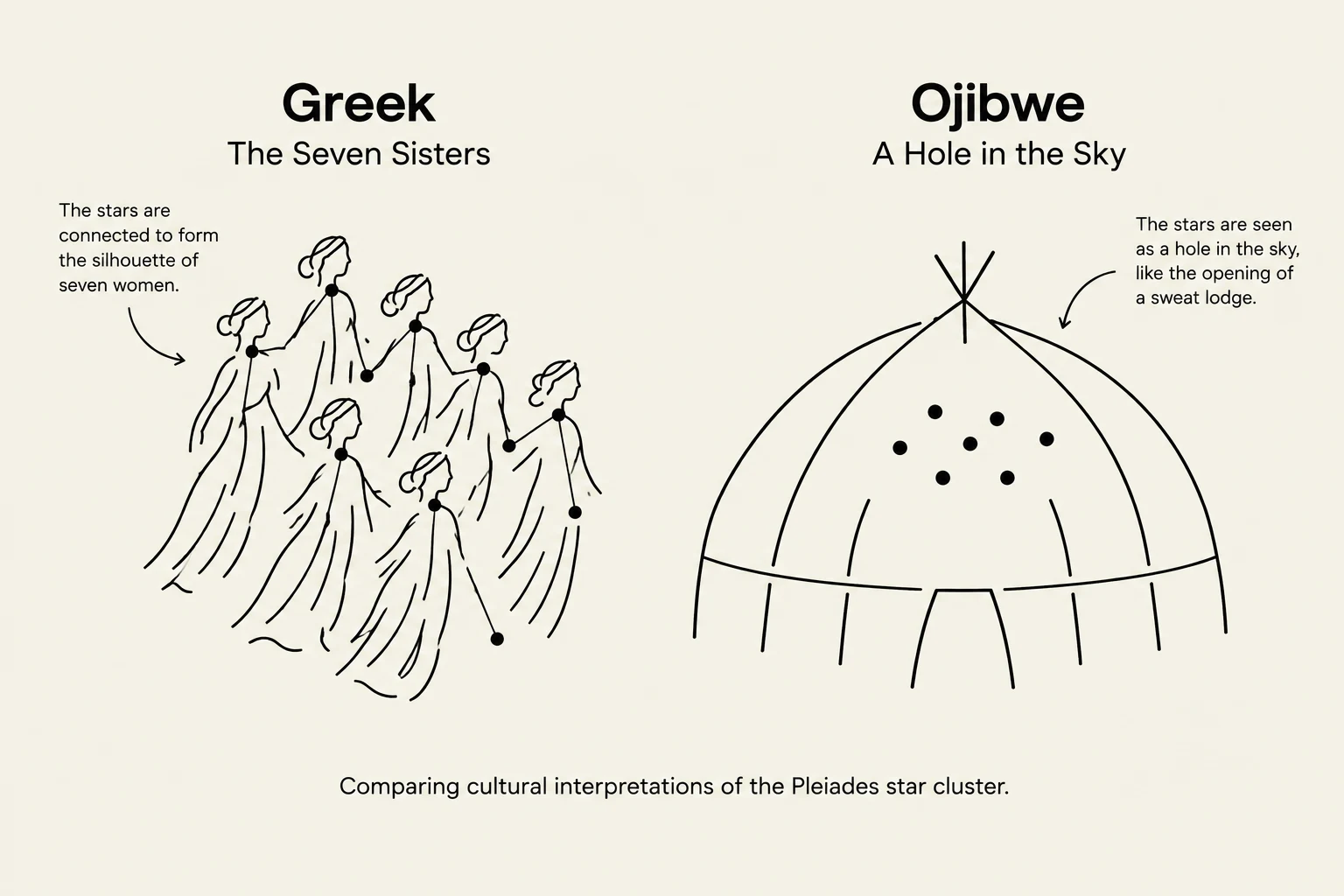
This illustration compares two cultural interpretations of the Pleiades star cluster: the Greek "Seven Sisters" and the Ojibwe "A Hole in the Sky."
Constellations and the Art of Storytelling
Constellations function as celestial narratives, allowing cultures to encode their mythologies into the fabric of the sky. The Ancient Greeks famously utilized 88 constellations derived from their mythology to divide the sky into manageable sections.
However, these patterns are not universal. While one culture sees a hero or a beast, another may see a fundamental part of their origin story. A primary example is the Pleiades star cluster. In Greek mythology, these stars represent the "Seven Sisters". In contrast, the Ojibwe people of North America utilize a different star map where the Pleiades, known as Bagone’giizhig, represent a "hole in the sky" or a sweat lodge, symbolizing their very origins.
Astrology, Planets, and Governance
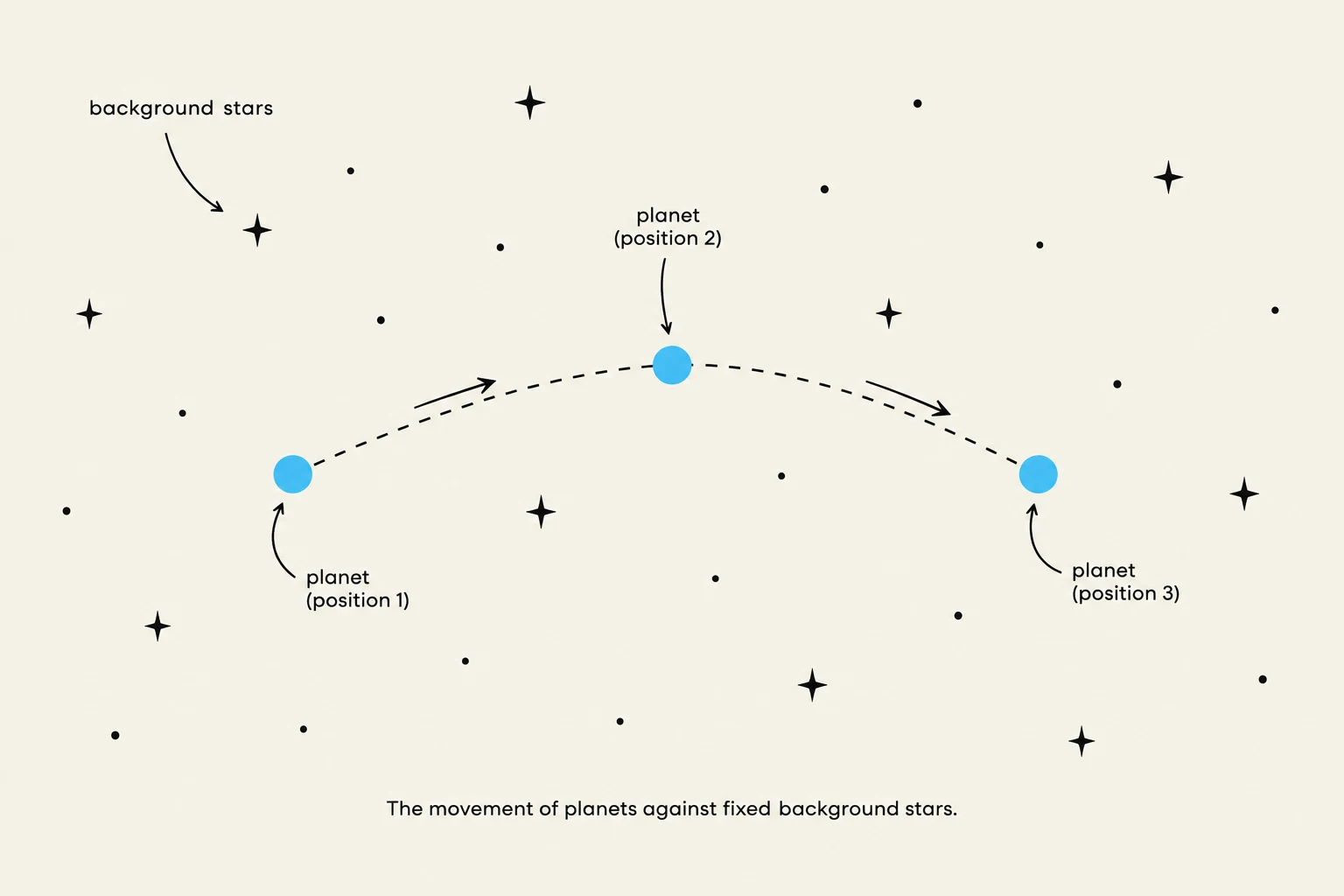
The movement of planets against fixed background stars.
The connection between the heavens and human affairs often manifested through astrology, which emerged from a perceived link between celestial bodies and supernatural forces or gods.
This connection is embedded in our very language. The term planeta originates from the Greek word for "wanderers," referring to the fact that these objects move across the background of fixed stars. Historically, the Babylonians applied astronomical knowledge to guide the decisions of rulers, a practice that was later absorbed by the Greeks. This lineage of thought established the foundation for Western astrology, most notably through the work of Ptolemy, who authored the Tetrabiblios, a foundational treatise that remains a reference point in the study of astrological history.
Navigation and the Use of Star Charts
Beyond storytelling and governance, the stars have served as vital beacons for physical travel. For maritime cultures, the ability to read the sky was a matter of survival. The inhabitants of the Polynesian Triangle developed sophisticated star charts that allowed them to navigate the vast expanses of the Pacific Ocean.
Other cultures built permanent structures to facilitate this celestial observation. On Rapa Nui, specialized "observatories" were constructed to monitor the movements of the stars. These structures, such as the one compared to the Na ‘Tsa’Maht, often featured narrow openings in the ceiling designed to frame specific celestial events.
Cultural Insight: The Rapa Nui Moai
On Rapa Nui, the alignment of the landscape and the sky was deeply integrated. The famous moai statues are positioned such that their shadows align during the equinox. Specifically, at Ahu Akivi, the shadows point toward only the moai that are looking out toward the ocean.
Religion, Spirituality, and Time-keeping
The celestial sphere has long acted as a pillar for religious practice and a tool for precise time-keeping.
Islamic Astronomy: Islamic astronomers utilized the stars to determine the precise timing and direction for prayers. This scientific legacy is still visible today, as many stars in our modern catalogs retain their original Arabic names.
European and Chinese Traditions: Both civilizations maintained detailed bookkeeping of astronomical phenomena to ensure their religious and social calendars remained aligned with the heavens.
Lunar and Solar Calendars: The Moon has been used by Polynesian and Asian cultures as a celestial calendar. Similarly, the Sun serves as a primary driver for time-keeping; the Roman calendar used today is based on Earth's rotation around the Sun, and the position of the Sun dictates the zodiac signs.
The Mayan civilization provides a profound example of integrating astronomy with complex mathematics and time-keeping. They utilized a solar component in their calendar and built observatories, such as the Caracol in Mexico, to track the orbit of Venus, solar eclipses, and solstices.
The Changing Sky: Solstices and Equinoxes
Diagram illustrating the Earth's position relative to the Sun during the Summer Solstice, Winter Solstice, and Equinoxes, highlighting the constant 23.5° axial tilt of the Earth.
To understand how ancient cultures tracked time, one must understand the mechanics of the Earth's orbit and tilt.
Equinox: Derived from the term for "equal night," an equinox occurs when the duration of day and night are approximately equal.
Solstice: Meaning "stationary sun," a solstice represents the points where the Sun reaches its maximum movement north or south of the equator. This corresponds to the Sun being directly above the tropics (23.5∘ N or S).
Study Tip: Connecting Concepts
When studying for your cultural astronomy project, remember that these celestial events (solstices/equinoxes) are often the "anchors" for ancient religious calendars and architectural alignments.
Conclusion: From Myth to Technology
While we once looked to the stars to explain our origins and guide our ships, modern astronomy uses those same stars to drive technological innovation. From the development of the Charge Coupled Device (CCD) in cameras to the massive data processing required by the Vera Rubin Observatory, our quest to understand the cosmos continues to push the boundaries of what is possible. Whether through the lens of an ancient myth or a high-powered telescope like the James Webb Space Telescope, the night sky remains our greatest tool for asking: Where are we, and why do we exist?.
Keep reading for free.
Create an account to finish this reading and make it part of your study routine.