Cultural Competence in Healthcare: Understanding Patient Perspectives
This guide explains the importance of cultural competence in healthcare, detailing how cultural differences impact patient care and outlining the "4 C's of Culture" (Call, Cause, Cope, Concerns) to help providers understand patient perspectives. It also discusses cultural beliefs about disease, the distinction between
In a multiethnic society, the goal of the medical system is to provide optimal care for all patients. However, achieving this goal is often complicated by cultural differences that can lead to confusion, conflict, and even health disparities. When a provider fails to understand a patient's cultural background, the result can be inferior medical care, poor communication, and a lack of patient adherence to treatment plans.
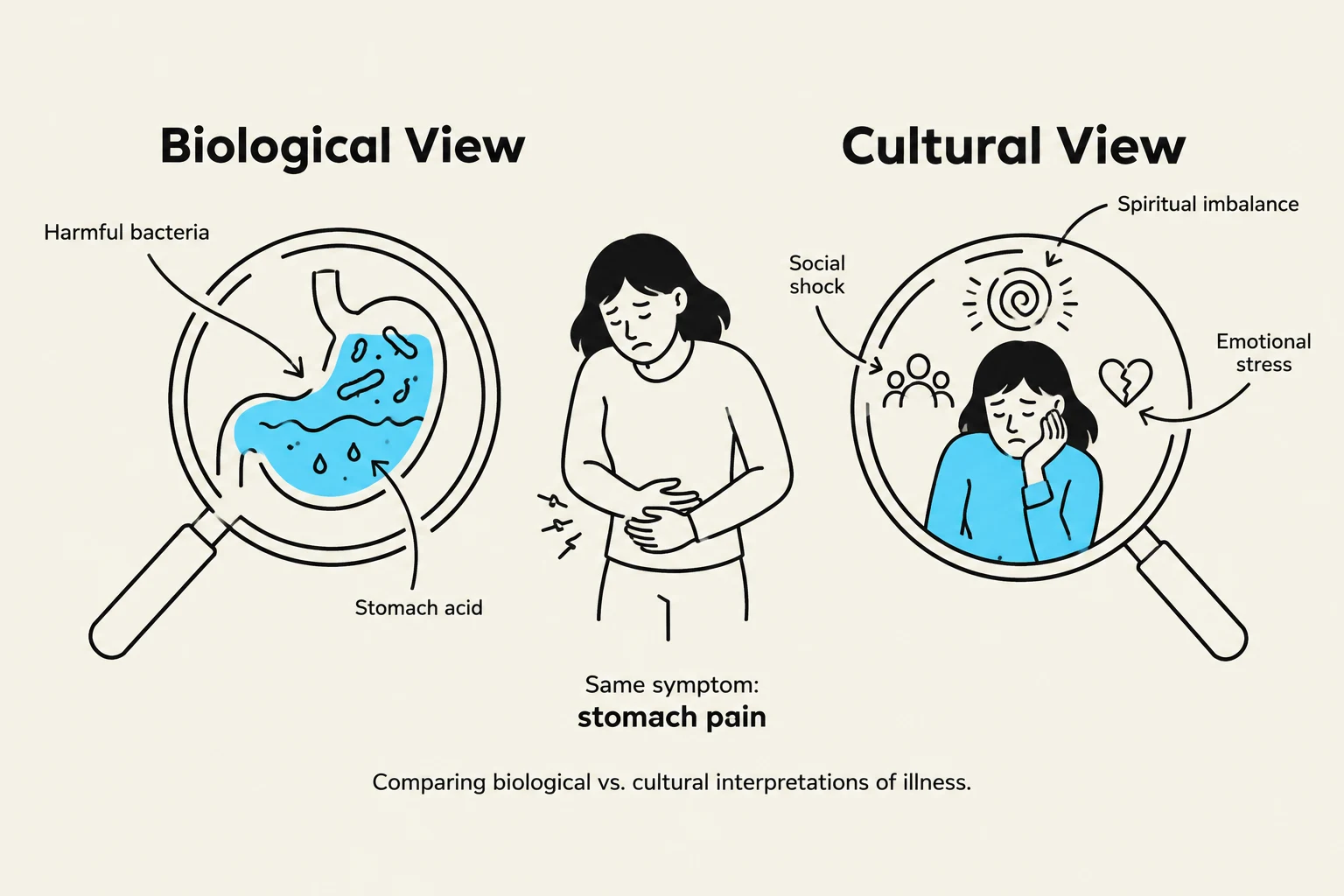
This illustration compares biological and cultural interpretations of stomach pain, showing how it can be attributed to factors like harmful bacteria and stomach acid in a biological view, or social shock, spiritual imbalance, and emotional stress in a cultural view.
To provide truly effective care, healthcare providers must move beyond a purely biological view of illness and embrace "cultural competence"—the ability to understand, respect, and apply knowledge of different cultures to clinical practice.
The Importance of the Patient's Perspective
At the heart of culturally competent care is the patient's perspective. While Western medicine focuses on biological mechanisms like germs or cellular dysfunction, many patients interpret their symptoms through a cultural lens.
Understanding this perspective is not just about being polite; it is a clinical necessity. For example, a patient's interpretation of a symptom can directly impact the differential diagnosis. If a provider ignores the patient's view, they may miss critical information. Consider the case of a young Mexican boy experiencing cyclic vomiting; while a doctor might look for physiological causes, the family might believe he is experiencing susto (soul loss) due to a sudden shock. While the biological treatment might remain the same, acknowledging the patient's belief can significantly improve the relationship between the provider and the family.
Clinical Tip: Avoid the "Fixation Trap"
While it is vital to understand what the patient thinks is wrong, do not let their perspective replace your clinical reasoning. Use their input to guide your communication, but do not stop performing a standard medical workup. Fixating on a patient's cultural explanation at the expense of a differential diagnosis can be dangerous.
The 4 C’s of Culture
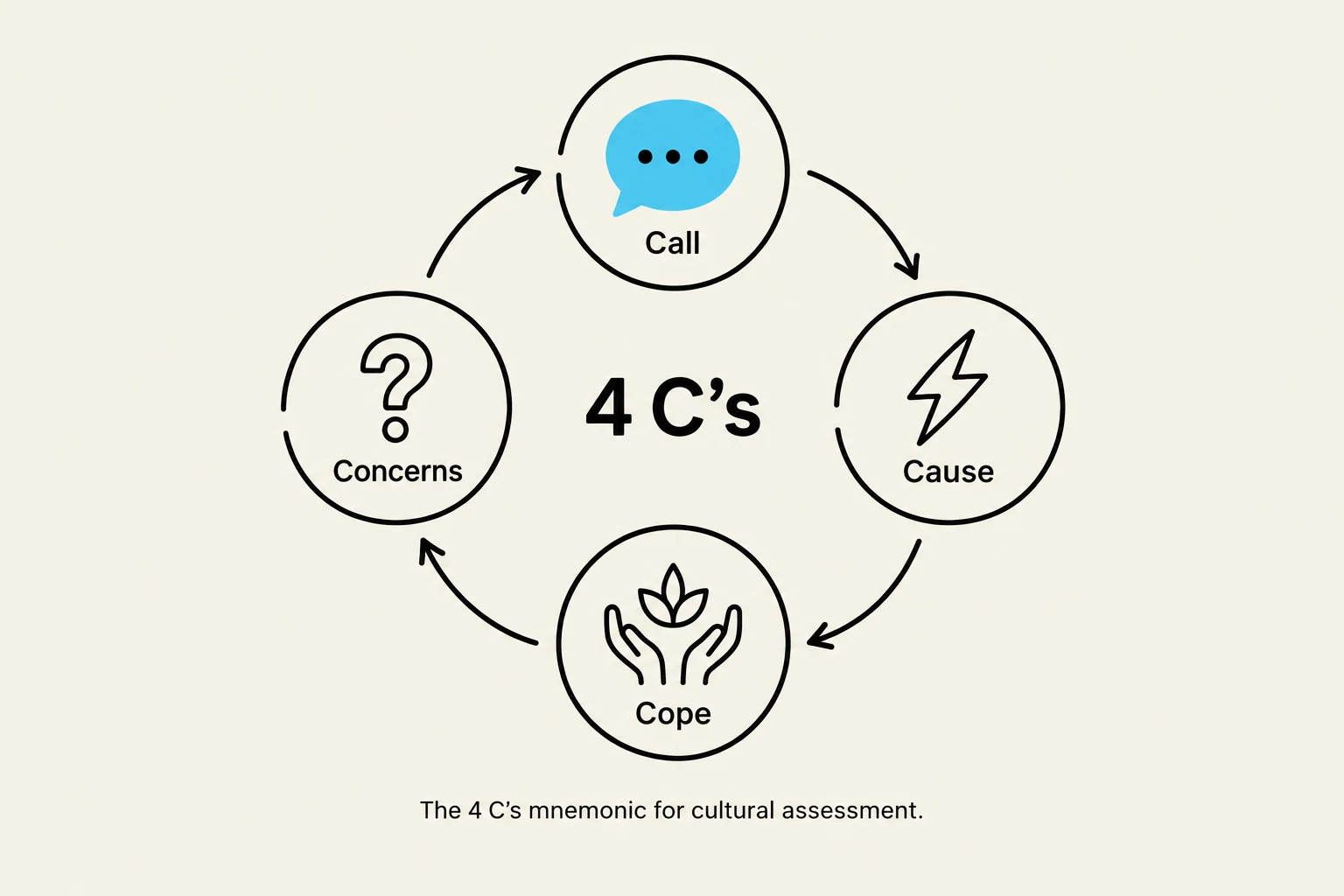
The 4 C's mnemonic for cultural assessment.
To help practitioners elicit a patient's point of view without being intrusive or sounding judgmental, a mnemonic known as the 4 C’s of Culture can be used:
Call: "What do you call your problem?" This asks the patient to define the issue in their own words, helping the provider understand their perception of the illness.
Cause: "What do you think caused your problem?" This explores the patient's beliefs regarding the source of the illness.
Cope: "How do you cope with your problem?" This identifies what the patient has already tried, such as home remedies or traditional healers, which is crucial for avoiding dangerous drug interactions.
Concerns: "What are your concerns regarding your problem or the recommended treatment?" This helps uncover fears—such as a fear of side effects or misconceptions about a medication—that might lead to non-adherence.
Cultural Beliefs Regarding Disease Cause
Patients' beliefs about why they are sick vary widely across the globe. Understanding these can help a provider tailor their approach to increase patient trust.
Body Balance
In many cultures, such as Traditional Chinese Medicine, health is viewed as a state of equilibrium. Disease is often attributed to an upset in body balance, specifically between "hot" (yang) and "cold" (yin) qualities. For instance, a patient might refuse ice water or certain medications because they believe they need to restore "warmth" to their system.
Spirit Possession and Soul Loss
Some cultures interpret illness through spiritual lenses:
Spirit Possession: The belief that a spirit has taken over a person's body, often requiring exorcism.
Soul Loss: The idea that a person's soul has left the body due to trauma, requiring a specialist like a shaman to retrieve it.
Religious Beliefs and Taboos
Religious beliefs in healthcare can significantly influence treatment decisions. A patient might view illness as a divine punishment for a sin, leading them to prioritize prayer or penance over medical intervention. Similarly, a "breach of taboo"—doing something forbidden by cultural or religious law—is viewed by some as a direct cause of disease.
The Danger of Stereotyping vs. Generalization
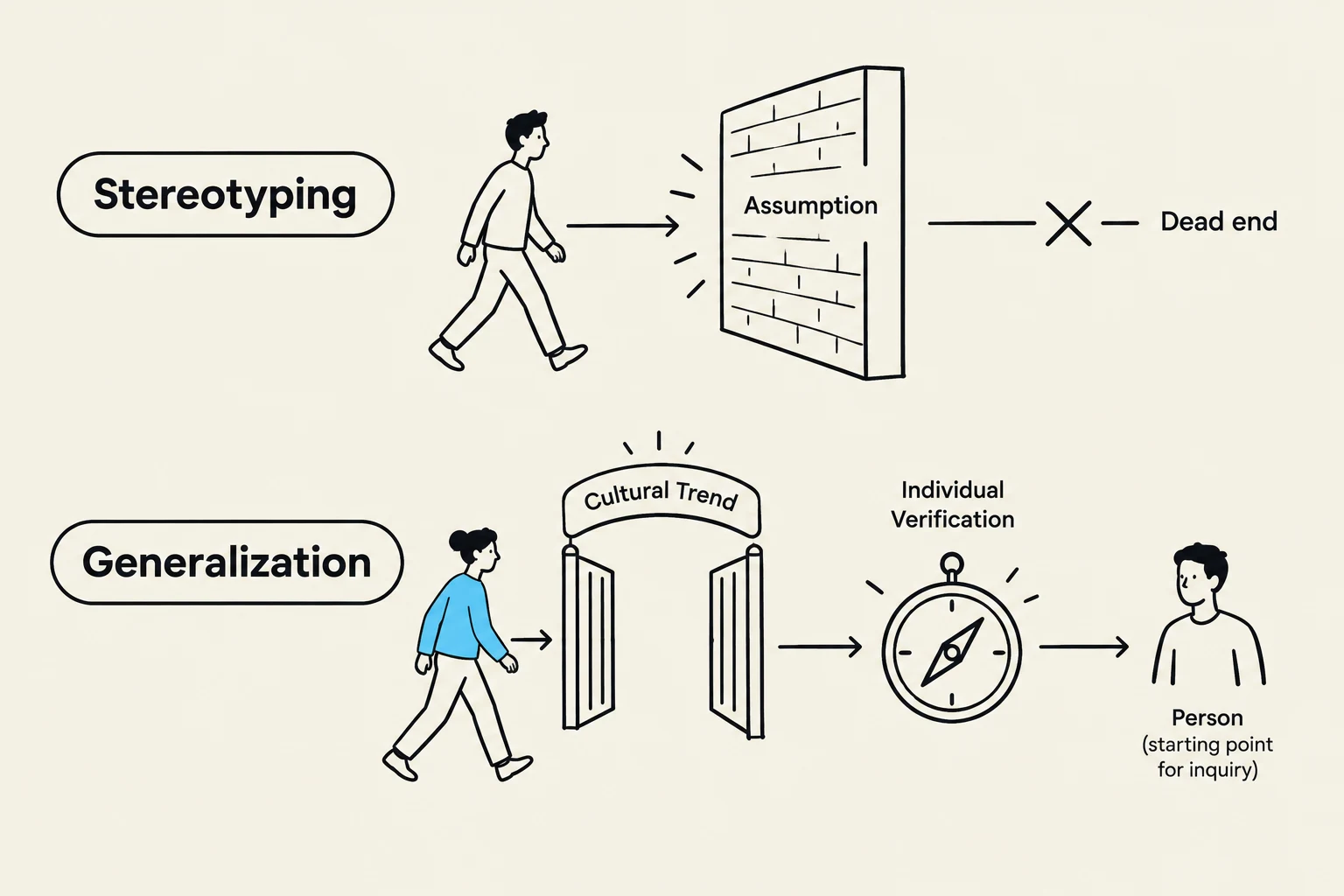
This illustration contrasts stereotyping, which leads to a dead end through assumptions, with generalization, which involves individual verification and serves as a starting point for inquiry.
A critical distinction for any healthcare student is the difference between a stereotype and a generalization.
Stereotyping is an "ending point." It involves making an assumption about an individual based on their group membership and refusing to look further (e.g., assuming a patient is a "drug seeker" because of their appearance or ethnicity). Stereotyping is dangerous and can lead to fatal clinical errors.
Generalization is a "beginning point." It involves recognizing common trends within a culture to help anticipate needs, but it always requires individual verification (e.g., noting that some cultures value emotional expressiveness and then observing the specific patient's behavior).
Exam Tip: Cultural Competence is a Journey
Remember that cultural competence is not a destination you reach, but a continuous process of learning, self-awareness of your own biases, and application of knowledge.
By utilizing tools like the 4 C's and maintaining a distinction between helpful generalizations and harmful stereotypes, providers can build the trust necessary to improve clinical outcomes and bridge the gap in healthcare disparities.
Keep reading for free.
Create an account to finish this reading and make it part of your study routine.