An overview of crystalline imperfections in materials science, covering point defects (vacancies, interstitials, Schottky, Frenkel), line defects (dislocations), planar defects (grain boundaries, twin boundaries, stacking faults), and volume defects (voids, cracks). It explains their impact on material properties like
In an ideal world, every crystal would consist of a perfectly repeating, infinite array of atoms. However, in real-world materials, such perfection is impossible to achieve. Crystals almost always contain imperfections, which are deviations from the ideal periodic arrangement of atoms. While the word "defect" often implies something negative, these imperfections are actually fundamental to material science; they are the primary reason why metals can be shaped, why semiconductors conduct electricity, and why alloys are stronger than pure metals.
Crystalline imperfections are classified based on their geometry and dimensionality: zero-dimensional point defects, one-dimensional line defects, two-dimensional planar defects, and three-dimensional volume defects.
Point Defects (Zero-Dimensional)
Point defects are localized disruptions that involve only one or a few atoms. They are categorized into several types depending on whether they occur in pure metals or ionic crystals.
Vacancies and Interstitialcy
A vacancy is the simplest point defect, occurring when an atom is missing from its regular lattice site. Vacancies are considered equilibrium defects, meaning they occur naturally due to thermodynamic stability. They are crucial for solid-state diffusion, as they allow atoms to move through the lattice by jumping into empty sites.
An interstitialcy defect occurs when an atom occupies an interstitial site—a void or "hole" between the regular lattice positions—rather than a standard lattice site. This causes significant local structural distortion because the interstitial atom is often larger than the void it occupies.
Solid Solutions
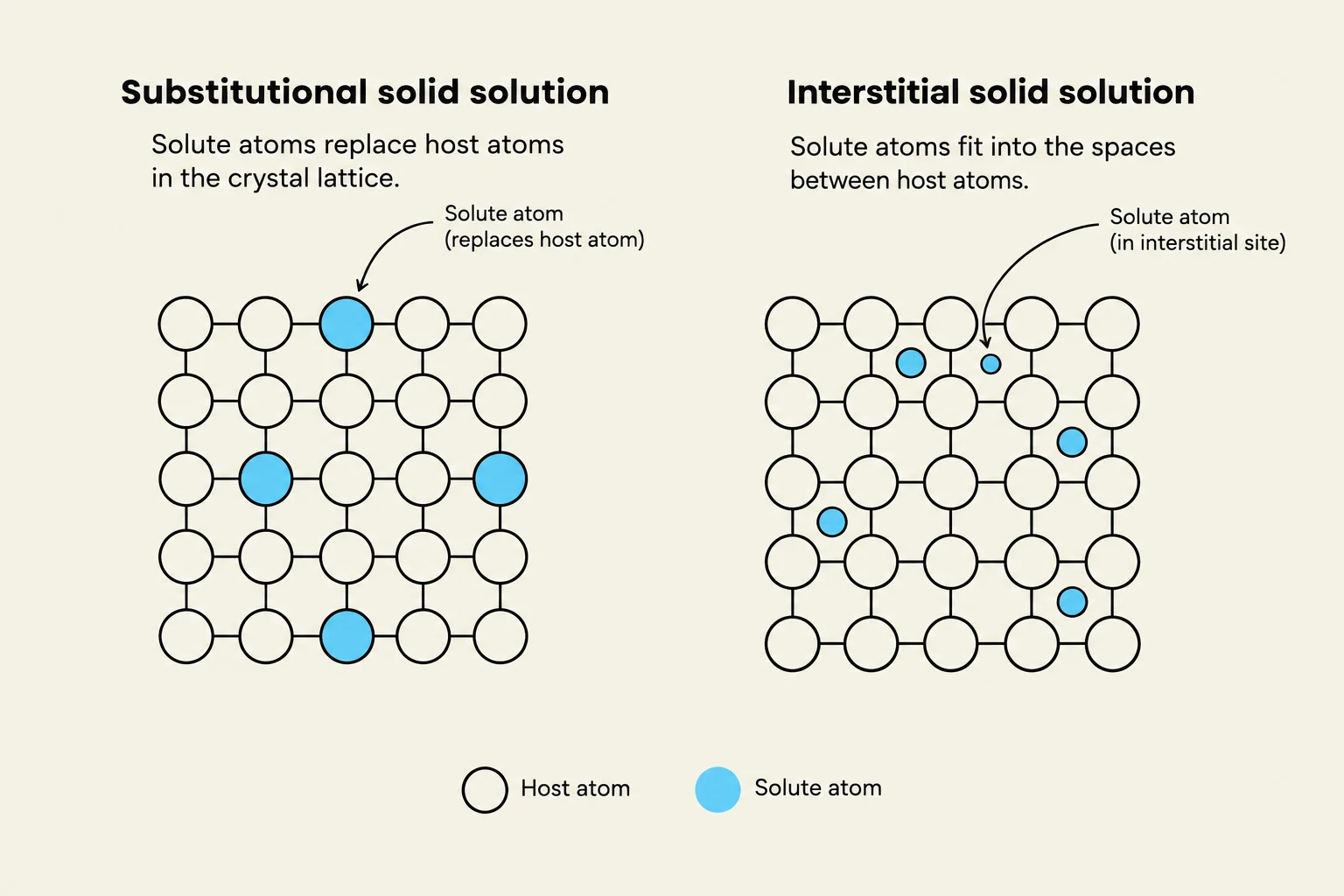
When impurity or solute atoms are added to a host (solvent) metal, they form a solid solution. There are two primary ways these atoms integrate into the lattice:
Substitutional Solid Solutions: Solute atoms replace or substitute for the host atoms in the lattice.
Interstitial Solid Solutions: Solute atoms, which must be significantly smaller than the host atoms, lodge themselves into the available voids (interstitial sites) between the host atoms.
Exam Tip: For a substitutional solid solution to be highly soluble, the solute and solvent should have similar atomic radii, similar crystal structures, similar electronegativities, and a similar number of valence electrons (Hume-Rothery rules).
Diagrams illustrating substitutional and interstitial solid solutions, showing how solute atoms integrate into a crystal lattice.
Defects in Ionic Crystals
In ionic crystals, point defects must maintain electrical neutrality. Two specific types are commonly discussed:
Schottky Imperfection: A pair of oppositely charged particles (a cation and an anion) are both missing from the lattice, creating a di-vacancy.
Frenkel Imperfection: A cation moves from its regular site into an interstitial site.
Line Defects: Dislocations (One-Dimensional)
Line defects, or dislocations, are distortions centered around a line of atoms. They are primarily responsible for the ductility and strength of metals, as they allow planes of atoms to slide over one another during plastic deformation.
Types of Dislocations
Edge Dislocation: Formed when an extra half-plane of atoms is inserted into the crystal lattice. This creates a region of compression above the dislocation line and tension below it.
Screw Dislocation: Formed by shear stresses that cause the lattice to distort into a spiral ramp shape.
Mixed Dislocation: In most real materials, a dislocation is neither purely edge nor purely screw but a combination of both.
To describe these defects, scientists use the Burgers vector (b), which represents the magnitude and direction of the lattice distortion. In an edge dislocation, the Burgers vector is perpendicular to the dislocation line, whereas in a screw dislocation, it is parallel to the line.
Planar Defects (Two-Dimensional)
Planar defects are boundaries that separate regions of the crystal with different orientations or structures.
Grain Boundaries
During solidification, multiple crystals (grains) grow simultaneously. When these growing crystals meet, they form grain boundaries. These boundaries are regions of atomic mismatch where the packing is less dense than inside the grain.
Mechanical Effect: Grain boundaries act as barriers to dislocation movement. Therefore, a smaller grain size (more boundaries) generally results in a stronger metal at room temperature.
Thermal Effect: At very high temperatures, grain boundaries can become a source of weakness as they may melt or slide more easily than the grain interiors.
Twin Boundaries and Stacking Faults
Twin Boundaries: A special type of boundary where the lattice on one side is a mirror image of the lattice on the other. These are often formed during plastic deformation or recrystallization and can strengthen the metal.
Stacking Faults: These occur when the regular sequence of atomic layers is interrupted (e.g., instead of ABCABC, the sequence becomes ABCABABC).
Volume Defects (Three-Dimensional)
Volume defects are the largest scale of imperfections. They often occur when clusters of point defects (like vacancies) join together to form a three-dimensional void or crack. These can significantly impact the structural integrity of a component by acting as stress concentrators.
This illustration depicts the formation of volume defects in a crystal lattice through the coalescence of point defects, such as vacancies, leading to the creation of a three-dimensional void or cavity.