This document explores essential analytical frameworks for understanding environmental issues, integrating science, technology, governance, politics, values, and uncertainty to provide a holistic perspective on complex socio-ecological systems.
Environmental issues are rarely isolated phenomena. A change in ocean temperature is not just a biological or chemical event; it is a political event, a technological challenge, and a matter of social justice. To truly understand the complexities of our changing world, we cannot rely on a single lens. Instead, we must employ "cross-cutting themes"—a set of analytical frameworks that allow us to look at an issue from multiple angles simultaneously.
By integrating science, governance, politics, and technology, we can move beyond simple observations and begin to understand the underlying drivers and potential solutions to environmental crises.
The Foundation: Science, Technology, and Life Cycle Assessment
At the core of most environmental discussions is science. Science provides the empirical data required to understand how natural systems function and how they are being altered. However, science does not exist in a vacuum; it is often applied through technology.
Technology is frequently viewed as the "step-child" of science—the practical product of scientific inquiry. While technology can be a powerful force for environmental good (such as renewable energy systems), it can also be a source of significant negative impacts. The speed at which new technologies are deployed often outpaces our ability to fully understand their long-term ecological consequences.
To mitigate these risks, analysts use Life Cycle Assessment (LCA). An LCA is a systematic tool used to assess the total environmental impacts associated with a technology or product throughout its entire existence—from raw material extraction to manufacturing, use, and eventual disposal.
This diagram illustrates the stages of a product's life cycle, from raw material extraction and production to distribution, use, and end-of-life options such as recycling or landfilling.
Exam Tip: When discussing technology in an environmental context, don't just focus on the "solution." Always mention the potential for unintended consequences and the importance of using Life Cycle Assessments to quantify those impacts.
Navigating Uncertainty: Risk, Complexity, and Precaution
One of the greatest challenges in environmental analysis is the inherent uncertainty of the future. To make sense of what might happen, scientists create models to simulate the world as it is. However, these models are approximations; they may, and often do, represent the world incorrectly. This creates a gap between our predictions and reality, leading to significant uncertainty.
When dealing with this uncertainty, decision-makers face a fundamental tension: Precaution vs. Adaptation.
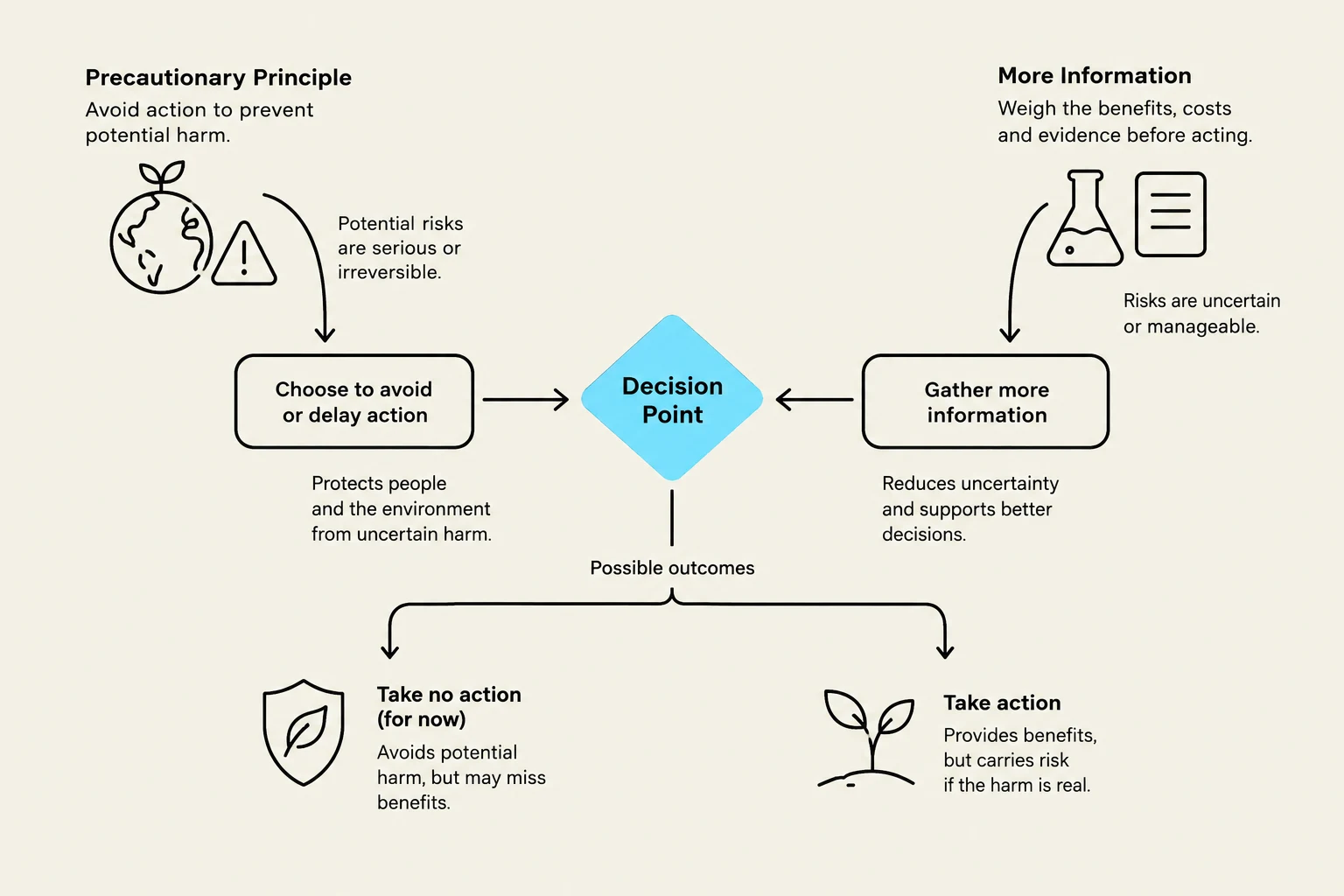
The Precautionary Principle: This approach suggests that if an action or policy has a suspected risk of causing harm to the public or the environment, in the absence of scientific consensus, the burden of proof falls on those proposing the action. It is a "better safe than sorry" mindset.
Adaptive/Flexible Management: This approach accepts uncertainty and focuses on being able to change course as new information becomes available. It allows for experimentation and learning through doing.
Analysts must often trade off one risk against another. For example, a new technology might carry an unknown environmental risk, but the risk of not using it (e.g., failing to address climate change) might be significantly higher.
This diagram illustrates the precautionary principle, outlining a decision-making process that involves weighing potential harm against the need for action, considering the availability of more information, and exploring possible outcomes such as taking action, delaying action, or taking no action.
Governance, Scale, and Jurisdiction
Once we understand the science and the risks, we must ask: Who decides what to do? This brings us to governance and laws and regulations.
Governance refers to the forums and institutions used to discuss and manage environmental issues. In Canada, for instance, laws and regulations have fundamentally changed how land and resources are utilized. Different organizations and institutions have varying levels of impact, and their structures can dictate the success or failure of environmental policy.
A critical complication in governance is scale and jurisdiction. Environmental issues are often "borderless"—pollution in one country can cause acid rain in another, and rising sea levels affect the entire planet. However, our legal and political systems are often bound by strict borders (jurisdictions). This creates a mismatch between the scale of the problem (global) and the scale of the decision-making (local or national). Effective environmental management requires intense collaboration, which can be hindered when political leaders are unable or unwilling to cooperate.
The Human Element: Values, Politics, and Power
Finally, we must acknowledge that environmental analysis is not purely objective; it is deeply human.
Values and Ideas shape what a society deems "important". These values are dynamic; they change over time and vary significantly between different cultures and societies. To conduct a thorough analysis, one must use knowledge and influence to share ideas while remaining open to the lived experiences and cultural perspectives of others.
These values feed directly into politics, interests, and power. Environmental issues are often battles over competing interests: what do people want?. Gaining political power often requires "gaining the numbers"—organizing enough people who care about an issue to force a change in the status quo.
Theme
Key Question for the Analyst
Science
What is the empirical evidence?
Technology
What are the life-cycle impacts?
Governance
What laws and institutions are in play?
Politics
Who holds the power and what are their interests?
Values
What does this society prioritize?
By weaving these themes together, we move from a narrow view of "nature" to a holistic understanding of the complex socio-ecological systems that define our world.
Keep reading for free.
Create an account to finish this reading and make it part of your study routine.