


Cultural Studies has long provided a vital lens for understanding how power, identity, and meaning are constructed within societies. By focusing on the "lived experience" of individuals, it has successfully deconstructed many traditional hierarchies. However, when applied to the study of religion, many scholars argue that certain foundational pillars of Cultural Studies—specifically Postmodernism, Cultural Relativism, and Cultural Determinism—fall short of providing a complete explanation. While these frameworks excel at describing what people believe and how those beliefs function socially, they often struggle to explain why religious phenomena emerge with such consistency across diverse human populations.
The Postmodern Challenge: Fragmentation vs. Universal Patterns
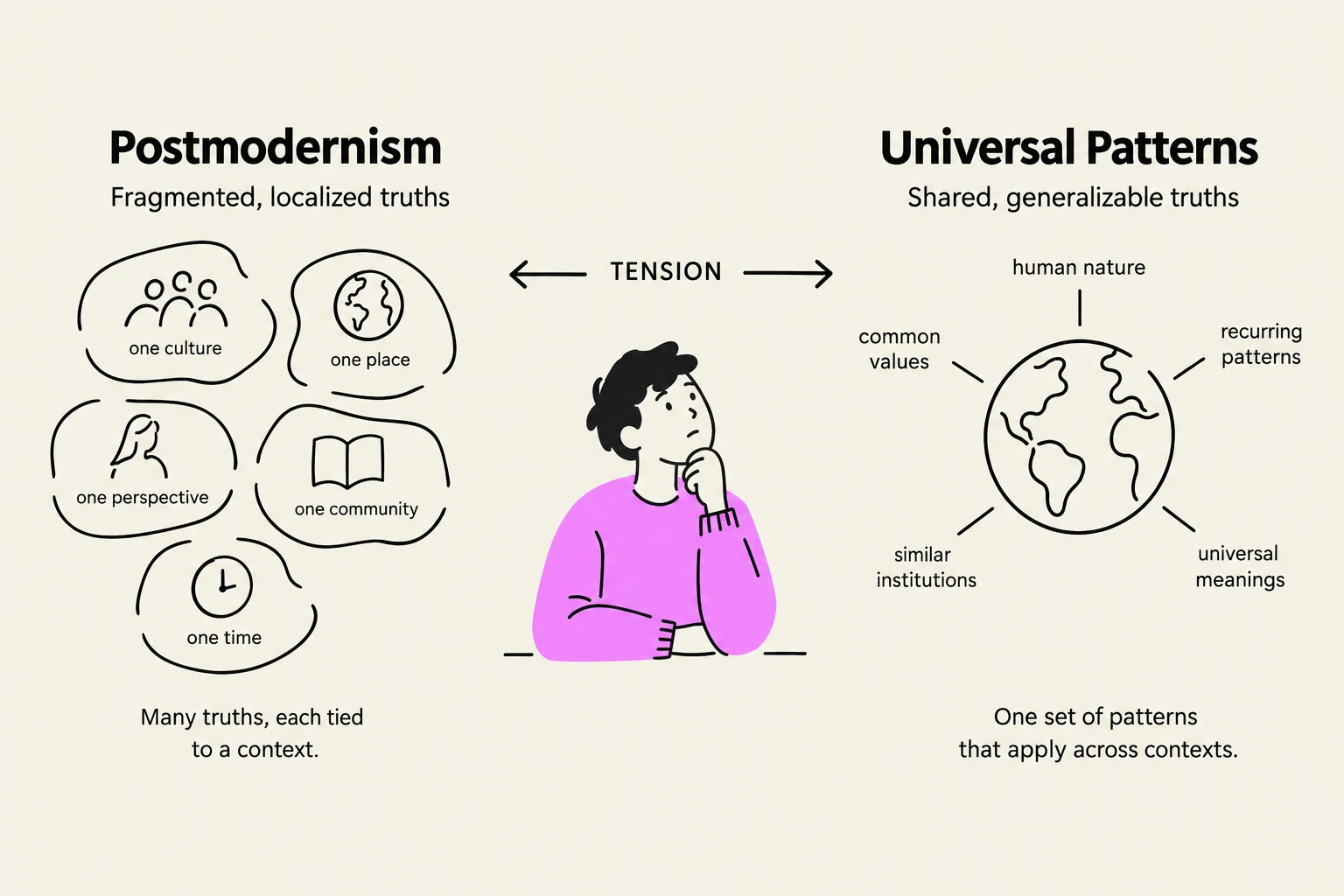
Postmodernism, a cornerstone of modern Cultural Studies, emphasizes the fragmentation of truth and the rejection of "grand narratives." In the context of religion, a postmodern approach suggests that religious truth is merely a social construct—a localized narrative used to navigate power dynamics or provide identity.
While this approach is useful for analyzing how specific religious groups use dogma to exert control, it faces a significant critique: it struggles to account for the cross-cultural ubiquity of certain religious concepts. If all religious truth is merely a localized social construct, why do we see remarkably similar patterns of ritual, sanctity, and agency across vastly different cultures and historical epochs?
Exam Tip: When discussing postmodernism in religious studies, distinguish between its strength (analyzing power and identity) and its weakness (its inability to account for universal cognitive or evolutionary patterns).


Keep reading for free.
Create an account to finish this reading and make it part of your study routine.
Continue reading freeAlready have an account? Log in
Updated