Core Financial Principles for International Business
This content explains the fundamental principles of finance, including the Time Value of Money, Risk-Return Tradeoff, and Capital Budgeting, as they apply to international business operations and decision-making.
Whether a company is managing a local retail shop or a multinational conglomerate operating across six continents, the fundamental logic of finance remains remarkably consistent. While international finance introduces complexities like currency fluctuations, geopolitical instability, and varying tax laws, the underlying decision-making process relies on a few immutable pillars. To master international finance, one must first master the core principles that govern how money moves, how value is measured, and how risk is priced.
The Time Value of Money (TVM)
The most fundamental concept in all of finance is the Time Value of Money (TVM). The core premise is simple: a dollar held today is worth more than a dollar promised in the future. This is true because money available now can be invested to earn interest or capital gains, providing a higher nominal amount in the future.
In an international context, TVM becomes even more critical. When a firm evaluates a long-term project in a foreign country, it must discount future cash flows back to their "present value" using an appropriate discount rate. This process accounts for both the opportunity cost of capital and the uncertainty of receiving those funds in the future.
The mathematical foundation of TVM is expressed through the formula for Future Value (FV) and Present Value (PV):
FVPV=PV⋅(1+r)n=(1+r)nFV
Where:
PV is the Present Value.
FV is the Future Value.
r is the interest rate (or discount rate) per period.
n is the number of periods.
This illustration demonstrates the concept of compound interest, showing how an initial investment (Present Value) grows over time to a larger amount (Future Value) due to a specified interest rate. The formula FV = PV x (1 + i)^t is also presented, where FV is future value, PV is present value, i is the interest rate, and t is the time in periods.
Exam Tip: When calculating Present Value for international projects, always ensure that the interest rate (r) and the number of periods (n) are expressed in the same time units (e.g., if the rate is annual, n must be in years).
The Risk-Return Tradeoff
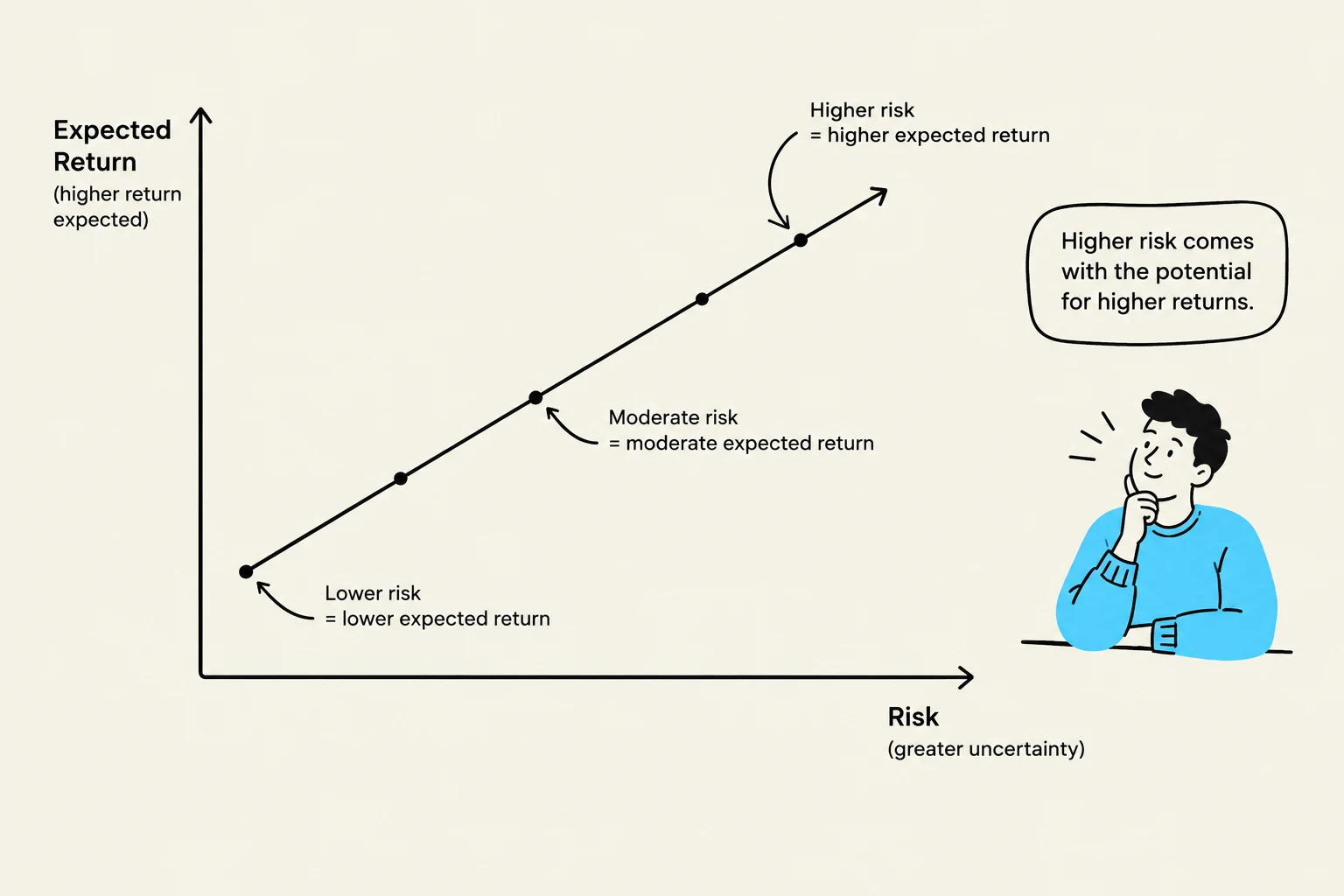
In the world of finance, there is no such thing as a "free lunch." The risk-return tradeoff is the principle that the potential return on an investment rises with an increase in risk. Low levels of uncertainty (low risk) are associated with low potential returns, whereas high levels of uncertainty (high risk) must be compensated with higher potential returns to attract investors.
In international finance, "risk" takes on many layers. Beyond the standard market risk (the volatility of stock prices), international managers must contend with:
Exchange Rate Risk: The danger that a foreign currency will depreciate against the home currency.
Political Risk: The possibility that changes in government policy or instability will impact business operations.
Country Risk: The broader economic stability of a nation.
Because these international factors increase the total uncertainty of a project, the required rate of return (the discount rate) used in TVM calculations must be adjusted upward to compensate for this extra risk.
A graph illustrating the relationship between risk and expected return, showing that higher risk is associated with higher potential returns.
Capital Budgeting: Deciding Where to Allocate Wealth
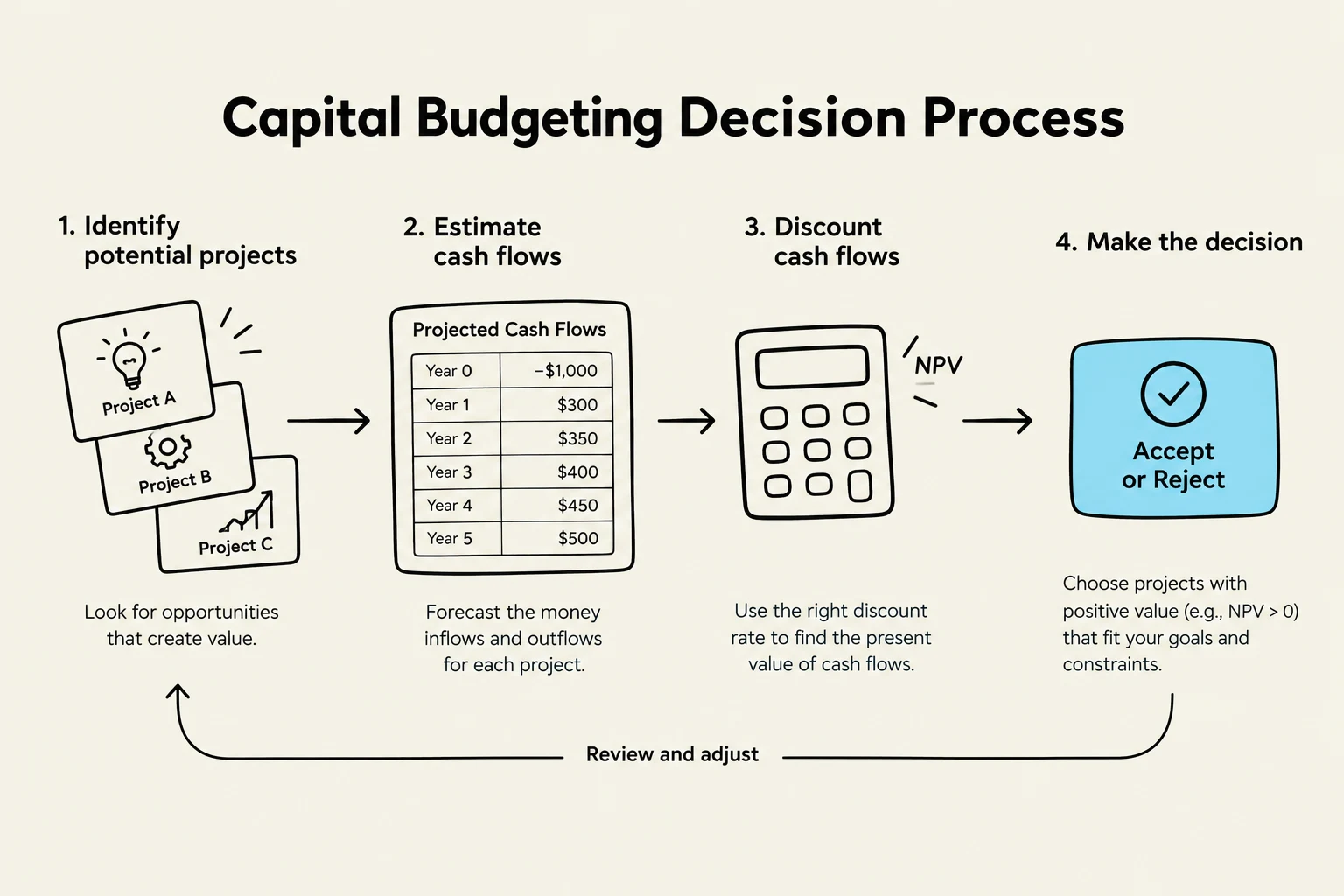
Capital budgeting is the process a firm uses to evaluate and select long-term investments. For a multinational corporation, capital budgeting involves deciding whether to build a new factory in Vietnam, acquire a tech firm in Germany, or expand a distribution network in Brazil.
To make these decisions, managers typically use several key metrics:
Net Present Value (NPV)
NPV is widely considered the "gold standard" of capital budgeting. It calculates the difference between the present value of cash inflows and the present value of cash outflows over the life of a project.
NPV=t=1∑n(1+r)tCFt−Initial Investment
If the $NPV > 0$, the project is expected to add value to the firm and should be accepted. If $NPV < 0$, the project will destroy value and should be rejected.
Internal Rate of Return (IRR)
The IRR is the discount rate that makes the NPV of a project equal to zero. It represents the expected compound annual rate of return that the project will provide. A common decision rule is to accept a project if the IRR is greater than the firm's cost of capital.
This diagram illustrates the capital budgeting decision process, which involves identifying potential projects, estimating cash flows, discounting those cash flows to their present value, and finally making a decision to accept or reject the project based on criteria such as a positive Net Present Value (NPV).
Worked Example: Evaluating a Foreign Expansion
Imagine a US-based company is considering investing $$1,000,000$ in a new subsidiary in Europe. The project is expected to generate $$400,000$ per year for three years. The company's required rate of return (cost of capital) is $10%$.
Step 1: Calculate the Present Value of each cash flow.
Year 1: (1+0.10)1400,000=363,636
Year 2: (1+0.10)2400,000=330,579
Year 3: (1+0.10)3400,000=300,526
Step 2: Sum the Present Values.
Total PV=363,636+330,579+300,526=994,741
Step 3: Calculate NPV.
NPVNPV=994,741−1,000,000=−5,259
Conclusion: Since the NPV is negative, the company should reject the project. Even though the total nominal cash inflows ($1.2 million) are greater than the initial investment ($1 million), the time value of money shows that the investment does not meet the required $10%$ return.
Summary
While the global economy is constantly shifting, the core principles of finance remain the compass for every international manager. By applying the Time Value of Money, accounting for the Risk-Return Tradeoff, and utilizing rigorous Capital Budgeting techniques, firms can navigate the complexities of the global marketplace and make decisions that create long-term value.
Keep reading for free.
Create an account to finish this reading and make it part of your study routine.