In physics, describing where an object is located is the first step toward understanding how it moves. Depending on the nature of the motion, one mathematical "language" might be much easier to speak than another. While we often default to the familiar grid of the Cartesian system, many natural phenomena—from the spinning of a hurricane to the path of a satellite—are much more elegantly described using polar coordinates. Understanding how to translate between these two systems is a fundamental skill in kinematics and vector analysis.
The Cartesian Coordinate System
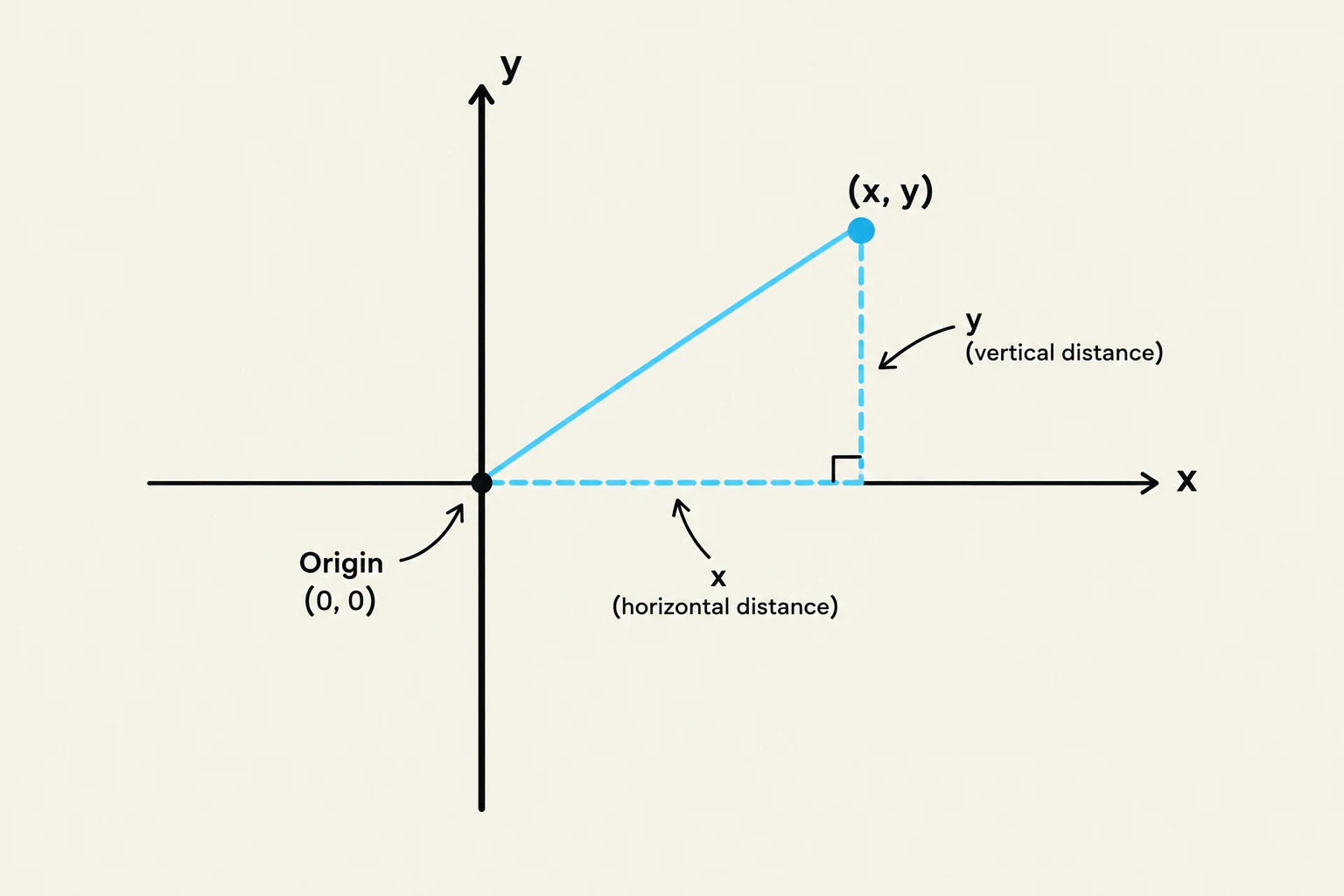
The Cartesian coordinate system is the most common method for locating points in a two-dimensional plane. It relies on two perpendicular axes: the horizontal x-axis and the vertical y-axis. Any point in this plane can be uniquely identified by an ordered pair (x,y), representing its signed distance from the origin along each respective axis.
This system is particularly powerful when dealing with linear motion or when adding multiple vectors together using unit vector notation (such as A=Axi^+Ayj^). By breaking a vector into its x and y components, we can simplify complex problems, such as calculating the total displacement of a skydiver or the combined force of multiple people pulling on an object.
A diagram illustrating a point (x, y) in a Cartesian coordinate system, showing its horizontal and vertical distances from the origin (0, 0).
The Polar Coordinate System
While Cartesian coordinates excel at describing rectangular paths, they become cumbersome when describing circular or curved motion. This is where the polar coordinate system becomes essential. Instead of using a grid, polar coordinates define a point by its distance from the origin and its angle relative to a reference direction.
A point in polar coordinates is represented by (r,θ), where:
r is the radial distance (the straight-line distance from the origin to the point).
θ is the angular coordinate, typically measured in degrees or radians counterclockwise from the positive x-axis.
Polar coordinates are the preferred choice for analyzing radial motion—motion that occurs along a radius or along an arc of a circle or ellipse. For example, calculating the gravitational pull of a planet or the movement of a hurricane's eye is often much simpler in polar form than in Cartesian form.
A diagram illustrating polar coordinates, showing a point P with coordinates (r, \u03b8), where r is the distance from the origin and \u03b8 is the angle from the positive x-axis.
The Mathematical Bridge: Trigonometry and the Pythagorean Theorem
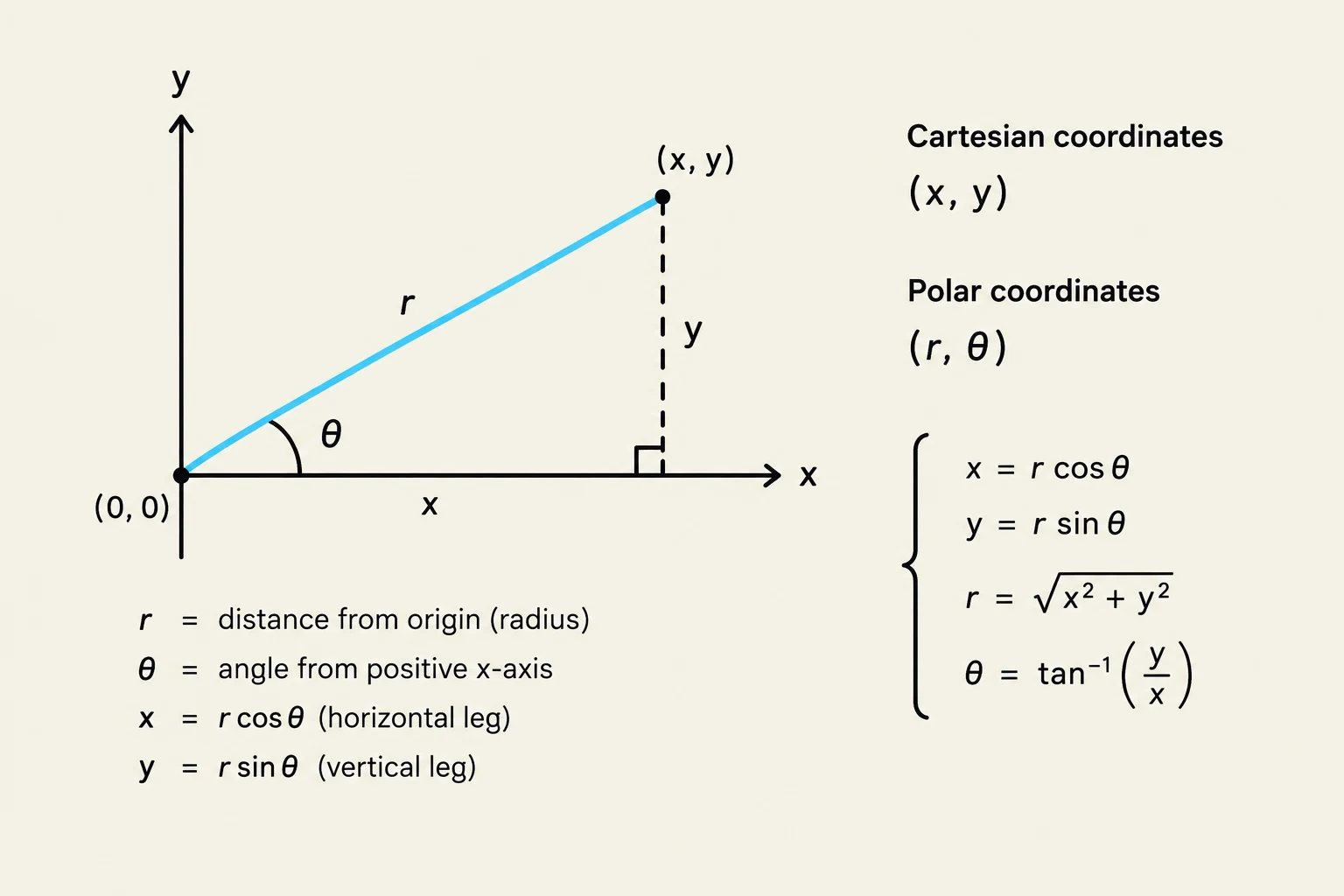
To move between these two systems, we use the geometry of a right triangle. If you imagine a point in the plane, you can draw a line from the origin to that point (the radius r) and then drop a perpendicular line to the x-axis to create a right triangle. The legs of this triangle are the Cartesian coordinates x and y.
Converting Polar to Cartesian
If you know the magnitude r and the angle θ, you can find the x and y components using trigonometric functions:
Cosine (cos): Relates the adjacent side (x) to the hypotenuse (r).
Sine (sin): Relates the opposite side (y) to the hypotenuse (r).
The conversion formulas are:
xy=rcosθ=rsinθ
Converting Cartesian to Polar
If you have the x and y coordinates and need to find r and θ, you apply the Pythagorean theorem and the tangent (tan) function:
Finding r: Since r is the hypotenuse of the triangle formed by x and y:
r2r=x2+y2=x2+y2
Finding θ: The tangent of the angle is the ratio of the opposite side to the adjacent side:
tanθθ=xy=tan−1(xy)
This illustration shows the relationship between Cartesian coordinates (x, y) and polar coordinates (r, θ), including the conversion formulas between them.
Exam Tip: Watch Your Quadrants!
When calculating θ using tan−1(y/x), your calculator may only give you a value in a specific range. You must check the signs of your x and y coordinates to determine which quadrant the point actually lies in. For example, if both x and y are negative, the point is in Quadrant III, and you may need to add 180∘ to your result to get the correct angle.
Force Components and Vector Analysis
The ability to switch between these systems is not just a mathematical exercise; it is a vital tool for solving physics problems involving force components.
In many real-world scenarios, a force is applied at a specific angle. For instance, if two people are pulling on an object with specific magnitudes and directions, it is often easiest to:
Describe each force in polar coordinates (magnitude and direction).
Convert those forces into Cartesian components (Fx and Fy) using sine and cosine.
Sum the components to find the resultant force.
By separating motion or force into independent x and y components, we can analyze complex two-dimensional problems as two simpler one-dimensional problems.
Worked Example: Finding Polar Coordinates
Problem: A fly lands on a wall at the Cartesian coordinates (1.95,1.05) meters. Find its location in polar coordinates (r,θ).
Step 1: Find the radial distance r.
Using the Pythagorean theorem: