This resource explains the essential elements required for forming a legally enforceable contract, including offer, acceptance, mutual assent, and consideration. It differentiates between bilateral and unilateral contracts and discusses exceptions to the consideration requirement.
In the study of law, a contract is more than just a handshake or a written document; it is a legally enforceable promise or a set of promises. While we often use the terms "agreement" and "contract" interchangeably in daily life, the legal system makes a sharp distinction. An agreement is merely a "meeting of the minds" or a consensus between parties, but a contract is an agreement that the law will actually enforce. To move from a mere agreement to a binding contract, specific elements must be present, most notably mutual assent and consideration.
The Foundation: Offer vs. Invitation to Offer
The process of contract formation begins with a proposal. However, not every proposal is a legal "offer." In contract law, an offer is a manifestation of willingness to enter into a bargain, made with the intention that it shall become binding as soon as it is accepted.
It is critical to distinguish an offer from an invitation to offer (also known as a "treat"). An invitation to offer is not a commitment to be bound; rather, it is an act intended to induce negotiations or invite others to make a proposal. For example, a store displaying an item with a price tag is generally considered an invitation to offer, while the customer makes the offer at the cash register.
Exam Tip: Always look for the "intent to be bound." If a reasonable person would interpret a statement as a definitive commitment rather than a negotiation tactic, it is likely an offer.
Mutual Assent: The Meeting of the Minds
For a contract to exist, there must be mutual assent, often described as a "meeting of the minds". This means both parties must agree to the same terms and manifest an intention to be bound by them.
At common law, mutual assent is typically achieved through the mechanism of offer and acceptance. Under the traditional "Mirror Image Rule," the acceptance must be unqualified and must exactly match the terms of the offer; if the offeree attempts to change the terms, they have not accepted the offer, but have instead made a counter-offer.
This illustration depicts the three key elements of contract formation: Offer, Acceptance, and Mutual Assent. An offer is a proposal, acceptance is agreement to the terms, and mutual assent signifies that both parties agree, forming a binding contract, provided the acceptance is valid and timely.
Categorizing Contracts: Bilateral vs. Unilateral
Once assent is established, contracts are categorized based on the nature of the exchange between the parties.
Bilateral Contracts
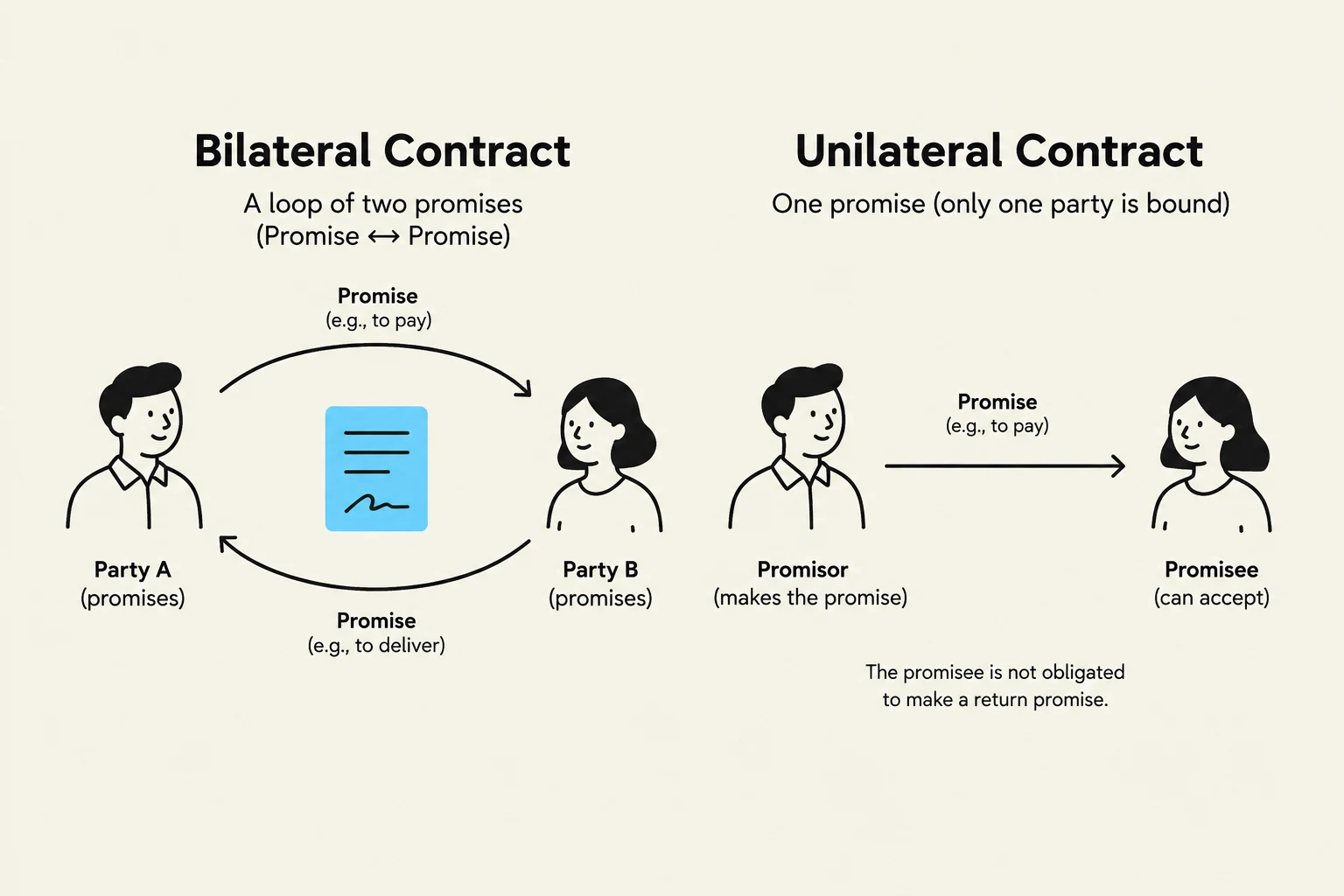
A bilateral contract is an agreement formed by the exchange of mutual promises. In this structure, Party A promises to do something, and in exchange, Party B promises to do something else. This "promise-for-a-promise" model is the standard for most modern business transactions, such as the sale of goods. Because both parties have made commitments, there is "mutuality of obligation".
Unilateral Contracts
A unilateral contract occurs when one party makes a promise in exchange for an act or an abstention. Here, the offeror is the only one making a binding promise, and the offeree is not obligated to act. The contract is only formed—and the offeror only becomes bound—once the offeree actually performs the requested act.
Unilateral contracts are typically limited to specific scenarios, such as:
Public offers: Such as a reward posted for a lost pet.
Explicit language: Where the offeror unambiguously states that performance is the only method of acceptance.
This illustration contrasts bilateral contracts, involving a two-way exchange of promises, with unilateral contracts, where only one party makes a binding promise.
The Requirement of Consideration
Even if there is an offer, an acceptance, and mutual assent, a contract is not enforceable without consideration. Consideration is a legal term of art representing the sum of conditions necessary for a bargained-for exchange. It is the "price" paid for the promise, distinguishing a binding contract from a mere gratuitous promise (a gift).
Theories of Consideration
Legal scholars and courts have historically used two primary theories to determine if consideration exists:
Benefit-Detriment Theory: This traditional view suggests a contract is valid if the promise results in a legal benefit to the promisor or imposes a legal detriment on the promisee. A legal detriment is defined as the relinquishment of a legal right.
Bargain Theory: This modern view focuses on the subjective exchange. A promise is "bargained-for" if the promisor gives the promise specifically to induce the promisee's performance or promise, and the promisee gives the performance/promise specifically to induce the promisor's promise.
In modern legal interpretation (such as the Restatement (Second) of Contracts and the UCC), the Bargain Theory has largely replaced the benefit-detriment theory. This shift helps avoid the circular logic of the benefit-detriment theory and aligns better with the idea that courts should not inquire into the "adequacy" of the deal—only whether a bargain actually took place.
Note on Adequacy: Courts generally do not care if you made a "bad deal." If you sell a car worth $$10,000$ for $500 because you simply want it gone, the court will not invalidate the contract. They look for a "bargained-for" exchange, not whether the value was equal.
Exceptions: When Consideration is Not Required
There are specific instances where a promise may be enforced even without traditional consideration:
Promissory Estoppel: If a party makes an unambiguous promise, and it is foreseeable that another party will rely on that promise, and they do rely on it to their detriment, a court may enforce the promise to prevent injustice.
Moral Obligations: In some cases, a promise to fulfill a moral obligation (like supporting someone injured while rescuing the promisor) may be binding.
This illustration depicts the legal concept of promissory estoppel, showing an unambiguous promise leading to foreseeable reliance by the other party.
Summary of Contract Formation
To summarize, the formation of a valid, enforceable contract requires the following elements:
Offer: A proposal with intent to be bound.
Acceptance: Unqualified agreement to the terms.
Mutual Assent: A "meeting of the minds".
Consideration: A bargained-for exchange of value.
Capacity and Legality: The parties must be legally capable, and the purpose must be lawful.
Failure to meet these requirements can render a contract void (no legal obligation exists), voidable (one party has the option to cancel), or unenforceable (a valid contract exists but cannot be enforced due to a legal defense).
Keep reading for free.
Create an account to finish this reading and make it part of your study routine.