Contextual and Emotional Factors in Memory and Forgetting
Explore how environmental context and emotional states influence memory retrieval, alongside the various mechanisms of forgetting such as encoding failure, storage decay, retrieval failure, and interference.
Have you ever walked into a room to grab something, only to forget what it was the moment you crossed the threshold? Or perhaps you found that you could only recall a specific historical date while listening to a particular type of music? These are not just random lapses in concentration; they are demonstrations of how our brains link information to the world around us. Memory is not a static filing cabinet; it is a dynamic, reconstructive process influenced by our surroundings, our emotions, and the way we process information.
The Power of Context and Mood
Successful memory retrieval often depends on the presence of "cues"—signals that help trigger the brain to access stored information. Two of the most powerful types of cues are environmental and emotional.
Context-Dependent Memory
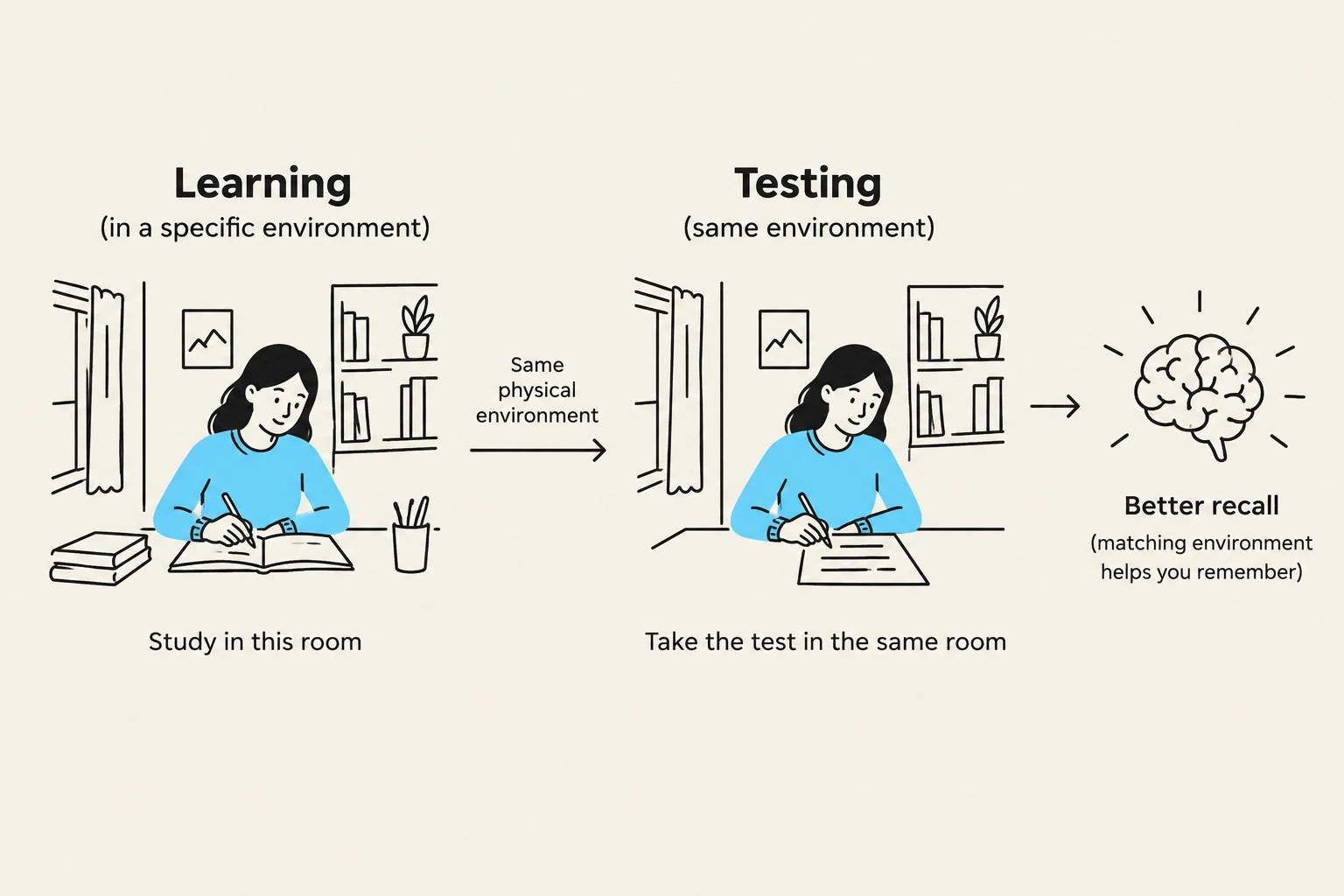
Context-dependent memory refers to the influence of the physical environment on how well we remember things. When you learn something in a specific setting, that setting becomes part of the "associative network" of that memory. If you return to a similar environment during testing, the physical surroundings can act as a retrieval cue, helping you "unlock" the information.
A classic study involved participants learning word lists either on land or underwater. The researchers found that recall was highest when the testing environment matched the learning environment. For example, people learned underwater and were tested underwater performed better than those who were moved to land for the test.
This illustration demonstrates the concept of context-dependent memory, showing that learning and testing in the same environment can lead to better recall.
Mood-Dependent Memory
Just as physical surroundings matter, so does your internal state. Mood-dependent memory suggests that retrieval is more successful when your emotional state during testing matches your emotional state during the initial learning phase.
If you study while feeling happy and are later tested while happy, you are more likely to remember the material than if your mood shifts to sadness during the exam. However, it is worth noting that extreme emotional states (very high or very low) might actually hinder concentration; a calm, moderately positive state is often best for efficient learning.
Exam Tip: If a question asks for the difference between context-dependent and mood-dependent memory, remember: Context = Physical Environment; Mood = Emotional State.
Why We Forget: The Mechanics of Memory Failure
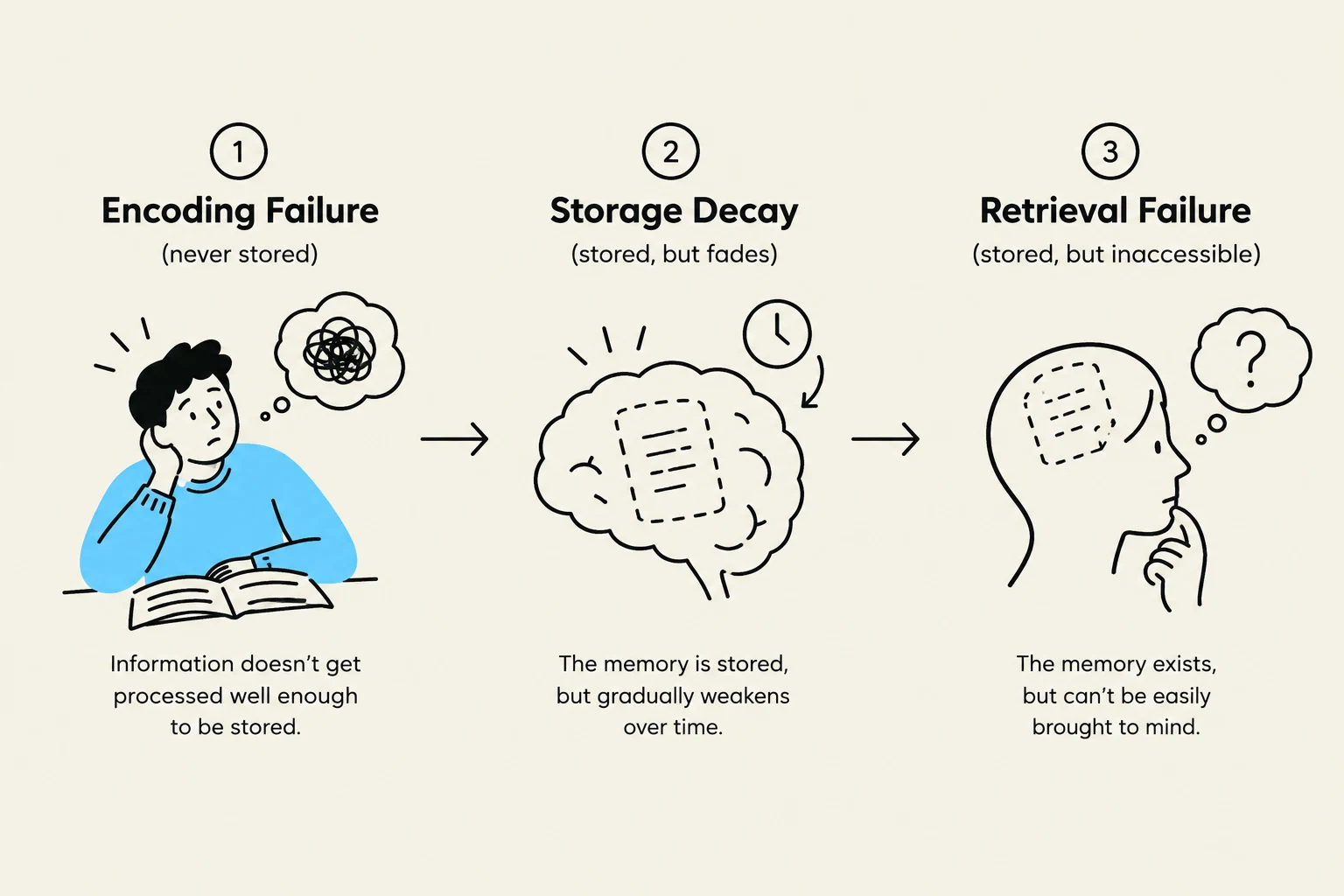
Forgetting is defined as the failure to retrieve information that a person would like to remember. It is rarely a single process; rather, it can happen at different stages of the memory cycle: encoding, storage, or retrieval.
1. Encoding Failure
This is perhaps the most common reason for forgetting. Encoding failure occurs when information is never actually processed deeply enough to enter long-term memory. You might read a textbook chapter, but if you are merely skimming without processing the meaning, the information stays in your limited-capacity working memory and then vanishes.
2. Storage Decay
Storage decay is the gradual weakening of a memory trace over time. Research shows a "forgetting curve" where retention drops very rapidly immediately after learning and then stabilizes over time. Some information is lost quickly, while other, more emotionally significant or meaningful information may stay with us for years.
3. Retrieval Failure
In retrieval failure, the information is actually stored in your brain, but you simply cannot find the "pathway" to get to it at that moment. A classic example is the "tip-of-the-tongue" phenomenon, where you feel certain you know a name or word, but it remains just out of reach. This usually happens because a necessary retrieval cue is missing.
This diagram illustrates three types of memory failure: encoding failure, storage decay, and retrieval failure.
4. Interference
Interference occurs when different pieces of information compete with one another, making retrieval difficult. There are two distinct directions this can take:
Proactive Interference: Old information interferes with your ability to learn new information (e.g., your old French vocabulary making it hard to learn Spanish).
Retroactive Interference: New information interferes with your ability to remember old information (e.g., learning Spanish makes you forget your old French words).
Motivated Forgetting and the Reconstructive Nature of Memory
Not all forgetting is "organic" or accidental. Sometimes, the brain may actively avoid certain memories.
Motivated Forgetting and Repression
Motivated forgetting occurs when a person has a psychological motivation to avoid certain thoughts or memories. In Freudian theory, this is known as repression—a defense mechanism where distressing or traumatic memories are pushed into the unconscious to protect the individual. While these memories are not "consciously" accessible, they may still influence a person's emotions or behaviors.
The Misinformation Effect and False Memories
One of the most critical findings in modern psychology is that memory is reconstructive, not a perfect video recording.
The misinformation effect occurs when misleading information presented after an event alters how you remember that event. For example, in a famous study, participants who were asked how fast cars were going when they "smashed" into each other gave much higher speed estimates than those asked how they "bumped" into each other.
This process can lead to false memories—vivid, convincing recollections of events that never actually happened. Because our confidence in a memory does not always correlate with its accuracy, this phenomenon has significant implications for eyewitness testimony in legal settings.
Summary Table for Exam Prep
Concept
Key Definition
Example
Proactive Interference
Old → New
Old phone number makes it hard to learn a new one
Retroactive Interference
New → Old
New password makes you forget your old one
Encoding Failure
Never stored
Reading a page without paying attention
Retrieval Failure
Stored but inaccessible
Tip-of-the-tongue phenomenon
Misinformation Effect
Post-event info changes memory
Being told a car "smashed" changes speed estimate
False Memory
Inaccurate recollection
Remembering a childhood event that never occurred
Keep reading for free.
Create an account to finish this reading and make it part of your study routine.