An explanation of Newton's laws of motion, contact forces, free-body diagrams, and the Atwood machine, including worked examples and connections to kinematics.
Understanding how objects move requires more than just looking at their speed; we must look at the forces that cause that motion. Whether it is two blocks being pushed across a table or two masses hanging from a pulley, the principles of classical mechanics remain consistent. By applying Newton's laws, we can predict the acceleration of complex systems and the internal forces, such as tension or contact pressure, that hold them together.
The Foundation: Newton's Three Laws
To analyze any physical system, we must start with the three laws formulated by Isaac Newton. These laws describe the relationship between an object, the forces acting upon it, and its motion.
Newton's First Law (Law of Inertia): An object at rest stays at rest, and an object in motion stays in motion with a constant velocity unless acted upon by a net external force. This means if the forces in a specific direction (like the vertical y-direction) are balanced, the net force is zero, and the acceleration in that direction is also zero.
Newton's Second Law (Law of Acceleration): The acceleration of an object is directly proportional to the net force acting on it and inversely proportional to its mass. This is expressed by the fundamental equation:
∑F=ma
where ∑F is the net force, m is the mass, and a is the acceleration.
Newton's Third Law (Action-Reaction): For every action, there is an equal and opposite reaction. When two objects are in contact, they exert forces on each other that are equal in magnitude but opposite in direction.
Exam Tip: When analyzing a system of multiple objects, remember that internal contact forces (like the force one block exerts on another) cancel out when you treat the group as a single system. Only external forces contribute to the system's overall acceleration.
Analyzing Contact Forces and Free-Body Diagrams
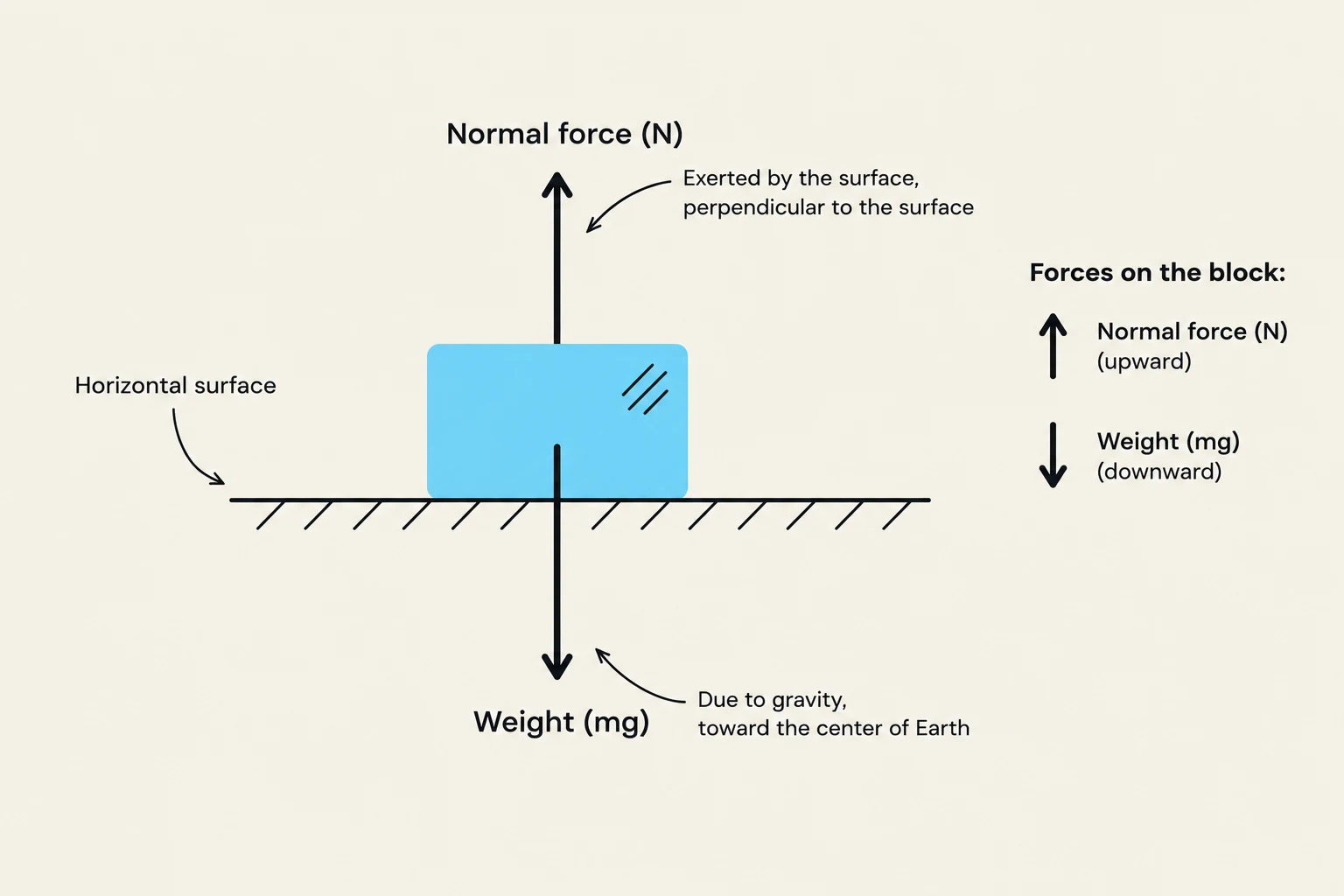
When objects touch, they exchange forces. Common examples include the normal force (the surface pushing back against an object) and contact forces between two adjacent blocks. To solve these problems without getting lost in the complexity, physicists use a Free-Body Diagram (FBD).
An FBD is a simplified sketch where the object is represented as a point, and all external forces acting on that object are drawn as arrows pointing in the direction of the force.
Diagram illustrating the normal force and weight acting on a block resting on a horizontal surface.
When two blocks (m1 and m2) are pushed together by an external force F, they move with a joint acceleration. To find this acceleration, you can treat them as one large mass:
a=m1+m2F
However, if you want to find the specific contact force between the blocks, you must analyze them individually using their own FBDs.
The Atwood Machine: Tension and Gravity
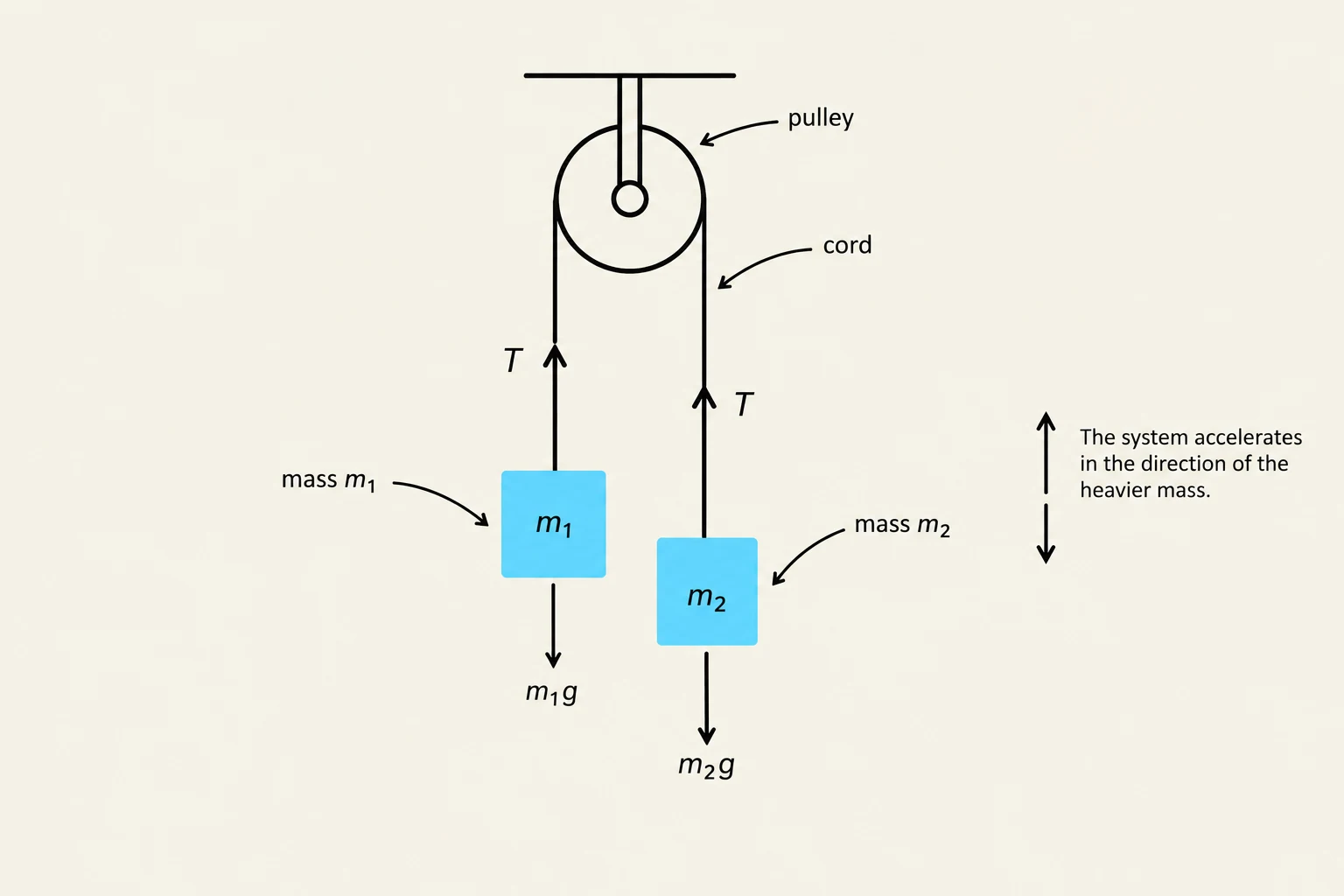
An Atwood machine is a classic physics setup consisting of two masses suspended by an inextensible cord (a cord that does not stretch) over a frictionless pulley. Because the cord is inextensible, the two masses must move together; if one moves down, the other must move up with the same magnitude of acceleration.
In this system, the primary forces are the gravitational force (weight, mg) acting downward and the tension (T) in the cord acting upward. For a massless, frictionless pulley, the tension is uniform throughout the entire cord.
A diagram illustrating a simple pulley system with two masses, m1 and m2, connected by a cord. The diagram shows the forces acting on each mass, including tension (T) and gravitational force (m1g and m2g). It also indicates that the system accelerates in the direction of the heavier mass.
To find the acceleration (a) of the system, we apply Newton's second law to both masses. If m1>m2, the acceleration is:
a=gm1+m2m1−m2
where g is the acceleration of gravity (approximately 9.80 m/s2).
Worked Example: Atwood Machine Calculation
Problem: An Atwood machine has m1=4.5 kg and m2=4.0 kg. Find the acceleration and tension.
Step 1: Find Acceleration
Using the formula derived from Newton's Second Law:
a=9.84.5+4.04.5−4.0a=9.88.50.5≈0.576 m/s2
Step 2: Find Tension
Apply ∑F=ma to the lighter mass (m2), where tension is the only upward force and weight is downward:
T−m2g=m2aT=m2(g+a)T=4.0(9.8+0.576)=41.5 N
Connecting Dynamics to Kinematics
Once the acceleration is determined through Newton's laws, we can predict the future position and velocity of the objects using kinematic equations. If the acceleration is constant, the displacement (Δx) over a period of time (t) can be found using:
Δx=vit+21at2
If the object starts from rest (vi=0), this simplifies to:
Δx=21at2
By combining these tools—Newton's laws to find acceleration and kinematics to find motion—we can fully describe the behavior of any mechanical system.
Summary Table: Force and Motion Relationships
Change in Parameter
Effect on Acceleration (a)
Effect on Displacement (Δx)
Increase External Force (F↑)
Increases (a↑)
Increases (Δx↑)
Increase Total Mass (m↑)
Decreases (a↓)
Decreases (Δx↓)
Keep reading for free.
Create an account to finish this reading and make it part of your study routine.