Construction Marketing and Public Relations Fundamentals
This document differentiates the objectives, audiences, tools, and measures of construction marketing and public relations to build a credible, competitive construction business.
In the complex ecosystem of the construction industry, success is not merely a matter of engineering excellence or timely project delivery. To build a truly competitive and credible business, a firm must master two distinct but deeply interconnected disciplines: Marketing and Public Relations (PR). While they are often conflated by those outside the profession, understanding their unique objectives, audiences, and tools is essential for any strategic business leader. When aligned correctly, these disciplines transform a company from a mere contractor into a trusted market leader.
The Strategic Foundation: Business Integration
Before diving into the specifics of marketing or PR, it is vital to understand that neither exists in a vacuum. Both must be driven by a central Business Strategy. A common mistake in the industry is to treat marketing or PR as "add-ons" or reactive measures rather than strategic imperatives.
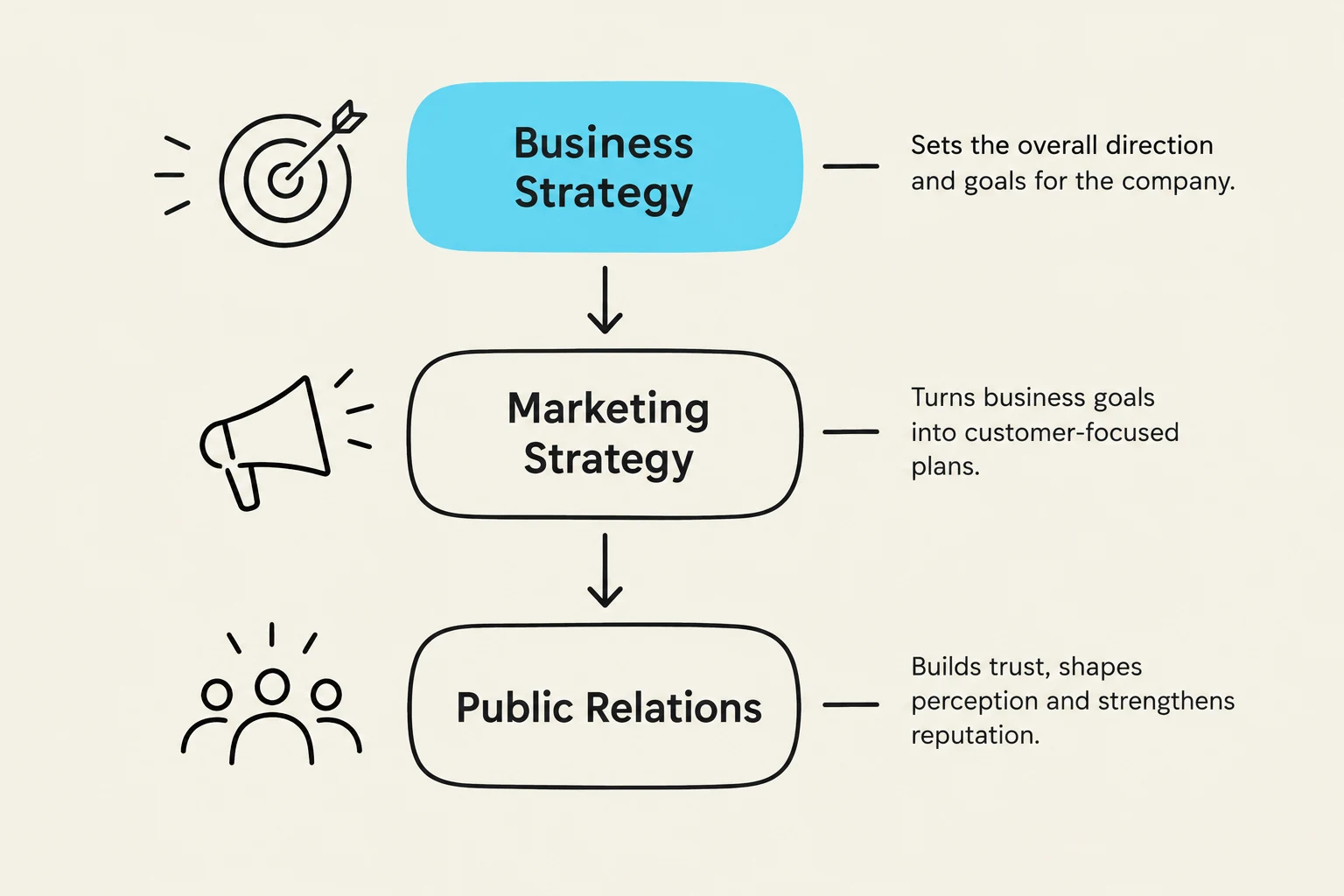
The relationship follows a logical hierarchy:
Business Strategy: Determines where the company will compete and how it intends to win.
Marketing Strategy: Identifies the specific markets, clients, and value propositions required to fulfill that business strategy.
PR Strategy: Identifies the stakeholders, relationships, and reputation management required to support those market positions.
This diagram illustrates the relationship between business strategy, marketing strategy, and public relations, outlining the function of each component within a company's overall goals and reputation management.
Marketing Management: Driving Demand and Preference
Marketing management is the process of identifying, anticipating, and satisfying customer requirements profitably. In a construction context, this is about finding the right projects and ensuring your firm is the preferred choice for the client.
Market Intelligence and the Value Proposition
Effective marketing begins with Market Intelligence—the systematic gathering of data regarding clients, competitors, industry sectors, tender trends, and emerging technologies. This intelligence allows a firm to develop a robust Value Proposition. This is not just a list of services, but a clear articulation of what makes the firm's offer distinctive, such as specialized expertise, a proven track record, or unique digital capabilities.
Market Activation and the Marketing Mix
Once the market is understood and the value proposition is defined, the firm moves to Market Activation. This involves using the Marketing Mix—traditionally involving product, price, place, and promotion—to engage target segments. In construction, activation often manifests through:
High-quality project proposals and tenders.
Strategic networking and business development.
A strong digital presence and targeted campaigns.
The primary goal of marketing is to generate leads, secure bids, and ultimately drive revenue and market share.
Public Relations: Building Trust and Legitimacy
While marketing focuses on the "buyer," Public Relations (PR) focuses on the Stakeholder. Stakeholders are any individuals or groups who can affect, or are affected by, the organization. This includes a much broader ecosystem than just the client, encompassing communities, regulators, employees, media, and government bodies.
Stakeholder Engagement and Reputation Management
The core purpose of PR is to build, maintain, and protect relationships and reputation. This is achieved through:
Stakeholder Relations: Managing the expectations of those who influence the business, such as local authorities or industry bodies.
Reputation Management: Ensuring the brand is perceived as credible, transparent, and responsible.
Issues Management: Proactively addressing concerns (such as environmental impact or site noise) before they escalate into crises.
Exam Tip: Do not confuse PR with mere publicity. A press release is a tool, but the purpose of PR is to build long-term trust and legitimacy, not just to get "likes" or media mentions.
The PR Response and Business Outcomes
PR does not just "happen"; it is a response to strategic needs. For example, if a company wants to enter a new renewable energy market, the PR response might involve thought leadership, community engagement, and media relations to build the necessary social license to operate. The ultimate business outcome of successful PR is a cycle of:
Trust→Access→Preference→Opportunity→Resilience.
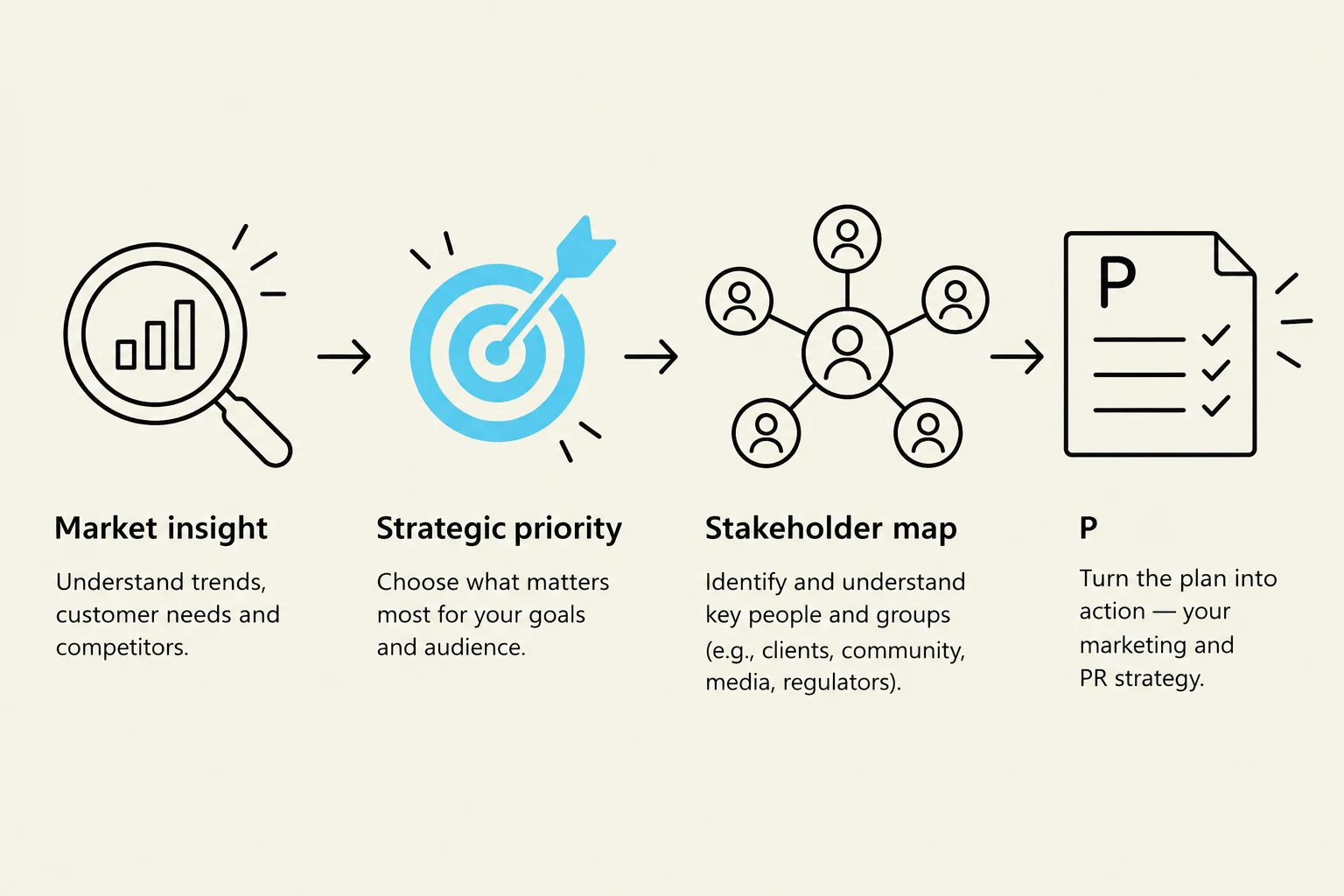
This diagram illustrates a four-step process for developing a marketing and PR strategy: Market Insight, Strategic Priority, Stakeholder Map, and Plan Execution.
Distinguishing Marketing from PR
To avoid common industry mistakes, it is helpful to view the two disciplines side-by-side.
Feature
Marketing
Public Relations
Primary Orientation
Markets and demand
Relationships and reputation
Main Objective
Generate preference and business opportunities
Build trust, legitimacy, and stakeholder support
Key Audience
Target customers and decision-makers
Broader stakeholder ecosystem
Typical Tools
Tenders, proposals, digital campaigns
Media, stakeholder engagement, issues management
Success Indicators
Leads, bids, revenue, market share
Trust, sentiment, reputation, issue resolution
Time Horizon
Often campaign or opportunity focused
Often cumulative and long-term
Summary: The Integrated Communication Model
A successful construction firm does not choose between marketing and PR; it integrates them. By using market intelligence to inform PR, and using PR to build the trust necessary to win marketing opportunities, a firm creates a powerful, self-reinforcing cycle of growth.
Common Pitfalls to Avoid:
Thinking PR = Publicity: Focus on relationships, not just mentions.
Thinking Marketing = Advertising: Remember that intelligence and positioning are key.
Communicating before thinking: Always align your messages with your business strategy.
Measuring only "attention": Prioritize outcomes like access and resilience over "likes" and views.
Keep reading for free.
Create an account to finish this reading and make it part of your study routine.